What is 45 steel? No. 45 steel is a common carbon steel, where “45” indicates that its average carbon content is 0.45%. This kind of steel has good hardness and wear resistance, so it is widely used in machinery manufacturing, construction, tools, and other fields.
Are you searching for a reliable and economical steel for your next engineering project? 45 Steel, also known by its equivalent grades S45C (JIS) and 1045 (AISI/SAE), is a premium medium carbon steel that has become the go-to choice for engineers and designers worldwide. From high-tensile shafts to wear-resistant machine parts, 45 steel plays a critical role in countless industrial applications.
This comprehensive guide provides all the essential information you need to understand this versatile material. We aim to empower you to make informed purchasing decisions for your specific needs.
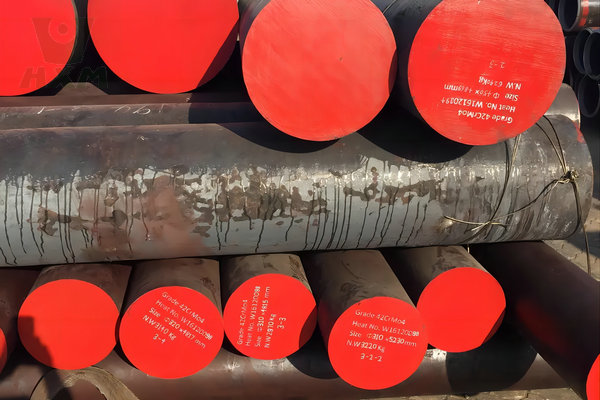
Introduction to 45# Steel / What is 45# Steel?
45# steel is a high-quality carbon structural steel with a carbon content of approximately 0.45%. In the Chinese GB standard, it is simply called “45#”. Its international counterparts include AISI 1045 (USA), C45 (Europe/DIN), and S45C (Japan).
Key Characteristics:
Medium Carbon Content: Provides higher strength than mild steel (like 1018) but better toughness than high-carbon steels.
Heat Treatability: Excellent response to normalizing, annealing, and induction hardening.
Machinability: Ranked at 70% of AISI 1212, making it very “friendly” for CNC turning and milling.
Whether you are manufacturing durable mechanical parts or looking for reliable structural component materials, 45 steel provides unmatched performance and value.
Huaxiao Metal is one of your trusted partners for quality 45 material steel products. We offer a comprehensive inventory of 45 steel in various shapes and sizes to meet your specific requirements.
Contact us today for a free quote and learn why 45# steel has the right properties for your application!
Chemical Composition of 45 Steel:
С | Si | Mn | P | Ni | Cr | S | Cu | As | Fe |
0.42-0.5 | 0.17-0.37 | 0.5-0.8 | <0.035 | <0.25 | <0.25 | <0.04 | <0.25 | <0.08 | Bal |
Mechanical Properties of 45# Steel:
| Normalizing | 850℃ |
| Quenching | 840℃ |
| Tempering | 600℃ |
| Tensile Strength | ≥600Mpa |
| Yield Strength | ≥355Mpa |
| Elongation | 16% |
| Shrinkage | 40% |
| Impact Energy | 39J |
| Hardness of the delivery condition | |
| Hot rolled steel | ≤229HB |
| Annealed steel | ≤197HB |
Physical Properties of 45# Steel:
| Physical Properties | Value |
|---|---|
| Density | 7.85 g/cm³ |
| Melting Point | ≈1420-1460℃ |
| Thermal Conductivity | 50.2 W/(m·K) |
| Linear Expansion Coefficient | 11.9 × 10⁻⁶ /K (20-100℃) |
| Elastic Modulus | 210 GPa |
45# Equivalent Steel Grade:
Understanding international grade equivalents is vital for procurement and engineering specifications.
Japan JIS Standard Grade is S45C/S48C;
Germany DIN Standard Material No. is 1.0503;
UK BS Standard Grade is IC45/080A47;
Italy UNI Standard Grade is C45;
Spain Standard Grade is F.114;
American AISI/SAE Standard Grade is 1045;
International Standard Organization ISO Standard Grade is C45E4.
Manufacturing Process of 45 Steel:
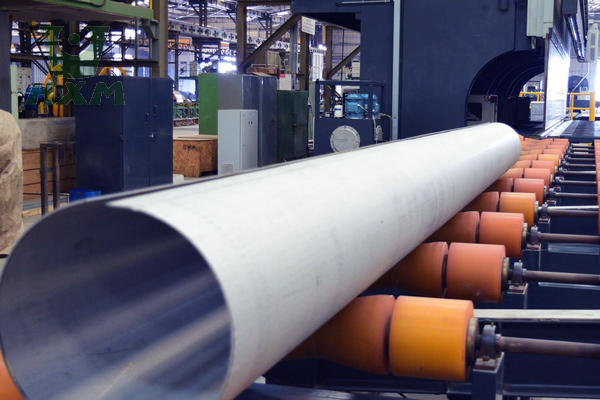
45# steel is usually manufactured using smelting methods, including electric arc furnace smelting and converter smelting. After casting, the steel needs to undergo processes such as continuous casting, rolling and annealing to obtain the required shape and properties.
Performance Characteristics:
No. 45 steel has high strength, hardness and wear resistance but also low toughness. After heat treatment, it can obtain higher hardness and better wear resistance. This kind of steel has good cutting performance and relatively low price, so it is an economical engineering material.
Application Fields of 45# Steel:
Thanks to its versatility and robust performance, No. 45 steel is used across numerous industries:
Mechanical Engineering: The primary application field. It is used for manufacturing high-strength moving parts such as gears, shafts, axles, connecting rods, spindles, and crankshafts.
Automotive Industry: Used for manufacturing various shafts and gear components that operate under moderate stress.
Tool and Die Making: Suitable for manufacturing plastic molds, die bases, and some tools that require good durability.
Structural Components: Used for bolts, studs, and other structural parts that require higher strength than mild steel.
Heat Treatment of 45# Steel:
Heat treatment of No. 45 steel can include normalizing, annealing, quenching and tempering. Heat treatment can change the internal structure of steel, thereby improving its performance and quality. For example, 45 steel can achieve higher hardness and better toughness after quenching and tempering.
Annealing: heating to about 820-840℃, slow cooling, reduced hardness, easy processing.
Normalizing: heating to about 850-870℃, air cooling, grain refinement, improved strength and toughness.
Quenching: heating to about 820-860℃, water cooling or oil cooling, significantly improved hardness.
Tempering: heating to 150-600℃ after quenching, reducing brittleness, adjusting hardness and toughness.
Welding:of 45# Steel:
Welding 45 steel requires careful procedure due to its carbon content, which makes it prone to cracking.
Preheating: Preheating the workpiece to 200-300°C before welding is highly recommended.
Post-Weld Treatment: A post-weld stress relief or annealing process is essential to eliminate welding stresses and prevent cracking.
Welding Method: TIG and MIG welding are suitable. Gas welding is generally not recommended.
Processing Performance:
Cutting performance: medium, good cutting performance without heat treatment, increased hardness after heat treatment, and increased cutting difficulty.
Welding performance: poor, preheating and post-weld heat treatment are required to avoid cracks.
Forging performance: good, suitable for hot forging.
Looking for a Reliable 45# / 1045 Steel Partner? Huaxiao Metal provides premium 1045 steel bars, plates, and customized forged parts with full MTC documentation.
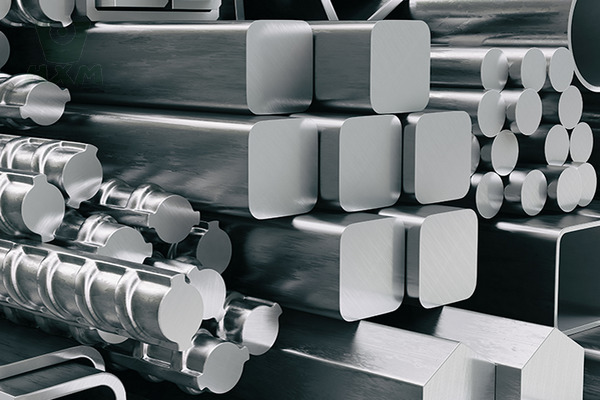
No. 45 steel is a medium carbon steel with high hardness and strength, but also low toughness. It has good cutting performance and relatively low price, so it is an economical engineering material. After heat treatment, it can obtain higher hardness and better wear resistance. For example, it can be used to make mechanical parts such as shafts, gears, pins, connecting rods, nuts and bolts. In addition, it can be used to make tools such as molds. In the construction field, No. 45 steel can be used to manufacture building structural parts and brackets.
Why Choose 45 Material Steel?
Superior Strength and Hardness: #45 material steel has excellent tensile strength and hardness, making it an ideal choice for parts subject to high stress and wear.
Excellent Machinability: #45 steel has good machinability and is easier to form and manufacture than high-carbon steel.
Cost-Effective Solution: 45 steel offers the best balance between performance and price, making it a cost-effective choice for various applications.
Wide Range of Applications: From gears and shafts to bolts and connecting rods, 45 steel is used in a wide range of industries, including automotive, machinery, and construction.
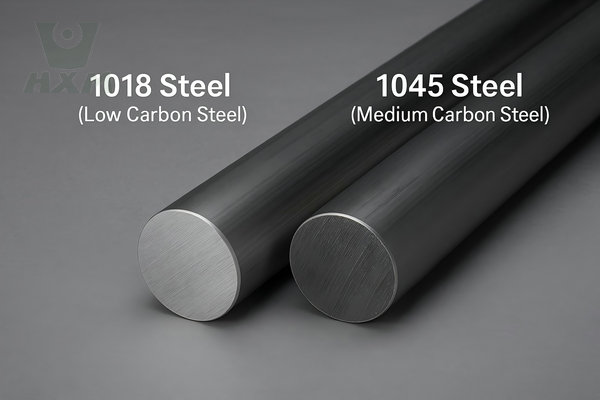
To help you decide, we’ve compared 45# steel with its two most common competitors in the workshop.
| Feature | 45# (Medium Carbon) | 4140 (Chromoly Steel) | 1018 (Low Carbon) |
| Hardness Potential | Medium-High | Very High | Low |
| Machinability | Excellent | Moderate | Superior |
| Weldability | Preheat Required | Difficult | Excellent |
| Typical Cost | Economical ($) | Expensive ($$$) | Cheapest ($) |
| Best For | General shafts/gears | High-stress engine parts | Simple brackets/fixtures |
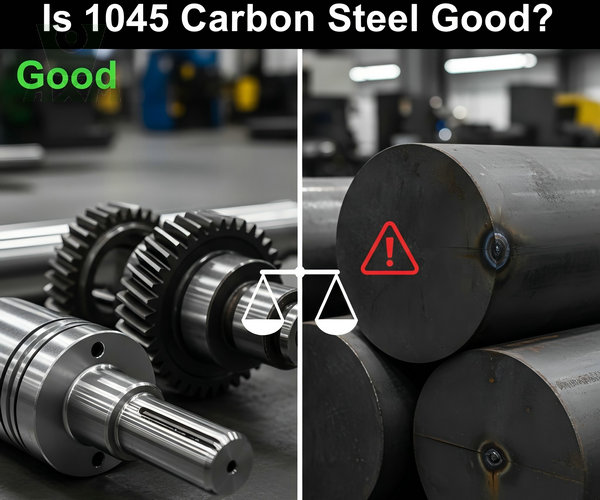
Is 1045 Carbon Steel "Good"? (Pros & Cons)
The Verdict: Yes, it is the best “all-rounder” for mechanical engineering, but it has limits.
Pros: Highly predictable response to heat treatment, very easy to machine, and significantly stronger than mild steel.
Cons: Poor atmospheric corrosion resistance (it will rust without oil/paint), and it is prone to cracking if quenched too aggressively in water.
How to Avoid Low-Quality 45# Steel
As a global supplier with 15+ years of experience at Huaxiao Metal, we suggest checking these three “hidden” factors:
Decarburization Layer: For cold-drawn bars, ensure the “decarb” layer is minimal, or you won’t reach the desired hardness after surface hardening.
Straightness: For long shafts, specify a straightness tolerance (e.g., 1mm/m). Many budget suppliers skip the final straightening process.
MTC Verification: Ensure the Manganese (Mn) is at least 0.50%. Anything lower is technically not a high-quality 45# grade.
If you are ready to purchase, please click below to view our “Ultimate 1045 Steel Sourcing Guide” to learn about inventory dimensions, tolerances, and factory sourcing tips.

Why Choose Us as Your 45 Steel Supplier?
As a professional steel supplier (Huaxiao Metal), we recommend checking these 6 points before placing an order:
Comprehensive Inventory: We stock a full range of 45 steel products, including round bars, plates, and custom forgings, to meet your exact requirements.
Quality Assurance: All our materials are sourced from reputable mills and come with Mill Test Certificates (MTC) to guarantee compliance with international standards.
Competitive Pricing & Fast Quotes: We leverage our supply chain to offer competitive prices and provide rapid responses to your inquiries.
Expert Technical Support: Our experienced team is ready to provide professional advice on material selection, heat treatment, and processing.
- Tolerance Standards: Are you buying Hot Rolled (lower precision) or Cold Drawn (tighter tolerance)? Cold drawn is preferred for high-speed machining.
Surface Condition: For plate products, check for “Black Surface” vs “Machined/Peeled”. Machined surfaces save you time in the workshop.
Request Your Quote for 45 Steel Today
Whether you need a few bars for prototyping or several tons for mass production, we can accommodate your order. Please click the button below and one of our sales engineers will promptly provide a detailed quote and delivery schedule.
FAQ: Common Questions from Buyers
Can 45# steel be welded?
Yes, but you must preheat it to 200°C–300°C to prevent cold cracking in the Heat Affected Zone (HAZ).
What is the difference between 45# and C45?
They are equivalents. 45# is the Chinese standard, while C45 is the European (EN10083) standard. C45 often has slightly lower impurity limits.
Does it rust easily?
Like most carbon steels, it will rust if exposed to moisture. We recommend a light oil coating or black oxide finish for stored parts.
In Conclusion:
In short, No. 45 steel is a commonly used carbon steel with good hardness and wear resistance and a relatively low price, so it is widely used in machinery manufacturing, construction, tools and other fields. Knowledge of its composition, manufacturing process, performance characteristics, application fields, and heat treatment will help to make better use of this material.
I hope you can consider us if you are looking for a 45 steel supplier. Our company has been engaged in this metal industry for more than ten years.