A complete comparison guide for engineers and procurement — manufacturing process, strength, cost (save 20-30% with welded), ASTM standards, and a decision matrix to pick the right tube.

Quick Answer: Seamless or Welded — Which Should You Choose?
If you need a one-sentence rule: choose seamless tube for high-pressure (>300 bar), high-temperature (>400°C), and safety-critical applications. Choose welded tube for everything else — you’ll save 20-30% on cost with performance that’s nearly indistinguishable in standard mechanical and structural applications.
But the real answer depends on four factors your supplier should help you evaluate:
Operating pressure and temperature — is it extreme?
Fatigue requirements — millions of cycles or static load?
Industry standards — does the code mandate seamless?
Budget and lead time — what’s your project timeline?
Key takeaway: Modern cold-drawn welded (DOM) tube made to EN 10305-3 achieves yield strength within 5 MPa of seamless equivalents.
For most mechanical parts — bushings, spacers, sleeves, hydraulic cylinders under 250 bar — the difference is “imperceptible” in real-world use. Don’t pay the seamless premium unless your application demands it.
How They're Made: Manufacturing Processes Compared
Understanding how each tube is made explains why they perform differently — and why seamless costs more. Here's the production process, step by step.
Seamless Tube: From Solid Billet to Hollow Tube
- Material yield: ~80-85% — the piercing process wastes ~15-20% of the billet
- Lead time: 4-8 weeks standard, 8-12 weeks for specialty alloys
- Best for: Small diameter × thick wall combinations, high-pressure applications
Welded Tube: From Coil to Finished Tube
- Material yield: ~95% — coil-to-tube efficiency is much higher
- Lead time: 2-4 weeks for standard sizes
- Best for: Large diameter × thin wall, long lengths, tight tolerance at lower cost
Welding Methods at a Glance
| Method | Full Name | Wall Thickness | Best For |
|---|---|---|---|
| ERW | Electric Resistance Welding | Thin to medium | General purpose, structural, mechanical — most cost-effective |
| TIG | Tungsten Inert Gas | Thin | Sanitary, food-grade, pharmaceutical — cleanest weld |
| Laser | Laser Beam Welding | Very thin | Precision instrument, medical — smallest HAZ |
| SAW | Submerged Arc Welding | Thick (6mm+) | Large diameter, heavy wall — structural & pressure vessels |
Stainless Steel Seamless vs Welded Tube Comparison: 12 Key Dimensions
| Dimension | Seamless Tube | Welded Tube (DOM/Cold-Drawn) |
|---|---|---|
| 1. Pressure Rating | ✅ High — uniform cross-section, no weak point | 🟡 Medium-High — DOM rated to 300 bar; above 400 bar use seamless |
| 2. Temperature Range | ✅ –200°C to 800°C+ | 🟡 –200°C to ~500°C; weld area sensitivity at extremes |
| 3. Yield Strength | As specified (e.g. 205 MPa for 304) | Within 5 MPa of seamless when cold-drawn |
| 4. Fatigue Life | ✅ Consistent — no weld to initiate cracks | 🟡 Weld zone may initiate cracks in high-cycle fatigue |
| 5. Corrosion Resistance | ✅ Uniform — homogeneous microstructure | 🟡 Slightly lower at weld if not properly treated |
| 6. Size Range | Small to medium OD, thick walls possible | ✅ Wide range: large OD, thin walls, long lengths |
| 7. Wall Thickness | ✅ Thick walls (schedules 40 to XXH) | Best for thin to medium walls |
| 8. Dimensional Tolerance | Good | ✅ Excellent when DOM — ±0.05 mm OD achievable |
| 9. Surface Finish | Good (better after cold-drawing) | ✅ DOM: excellent ID finish; bright annealed available |
| 10. Cost | Higher (baseline) | ✅ 20-30% cheaper than seamless |
| 11. Lead Time | 4-12 weeks | ✅ 2-4 weeks |
| 12. Material Yield | 80-85% | ✅ ~95% — less waste |
Need Help Deciding?
Strength & Pressure: Where Welded Tube Surprises
The biggest myth in the industry: “Welded tube is always weaker.” Let’s look at the data.
Static Strength: Nearly Identical
For static loads (constant pressure, no cycling), a DOM welded tube’s yield and tensile strength are within 5 MPa of a seamless tube of the same grade. Tests on EN 10305-3 E355 DOM tube show:
- Yield strength: within 0-5 MPa of seamless equivalents
- Tensile strength: essentially identical
- Elongation: comparable (typically 20-25% for 304 grade)
Real-world implication: If you’re making bushings, spacers, sleeves, or hydraulic cylinders operating under 250 bar, a DOM welded tube will perform exactly like a seamless tube — but cost you 20-30% less.
Where Seamless Wins: High-Cycle Fatigue & Extreme Conditions
The difference shows in three specific scenarios:
High-cycle fatigue (>1 million cycles): The weld zone can act as a stress concentration point, initiating fatigue cracks earlier than a seamless tube would. This matters in reciprocating hydraulic cylinders, rotating shafts, and dynamic structural members.
Above 400 bar with temperature cycling: Combined pressure + temperature cycles amplify the stress at the weld interface. Seamless tube’s uniform microstructure handles this better.
Code-mandated applications: ASME B31.3 and certain pressure vessel codes explicitly require seamless tube — no room for discussion.
| Application | Pressure | Fatigue | Recommendation |
|---|---|---|---|
| Hydraulic cylinder (agricultural) | 150-250 bar | Low-Medium | ✅ DOM welded (EN 10305-3) |
| Hydraulic cylinder (industrial presses) | 250-400 bar | Medium-High | 🟡 DOM or seamless — evaluate cycles |
| High-pressure boiler tube | >400 bar | High + thermal | ✅ Seamless (ASTM A213) |
| Instrumentation tubing | Low (<100 bar) | Low | ✅ Welded (ASTM A269) — saves cost |
| Food-grade process piping | <50 bar | Low | ✅ Welded (ASTM A269, bright annealed) |
| Oil & gas transmission | Varies | Low-Medium | ✅ Seamless for main lines; welded for laterals |
Cost Analysis: How Much You Actually Save with Welded Tube
Let’s put real numbers behind “welded is cheaper.” Here’s what drives the cost gap — and exactly how much you can save.
Why Welded Costs Less: 3 Drivers
Raw material: Steel coil (used for welded tube) is typically 10-15% cheaper per kg than solid billet (used for seamless). The coil market is more competitive with higher supply.
Material yield: Welded tube converts ~95% of raw material to finished product. Seamless loses 15-20% during the piercing process.
Production speed: A welded tube mill runs at 10-60 m/min. Seamless production is an order of magnitude slower — piercing and pilgering are inherently batch processes.
The Savings Breakdown
| Tube Type | Relative Cost | Savings vs Seamless | Best Use Case |
|---|---|---|---|
| Seamless (hot-finished) | $$$ — Baseline (100%) | — | High pressure, code-mandated |
| Seamless (cold-drawn) | $$$$ — ~115-125% | — | Precision + high pressure |
| Welded (as-welded, ERW) | $$ — ~70-80% | 20-30% | Structural, general mechanical |
| Welded (DOM / cold-drawn) | $$ — ~75-85% | 15-25% | Hydraulic cylinders, precision parts |
| Welded (bright annealed) | $$$ — ~85-95% | 5-15% | Sanitary, food, pharmaceutical |
Real example: A 50 mm OD × 5 mm wall × 6 meter 304 stainless tube. Seamless ≈ $XX/meter. DOM welded ≈ $XX/meter — saving 20-25%. On a 1,000-meter order, that’s thousands of dollars back in your project budget.
Lead Time: The Hidden Cost
For project-driven buyers, the 4-12 week lead time on seamless tube isn’t just an inconvenience — it’s a schedule risk. Welded tube’s 2-4 week turnaround can be the difference between hitting a milestone and delaying the entire project.
ASTM Standards: A312 vs A269 vs A213 Explained
ASTM standards tell you not just what tube to buy, but what the tube is allowed to do. Getting the standard wrong means your tube won’t pass inspection — even if the physical tube is identical.
| ASTM A312 | ASTM A269 | ASTM A213 | |
|---|---|---|---|
| Full Name | Seamless, Welded & Heavily Cold Worked Austenitic SS Pipes | Seamless & Welded Austenitic SS Tubing for General Service | Seamless Ferritic & Austenitic Alloy-Steel Boiler, Superheater & Heat-Exchanger Tubes |
| Tube Type | Seamless + Welded + HCW | Seamless + Welded | Seamless ONLY |
| Wall Range | Schedule 5S to XXH | Thin to medium wall (typically OD ≤ 0.5 in) | Thin wall (typically OD ≤ 0.5 in) |
| Key Tests | Hydrostatic, flattening, eddy current, hardness | Flaring, reverse flattening, flange, hardness | Flattening, flaring, tensile, hardness |
| Primary Use | High-pressure process pipe, steam lines, chemical plant | Instrument tube, sanitary lines, low-pressure chemical | Boiler tubes, superheater, heat exchanger |
| When Required | Pressure >150 psi or temp >200°C | Surface finish & dimensional precision matter more than pressure | High-temp heat exchange — thermal cycling expected |
Selection rule:
Start with your service conditions, not your preferred tube type.
For a chemical plant steam line at 400°C / 5 MPa → A312.
For dairy product tubing at 2 bar → A269.
For a boiler tube at 600°C → A213.
304 vs 316: Material Choice Matters Too
Choosing seamless vs welded is only half the decision. The material grade — 304, 304L, 316, 316L — must match your environment.
| Grade | Key Alloy | Corrosion Resistance | Max Temp | Typical Applications |
|---|---|---|---|---|
| 304 | 18% Cr, 8% Ni | Good — general purpose | ~870°C | Food equipment, architecture, chemical containers, general pipework |
| 304L | Low carbon (≤0.03%) | Good — better weldability | ~870°C | Welded fabrications, post-weld without annealing |
| 316 | 16% Cr, 10% Ni, 2-3% Mo | ✅ Excellent — resists chlorides | ~870°C | Marine, chemical processing, pharmaceutical, coastal structures |
| 316L | Low carbon + Mo | ✅ Excellent + weldable | ~870°C | Welded marine equipment, surgical implants, high-purity process |
Critical warning for 316 in chloride environments:
Even TP316 with 2-3% molybdenum can suffer chloride stress corrosion cracking (SCC) above 60°C in stagnant or evaporating conditions.
For hot seawater piping, evaluate duplex grades like 2205.
Decision Matrix: What to Pick for Your Application
Four-Question Decision Flow
Pressure >300 bar or temperature >400°C? → Seamless
Code mandates seamless (ASME B31.3, etc.)? → Seamless
High-cycle fatigue (>1M cycles) involved? → Seamless
None of the above? → Welded (save 20-30%)
Quick-Decision Application Matrix
Not Sure Which One to Pick?
5 Mistakes Buyers Make (And How to Avoid Them)
❌ Mistake #1: Always Defaulting to Seamless
"Better safe than sorry" thinking leads to overpaying 20-30% on tube that could have been welded. Evaluate the actual service conditions — not worst-case assumptions.
❌ Mistake #2: Ignoring the ASTM Standard
Buying "304 stainless tube" without specifying ASTM A312, A269, or A213. The standard determines testing, certification, and whether the tube passes inspection.
❌ Mistake #3: Choosing by Price Alone
The cheapest welded tube might lack proper post-weld treatment, leading to corrosion at the seam. Always ask: "Is the weld bead treated? Is it annealed after welding?"
❌ Mistake #4: Assuming All Welded Tube Is the Same
ERW as-welded is not the same as DOM cold-drawn. The former is structural-grade; the latter competes with seamless on precision. Know which one you're getting.
❌ Mistake #5: Overlooking MTC / Certification
Without a proper Mill Test Certificate (EN 10204 3.1), you can't verify the tube's chemistry, mechanical properties, or compliance. Always request the MTC before shipment.
Why Huaxiao Metal for Stainless Steel Tubes?
🔵 Seamless Tube Supply
- Grades: 304, 304L, 316, 316L, 321, 310S
- Standards: ASTM A312, A213, A269
- OD 6 mm – 630 mm, wall up to Schedule XXH
- ISO certified, full MTC (EN 10204 3.1) provided
- Third-party inspection: SGS, BV, TÜV available
🟠 Welded Tube Supply
- Grades: 304, 304L, 316, 316L, 201, 430
- Types: ERW, TIG-welded, DOM, bright annealed
- Standards: ASTM A312, A269, A554, EN 10305-3
- OD 10 mm – 2500 mm, thin-to-medium wall
- Custom cut-to-length, end finishing, polishing
FAQ: 8 Questions Buyers Ask Before Ordering
Which is stronger — seamless or welded stainless steel tube?
Seamless tube has uniform strength across its entire cross-section with no weld weak point, giving it a higher pressure rating. However, for most mechanical applications under 250 bar, a properly cold-drawn DOM welded tube performs almost identically — yield strength differs by less than 5 MPa. The real advantage of seamless shows in high-cycle fatigue and extreme temperature/pressure conditions above 400 bar.
How much cheaper is welded stainless steel tube compared to seamless?
Welded stainless steel tube is typically 20-30% cheaper than seamless tube of the same grade and size. The savings come from lower raw material costs (coil vs. billet), higher material yield (~95% vs. 80-85%), and faster production speeds. Even DOM cold-drawn welded tube saves 15-25% over seamless equivalents.
Can welded tube be used for high-pressure applications?
Yes — but within limits. DOM welded tube performs reliably at pressures up to 250-300 bar in hydraulic systems (covered by EN 10305-3). For pressures above 400 bar, high-temperature cycling, or applications under ASME B31.3, seamless tube is the safer choice. The weld zone can act as a stress concentration point under combined pressure + thermal cycling.
What ASTM standard should I specify for my stainless steel tube?
It depends on your service conditions:
ASTM A312 — high-pressure, high-temperature process pipe (pressure >150 psi, temperature >200°C)
ASTM A269 — general service, instrumentation, sanitary (low-pressure, precision-focused)
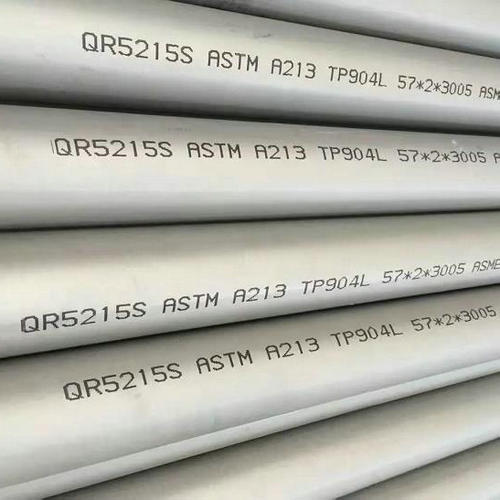
ASTM A213 — boiler, superheater, and heat exchanger tubes (seamless only, high-temperature heat exchange)
What is the minimum order quantity (MOQ) for stainless steel tubes?
At Huaxiao Metal, our MOQ starts from 500 kg for trial orders. For standard production orders, MOQ typically ranges from 500-1000 kg, depending on the grade, size, and any customization. We welcome small trial orders before bulk purchasing.
What is the typical lead time for seamless vs welded tube?
Welded tube: 2-4 weeks (standard sizes and grades)
Seamless tube: 4-8 weeks (standard), up to 12 weeks (specialty alloys like 316L or duplex)
Huaxiao Metal: 7-25 days for most specifications (300K-ton inventory enables fast shipment)
Is welded tube suitable for food-grade or pharmaceutical use?
Yes — ASTM A269 welded tube with bright annealed finish is widely used in food, dairy, and pharmaceutical industries. After TIG or laser welding, the internal bead is smoothed, and the tube is polished to achieve surface finishes comparable to seamless (typically Ra ≤ 0.8 μm for sanitary use).
Do you provide Mill Test Certificates (MTC) for all tubes?
Yes. Every shipment from Huaxiao Metal includes an EN 10204 3.1 Mill Test Certificate documenting the chemical composition, mechanical properties (yield strength, tensile strength, elongation), and hydrostatic/flattening test results. Third-party inspection by SGS, Bureau Veritas, or TÜV is also available at your request.