Choosing the right shipbuilding steel plate is critical for vessel safety, offshore structural reliability, and long-term operating performance in marine environments.
Among ASTM A131 structural marine steels, AH36, DH36, and EH36 are the most widely used high-strength shipbuilding steel grades for commercial ships, offshore platforms, LNG carriers, and marine engineering structures.
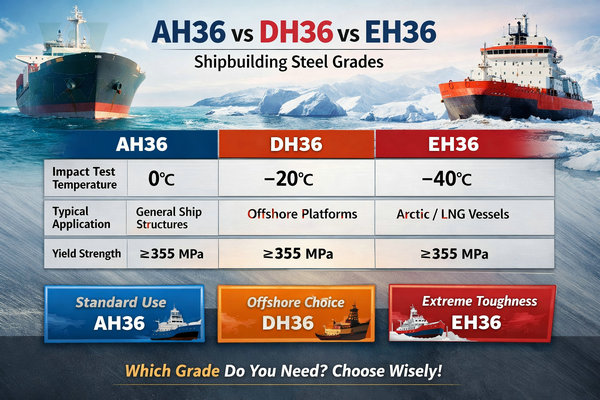
The main difference between AH36, DH36, and EH36 lies in their low-temperature impact toughness performance:
- AH36: Impact tested at 0°C
- DH36: Impact tested at -20°C
- EH36: Impact tested at -40°C
Because of these differences, each grade is suitable for different marine operating environments and project requirements.
In this guide, we compare AH36 vs DH36 vs EH36 steel plates in terms of:
- Mechanical properties
- Chemical composition
- Classification society requirements
- Welding performance
- Offshore and shipbuilding applications
- Procurement recommendations
- TMCP vs normalized processing
- Marine engineering selection tips
Quick Comparison: AH36 vs DH36 vs EH36
| Property | AH36 | DH36 | EH36 |
|---|---|---|---|
| Standard | ASTM A131 | ASTM A131 | ASTM A131 |
| Yield Strength | ≥355 MPa | ≥355 MPa | ≥355 MPa |
| Tensile Strength | 490–620 MPa | 490–620 MPa | 490–620 MPa |
| Impact Test Temperature | 0°C | -20°C | -40°C |
| Weldability | Excellent | Excellent | Excellent |
| Common Process | Normalized / TMCP | Normalized / TMCP | TMCP |
| Main Applications | Bulk carriers | Offshore vessels | LNG & Arctic ships |
| Relative Cost | Lower | Medium | Higher |
The lower the temperature, the higher the toughness requirement → the higher the grade.
What Is Shipbuilding Steel?
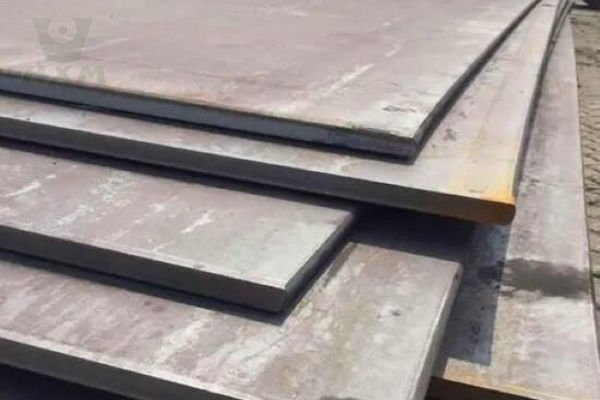
Shipbuilding steel is a type of high-strength structural steel specifically designed for marine and offshore applications requiring excellent strength, weldability, corrosion resistance, and low-temperature toughness.
Shipbuilding steel plates are widely used in:
- Ship hull structures
- Offshore platforms
- LNG carriers
- Marine engineering equipment
- Oil & gas vessels
- Ice-class ships
According to ASTM A131 and international marine standards, common shipbuilding steel grades include:
- AH36
- DH36
- EH36
What Is AH36 Shipbuilding Steel?
AH36 steel plate is a high-strength structural marine steel commonly used in general shipbuilding applications where moderate impact toughness is required.
AH36 plates are widely used for:
- Cargo ships
- Bulk carriers
- Ship decks
- Hull structures
- Marine platforms
AH36 offers excellent weldability, stable mechanical performance, and cost efficiency for standard marine environments.
Because AH36 is impact tested at 0°C, it is suitable for conventional ocean operating conditions but not ideal for extremely cold environments.
What Is DH36 Shipbuilding Steel?
DH36 steel plate provides better low-temperature toughness than AH36 steel.
DH36 is impact tested at -20°C, making it suitable for:
- Offshore support vessels
- Marine engineering structures
- Cold-region shipbuilding
- Oil & gas marine structures
Compared with AH36, DH36 offers improved crack resistance and structural safety under colder operating conditions.
Many offshore projects specify DH36 steel plates because of their enhanced reliability in dynamic marine environments.
What Is EH36 Shipbuilding Steel?
EH36 steel plate is designed for extreme marine environments requiring excellent low-temperature impact toughness.
EH36 is impact tested at -40°C and is commonly used for:
- LNG carriers
- Arctic ships
- Offshore platforms
- Ice-class vessels
- Deep-sea marine engineering
EH36 shipbuilding steel is often produced using TMCP (Thermo-Mechanical Controlled Processing) technology to achieve:
- Higher toughness
- Better weldability
- Reduced carbon equivalent
- Improved crack resistance
Because of its superior low-temperature performance, EH36 is one of the most important steel grades for high-end marine engineering projects.
AH36 vs DH36 vs EH36: Main Difference Explained
The primary difference between AH36, DH36, and EH36 is their Charpy V-notch impact toughness testing temperature.
| Grade | Impact Test Temperature |
|---|---|
| AH36 | 0°C |
| DH36 | -20°C |
| EH36 | -40°C |
Lower impact test temperatures indicate better toughness performance under cold operating environments.
For example:
- AH36 is suitable for standard shipbuilding projects
- DH36 is preferred for offshore engineering
- EH36 is required for LNG vessels and Arctic marine structures
As marine environments become colder and more demanding, higher-grade steel plates are necessary to maintain structural integrity and operational safety.
AH36 vs DH36 vs EH36 Shipbuilding Steel Mechanical Properties
| Property | AH36 | DH36 | EH36 |
|---|---|---|---|
| Yield Strength | ≥355 MPa | ≥355 MPa | ≥355 MPa |
| Tensile Strength | 490–620 MPa | 490–620 MPa | 490–620 MPa |
| Elongation | ≥21% | ≥21% | ≥21% |
| Impact Energy | ≥34J | ≥34J | ≥34J |
As the data above shows, the mechanical strength of the three ship steel materials is very similar. Therefore, in terms of strength, the key factor in choosing them is not strength, but their low-temperature toughness.
Chemical Composition (Why EH36 Performs Better)
Compared with AH36, EH36 typically contains:
- Higher Mn (Manganese) → improves toughness
- Possible addition of Ni (Nickel) → enhances low-temperature performance
- Lower P & S → reduces brittleness
👉 This is why EH36 performs reliably under extreme cold and high stress conditions.
Manufacturing Process (Critical for Quality)
Hot Rolling
- Basic forming process
- Suitable for standard AH36 applications
Normalizing
- Refines grain structure
- Improves consistency and ductility
TMCP (Thermo-Mechanical Controlled Process)
- Advanced rolling + controlled cooling
- Produces:
- Higher toughness
- Better weldability
- Lower carbon equivalent
👉 Industry Insight: Most high-end EH36 projects require TMCP, especially in offshore and LNG applications.
Z-Direction Performance (Critical for Thick Plates)
For heavy ship structures, through-thickness properties are crucial:
- Z15 / Z25 / Z35 testing
- Prevents lamellar tearing during welding
👉 Especially important for:
- Offshore platforms
- Thick EH36 plates
- High-stress welded joints
Applications
AH36 Applications
AH36 steel plates are commonly used for:
- Bulk carriers
- General cargo vessels
- Ship hulls
- Deck structures
- Marine fabrication
DH36 Applications
DH36 is widely used for:
- Offshore support vessels
- Oil & gas structures
- Marine bridges
- Cold-region marine projects
EH36 Applications
EH36 steel plates are ideal for:
- LNG carriers
- FPSO structures
- Arctic vessels
- Offshore drilling platforms
- Ice-class shipbuilding
Real Procurement Strategy: Which Grade Should You Choose?
Choosing the correct shipbuilding steel grade depends on:
- Operating temperature
- Marine environment
- Classification society requirements
- Welding conditions
- Structural safety requirements
- Project budget
Scenario 1: New Shipbuilding Projects
Recommended mix:
- AH36 → 60–80%
- DH36 → Critical zones
👉 Optimizes overall cost
Scenario 2: Ship Repair & Emergency Orders
Recommended:
- Use DH36 as replacement
- EH36 for urgent high-risk areas
👉 Ensures project timeline is not delayed
Scenario 3: Offshore / Arctic Projects
Mandatory:
- EH36 + TMCP
- Z25 / Z35 requirement
👉 Safety cannot be compromised
| Project Type | Recommended Grade | Reason |
|---|---|---|
| Bulk Carrier | AH36 | Cost-effective solution |
| Container Ship | AH36/DH36 | Standard marine environment |
| Offshore Platform | DH36 | Better low-temp toughness |
| LNG Carrier | EH36 | Excellent cryogenic toughness |
| Arctic Vessel | EH36 TMCP | Extreme cold resistance |
| Ice-Class Ship | EH36 | Superior crack resistance |
Classification Society Certifications (Global Compliance)
For international shipbuilding projects, certification is mandatory.
Major Standards Include:
- ABS (USA)
- DNV (Norway)
- BV (France)
- CCS (China)
- LR (UK)
- NK (Japan)
- KR (Korea)
- RINA (Italy)
- RMRS (Russia)
Without these certifications, materials are not accepted in global marine projects.
Certified AH36, DH36, and EH36 steel plates usually require:
- Mill Test Certificates (MTC)
- Charpy impact testing
- Ultrasonic testing
- Weldability verification
- Thickness tolerance inspection
For offshore and LNG projects, TMCP EH36 steel is often preferred because of its superior toughness and fabrication performance.
TMCP vs Normalized Shipbuilding Steel
TMCP Shipbuilding Steel
TMCP (Thermo-Mechanical Controlled Processing) improves:
- Toughness
- Weldability
- Strength consistency
- Crack resistance
TMCP EH36 plates are widely used in offshore engineering and LNG vessel construction.
Normalized Shipbuilding Steel
Normalized steel plates provide stable mechanical performance and are commonly used in standard marine projects.
However, normalized plates may have lower low-temperature toughness compared with TMCP steel.
Welding Recommendations for AH36 / DH36 / EH36
Proper welding procedures are critical for marine structural integrity.
Recommended Welding Practices
Use low-hydrogen electrodes
Control heat input carefully
Preheat thick plates when necessary
Reduce residual stress
Follow classification society welding procedures
EH36 TMCP steel plates generally provide better weldability due to lower carbon equivalent levels.
Common Risks When Purchasing Shipbuilding Steel Plates
Buyers should pay attention to the following procurement risks:
Fake Classification Certificates
Always verify ABS, DNV, LR, or BV certificates directly.
Poor Low-Temperature Toughness
Low-quality plates may fail impact testing requirements.
Inconsistent Thickness Tolerance
Thickness variation can affect structural performance.
Non-TMCP Materials
Some suppliers falsely market normalized plates as TMCP steel.
Poor Weldability
High carbon equivalent may increase cracking risk during fabrication.
Why Choose Huaxiao Metal for Shipbuilding Steel?
At Huaxiao Metal, we provide more than just steel — we deliver reliable project solutions.
✔ Full Product Range
- AH36 / DH36 / EH36
- Plates, coils, customized sizes
✔ Fast Delivery
- Stock availability for standard sizes
- Urgent order support
✔ Certified Quality
- Mill Test Certificates (MTC)
- Charpy impact test reports
- Z-direction testing
✔ Export Expertise
- Seaworthy packaging
- Global shipping experience
👉 We help reduce your procurement risk, cost, and lead time.
FAQ about AH36 vs DH36 vs EH36 Shipbuilding Steel
Can DH36 replace AH36?
Yes. DH36 has better low-temperature performance, so it can replace AH36 in most cases.
What is the difference between AH36 and EH36 steel?
The main difference is impact toughness temperature. AH36 is tested at 0°C, while EH36 is tested at -40°C for colder marine environments.
Can AH36 replace DH36 or EH36?
No. This may cause structural failure in low-temperature environments.
Is EH36 stronger than AH36?
Their yield strength is similar, but EH36 provides much better low-temperature toughness.
What steel is used for LNG carriers?
EH36 TMCP steel plates are commonly used for LNG carriers because of their excellent cryogenic toughness.
What does TMCP mean in shipbuilding steel?
TMCP stands for Thermo-Mechanical Controlled Processing, an advanced steel production method improving toughness and weldability.
Which classification societies certify shipbuilding steel?
Common classification societies include ABS, DNV, LR, BV, CCS, NK, KR, and RINA.
Can I substitute DH36 with EH36?
Yes, EH36 exceeds DH36 specifications and is a safe “upgrade,” but it will increase your material cost.
Why is EH36 more expensive?
Because of:
- Higher alloy content
- Advanced production process
- Strict testing requirements
Is EH36 suitable for Arctic vessels?
Yes. EH36 is specifically designed for low-temperature marine environments and Arctic shipbuilding applications.
What documents should suppliers provide?
- MTC (EN 10204 3.1 / 3.2)
- Classification certificates
- Impact test reports
In Conclusion
AH36, DH36, and EH36 are essential high-strength shipbuilding steel grades used in modern marine engineering and offshore structures.
- AH36 offers cost-effective performance for standard shipbuilding
- DH36 provides improved low-temperature toughness
- EH36 delivers superior performance for LNG carriers and Arctic applications
Selecting the correct marine steel plate depends on project environment, classification requirements, fabrication conditions, and operational safety demands.
For certified ASTM A131 shipbuilding steel plates, TMCP EH36 steel, and offshore marine steel solutions, contact Huaxiao Metal for technical support and global supply solutions.
Get a Quote for AH36 / DH36 / EH36 Steel Plate
Looking for a reliable Shipbuilding Steel Plate Supplier?
👉 Contact Huaxiao Metal today to get:
- Latest prices within 24 hours
- Stock availability
- Technical support
- Full certification documents
Send your inquiry now and get a competitive quote for your project.