[email protected]

24/7 Customer Support

+86-13761906384

24/7 Customer Support

1018 vs A36 Steel: What’s the Difference, Properties, Price & Best Choice (2026 Guide)

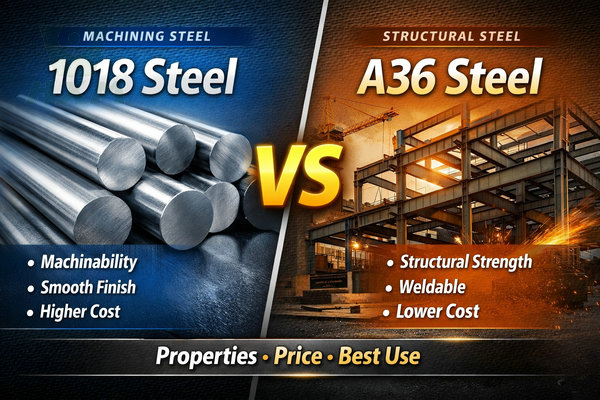
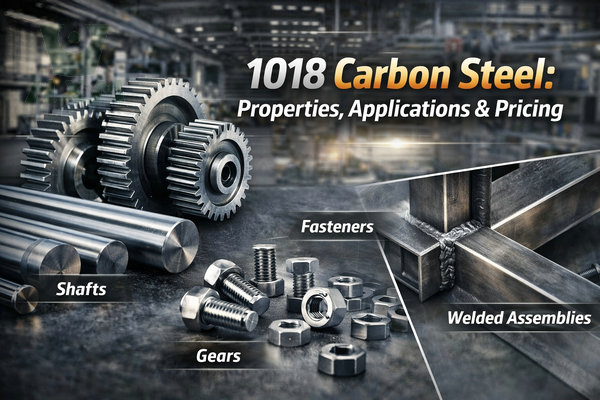
1018 vs A36 steel comparison illustration showing properties, strength, applications, and material differences for engineering and manufacturing use

When comparing 1018 vs A36 steel, both are widely used carbon steels, but they differ in strength, machinability, applications, and cost.

A36 steel is a structural steel ideal for construction and welding, while 1018 steel is a low carbon steel known for excellent machinability and surface finish.

In this guide, Huaxiao Metal breaks down the key differences, properties, and price comparison between 1018 and A36 steel, and how to choose the right material for your project.

What is 1018 Steel?

1018 steel is a low carbon steel (mild steel) with approximately 0.18% carbon content.

Key Features:

  • Excellent machinability
  • Good weldability
  • Smooth surface finish
  • Suitable for cold forming

Typical Applications:

  • Shafts and pins
  • Machinery parts
  • Automotive components
  • Precision parts

What is A36 Steel?

A36 steel is a structural carbon steel widely used in construction and engineering.

Key Features:

  • High strength
  • Excellent weldability
  • Good ductility
  • Cost-effective for large structures

Typical Applications:

  • Structural beams
  • Bridges
  • Buildings
  • Industrial platforms

1018 vs A36 Steel: Key Differences

Property1018 SteelA36 Steel
Carbon Content~0.18%~0.25–0.29%
StrengthLowerHigher
MachinabilityExcellentModerate
WeldabilityGoodExcellent
Surface FinishSmoothRougher
Main UsePrecision partsStructural applications
CostSlightly higherLower

Mechanical Properties Comparison

Property1018 SteelA36 Steel
Yield Strength~370 MPa~250 MPa
Tensile Strength~440 MPa~400–550 MPa
Elongation~15%~20%

👉 Conclusion:

  • A36 → better for load-bearing structures
  • 1018 → better for machining & precision parts

1018 vs A36 Steel Price Comparison (2026)

Prices vary depending on size, quantity, and market conditions:

  • A36 Steel Price: $500 – $800 / ton
  • 1018 Steel Price: $600 – $950 / ton

📌 Why 1018 is more expensive:

  • Better machinability
  • More controlled composition
  • Higher processing cost

👉 Need exact pricing? Contact Huaxiao Metal for a fast quote.

Processing and Finish

AISI 1018: The Cold Rolled Precision

1018 steel is typically cold rolled. This process involves rolling the steel at room temperature, which results in:

  • Tight Tolerances: Excellent dimensional accuracy.

  • Surface Finish: A smooth, oily, or “bright” finish that requires minimal machining.

  • Work Hardening: Increased strength and hardness compared to hot-rolled alternatives.

ASTM A36: The Hot Rolled Utility

A36 is the “workhorse” of the construction industry, usually produced through hot rolling.

  • Rougher Surface: Often has a blue-gray scale (mill scale) that may require pickling or grinding for aesthetic use.

  • Dimensional Variation: Looser tolerances due to cooling and contraction after hot rolling.

  • Cost-Effectiveness: Generally more affordable for large-scale structural projects.

Machinability and Weldability

  • Machinability: 1018 steel is superior. Its cold-drawn state makes it easier to cut, drill, and mill with a better surface finish. It is often the top choice for precision-machined parts like gears and pins.

  • Weldability: Both grades are highly weldable due to their low carbon content. However, A36 is the industry standard for welded structural frames, bridges, and brackets because its properties remain consistent across large sections.

Pros and Cons

1018 Steel

Pros:

  • Excellent machinability
  • Smooth finish
  • Good for precision

Cons:

  • Lower strength
  • Higher price

A36 Steel

Pros:

  • Strong and durable
  • Low cost
  • Excellent for welding

Cons:

  • Poor surface finish
  • Not ideal for precision machining

How to Choose?

When should you use 1018 Steel?

Choose AISI 1018 if your project requires high precision, a smooth surface finish, or extensive machining. It is ideal for:

  • Shafts, pins, and rods.

  • Components requiring carburizing (case hardening).

  • High-speed CNC machining applications.

When should you use A36 Steel?

Choose ASTM A36 for structural applications where cost and strength-to-weight ratio are more important than surface aesthetics. It is ideal for:

  • Structural beams (I-beams, channels).

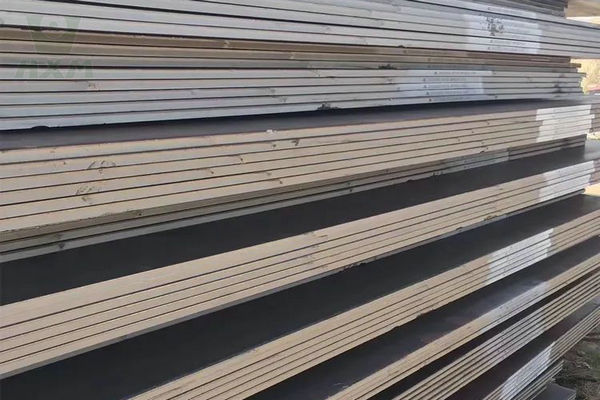
  • Steel plates for welding and construction.

  • General-purpose fabrication where precision tolerances aren’t critical.

FAQ about 1018 vs A36 Steel

Yes, in terms of yield strength. Due to the cold-rolling process, 1018 typically has a yield strength of around 370 MPa, while A36 is rated at a minimum of 250 MPa.

It depends on the application. If you are doing basic welding or structural work, A36 is a cost-saving substitute. However, if you need precision machining or a smooth finish, A36 will require significantly more labor to reach the same quality as 1018.

A36 is usually cheaper due to its simpler composition and large-scale production.

Yes, we specialize in exporting both AISI 1018 cold-finished bars and ASTM A36 hot-rolled plates globally, ensuring compliance with international standards like EN and JIS.

Conclusion

The battle of 1018 vs. A36 steel isn’t about which is “better,” but which is right for your specific manufacturing process. 1018 wins on precision and machinability, while A36 wins on versatility and structural value.

Need a Quote for 1018 or A36 Steel? As a professional metal manufacturer and exporter, Huaxiao Metal provides high-quality carbon steel solutions with full MTC (Mill Test Certificate) documentation.

Contact our engineering team today for a custom inquiry!

Share:

Facebook
Twitter
Pinterest
LinkedIn

Contact Us For Metal Prices

Table of Contents

On Key

Related Posts

Welcome