Quick Answer: Tinplate Temper Grades — How to Choose the Right One
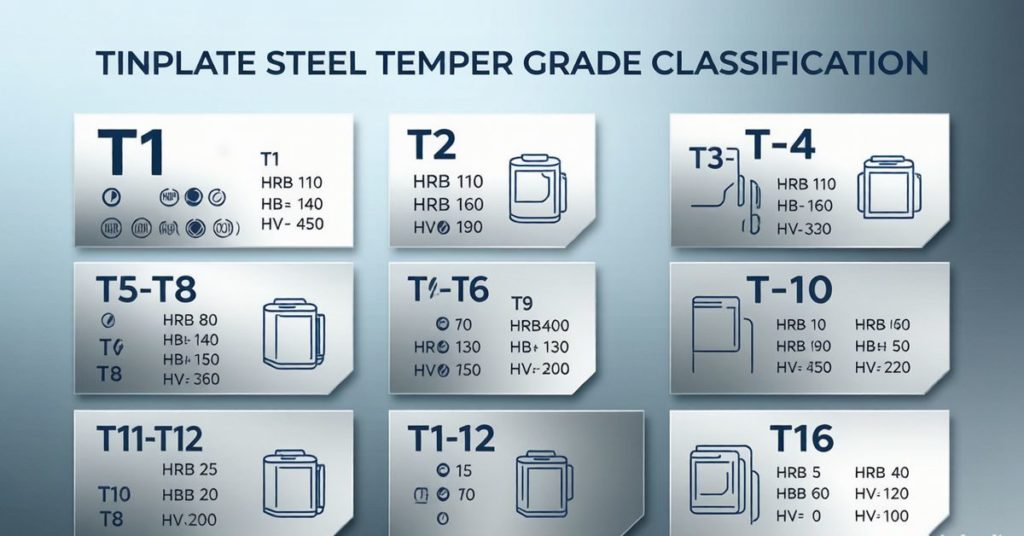
Tinplate temper grades define the mechanical hardness and formability of the steel base. BA (Batch Annealed) temper grades T1 through T5 offer increasing hardness from HR30T 49 to 65, optimized for deep drawing and decorative applications. CA (Continuously Annealed) temper grades DR8, DR9, TH550 through TH660 range from HR30T 55 to 73, engineered for high-speed welding lines and pressure containers.
The fundamental selection rule: soft tempers (T1–T3) for deep drawing, medium tempers (T3–T4/DR8/TH550) for general can bodies, and hard tempers (T5/DR9/TH660) for rigid/pressure containers. Selecting the wrong temper grade is the #1 cause of can body cracking during forming and weld failure during manufacturing — this guide provides the complete selection framework with data tables, a 6-step decision flow, and common mistake analysis.
What Is a Tinplate Temper Grade? — Definition
A tinplate temper grade is the standardized designation that quantifies the mechanical hardness, strength, and formability of the steel base after the annealing process. The temper grade determines whether the tinplate can withstand deep drawing into a 2-piece can, maintain dimensional stability for high-speed welding, or resist deformation under internal pressure in aerosol containers.
Temper grade is measured using the Rockwell HR30T hardness test (ASTM A623 / EN 10203 / JIS G3303), which applies a 30 kgf load with a 1/16-inch steel ball indenter on the tinplate surface. The resulting HR30T value directly correlates with the steel’s yield strength, tensile strength, and elongation:
- Lower HR30T (49–55) → Higher ductility, greater elongation (30–45%), suitable for deep drawing
- Medium HR30T (55–63) → Balanced strength and formability, general can-making workhorse
- Higher HR30T (63–73) → Higher strength, lower elongation (5–15%), suitable for rigid containers and high-speed welding
The temper grade is determined by the annealing process — BA produces softer, more ductile tempers (T1–T5), while CA produces harder, more uniform tempers (DR8/DR9/TH550–TH660). The critical parameter is not just the hardness value but hardness uniformity across the coil, which directly affects can-making line stability and rejection rates.
BA Tinplate Temper Grades: T1 Through T5 — Complete Specifications
Batch Annealed (BA) tinplate produces five standard temper grades — T1, T2, T3, T4, and T5 — with progressively increasing hardness and strength. Each grade is engineered for specific can-making and industrial forming operations:
| Temper Grade | HR30T Range | Yield Strength (MPa) | Elongation (%) | Formability Rating | Typical Applications |
|---|---|---|---|---|---|
| T1 | 49 ± 3 | 200–250 | 35–45 | Excellent — maximum draw depth | Very deep drawn containers, complex embossed decorative tins, highly ornamented gift boxes, battery cap cases, eyelet components |
| T2 | 53 ± 3 | 250–300 | 30–40 | Very Good — deep drawing capability | Deep-drawn 2-piece food cans, gift tin bodies, cookie tins, tea boxes, decorative containers with moderate embossing, small drawn components |
| T3 | 57 ± 3 | 300–350 | 25–35 | Good — standard can drawing | General food cans (vegetables, meat, seafood), 2-piece DRD cans, drawn aerosol bases, crown caps, twist-off caps, general-purpose containers |
| T4 | 61 ± 3 | 350–410 | 18–28 | Moderate — shallow draw only | Can ends and lids, easy-open ends (EOE), shallow-draw containers, stiffened can bodies, paint can lids, closure components requiring rigidity |
| T5 | 65 ± 3 | 410–480 | 10–20 | Limited — minimal forming | Industrial containers, chemical drums, overcap/vacuum closures, structural components, strapping, non-deformable packaging elements |
Key selection insight: T3 is the most widely specified BA temper grade, accounting for ~45% of BA tinplate orders. It provides the optimal balance of formability for general can-making and sufficient strength for structural integrity. If you are unsure about which BA temper to specify, T3 is the safest default — but verify your specific application requirements, particularly for acidic food products where differential coating may be required alongside the temper specification.
View our BA temper grade inventory with current availability →
CA Tinplate Temper Grades: DR8, DR9, TH550–TH660 — Complete Specifications
Continuously Annealed (CA) tinplate uses a different temper designation system reflecting the distinct microstructure produced by rapid heating and cooling. The primary CA temper grades are:
| Temper Grade | HR30T Range | Yield Strength (MPa) | Elongation (%) | Weldability Rating | Typical Applications |
|---|---|---|---|---|---|
| TH550 | 55 ± 3 | 330–380 | 20–30 | Very Good — stable resistance welding | 3-piece welded can bodies (medium speed: 150–250 cans/min), general food cans where BA T3 is not required for drawing, balanced formability and weld strength |
| TH570 | 57 ± 3 | 350–400 | 18–28 | Very Good — stable resistance welding | 3-piece welded can bodies (similar to T3 equivalent), general containers, compatible with differential coating for acidic products |
| TH620 | 62 ± 3 | 400–460 | 12–22 | Good — requires fine-tuned weld parameters | Stiff 3-piece can bodies, aerosol cone tops, crown caps, twist-off lids, applications requiring rigidity with moderate formability |
| TH660 | 66 ± 3 | 460–520 | 8–16 | Moderate — specialized welding setup needed | Aerosol can bodies (up to 12 bar), pressure-resistant containers, industrial chemical packaging, structural can components, deep-drawn aerosol bases requiring post-draw strength |
| DR8 | 63 ± 3 | 420–480 | 10–20 | Excellent — optimized for high-speed welding | 3-piece welded can bodies (high speed: 200–400 cans/min), the global standard for high-volume food can lines, excellent hardness uniformity (±0.5 HR30T across coil) |
| DR9 | 70 ± 3 | 480–550 | 5–12 | Moderate — specialized welding setup needed | High-pressure aerosol bodies (>12 bar), ultra-lightweight cans (down-gauging), applications requiring maximum strength-to-weight ratio, premium rigid containers |
Key selection insight: DR8 is the workhorse CA temper for 3-piece welded food cans globally, accounting for approximately 60% of CA tinplate orders. Its HR30T 63 hardness provides superior dimensional stability during high-speed welding (200–400 cans/min), and its ±0.5 HR30T uniformity across the coil dramatically reduces rejection rates compared to BA tempers. For applications requiring both the formability of T3 and the welding consistency of DR8, TH550 offers a middle-ground compromise.
BA vs CA Temper Grade Cross-Reference Table
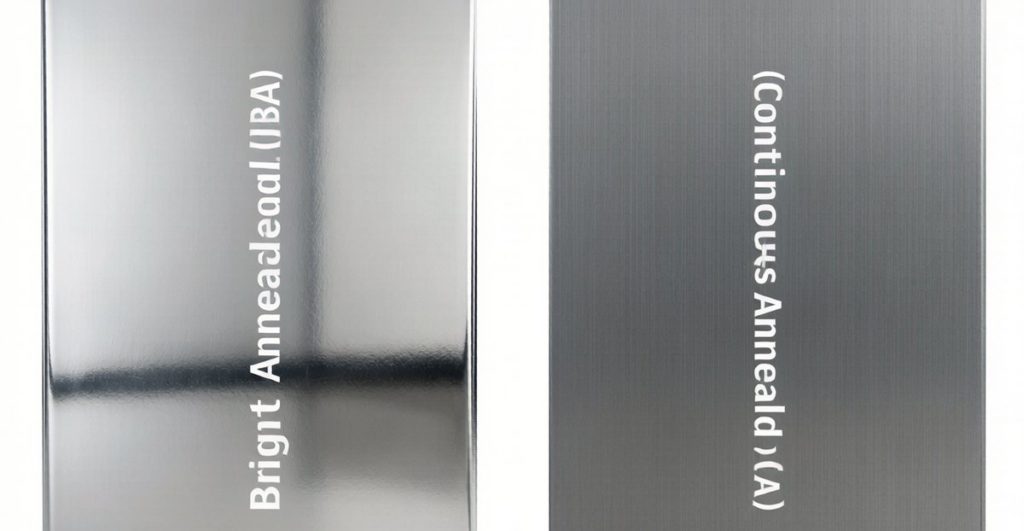
When transitioning between BA and CA temper grades or when comparing specifications across standard systems, use this cross-reference table. Note that these are equivalent hardness comparisons, not identical material properties — BA and CA grades at the same HR30T will differ in formability, anisotropy, and welding behavior due to different microstructures:
| HR30T Range | BA Grade (ASTM/EN) | CA Grade (EN) | CA Grade (US) | Formability Comparison | Weldability Comparison | Best For |
|---|---|---|---|---|---|---|
| 49 ± 3 | T1 | — | — | BA only — no CA equivalent exists at this softness | Not applicable for welding | Very deep drawing, complex embossing |
| 53 ± 3 | T2 | — | — | BA only — CA cannot achieve this ductility | Limited welding use | Deep-drawn decorative tins |
| 55 ± 3 | — (T2.5 custom) | TH550 | — | CA TH550 ≈ 85% of BA T2 formability | CA superior — ±0.5 HR30T consistency | Balanced formability + weld consistency |
| 57 ± 3 | T3 | TH570 | — | BA T3 ≈ 15–20% better draw depth than TH570 | CA TH570 — tighter hardness tolerance | General can making — BA for drawing, CA for welding |
| 61 ± 3 | T4 | TH620 | — | BA T4 ≈ 10–15% better than TH620 | CA TH620 — better for welding | Can ends, rigid bodies |
| 63 ± 3 | — | — | DR8 | DR8 formability ≈ 60–70% of BA T3 | DR8 — industry standard for high-speed welding | 3-piece welded cans at 200–400 cpm |
| 65 ± 3 | T5 | — | — | BA T5 — limited forming only | BA T5 — not optimized for welding | Rigid containers, closures |
| 66 ± 3 | — | TH660 | — | TH660 — minimal forming capability | CA TH660 — requires specialized parameters | Aerosol bodies, pressure containers |
| 70 ± 3 | — | — | DR9 | DR9 — very limited forming | DR9 — specialized welding | High-pressure aerosols, ultra-thin cans |
Critical transition note: When substituting BA T3 with DR8 (same HR30T 57 vs 63), the 6 HR30T difference results in approximately 30–40% reduction in formability. Do not use DR8 for 2-piece deep-drawn cans originally designed for BA T3 — cracking rates will exceed acceptable limits. For 3-piece welded cans, however, DR8 typically reduces rejection rates by 30–50% compared to BA T3 due to superior hardness uniformity.
For a complete BA vs CA comparison beyond temper grades, see our BA vs CA Tinplate: Full Annealing Type Comparison →
6-Step Temper Grade Selection Flowchart
Follow this 6-step decision flow to systematically determine the correct tinplate temper grade for your application. Each step filters the options based on your production parameters:
Step 1: Determine your can type.
- 2-piece deep-drawn can (DRD/DWI)? → Go to Step 2A
- 3-piece welded can? → Go to Step 2B
- Can end/lid/closure? → Go to Step 2C
- Aerosol or pressure container? → Go to Step 2D
Step 2A — Deep Drawing: Assess your draw ratio.
- Deep draw ratio >1.8? → BA T1 or T2 (maximum ductility required for complex deep draws and intricate embossing)
- Moderate draw ratio 1.3–1.8? → BA T3 (standard deep-draw can forming, optimal balance of drawability and strength)
- Shallow draw ratio <1.3? → BA T4 or CA TH550/TH570 (adequate formability with faster production throughput)
Step 2B — 3-Piece Welded: Assess your line speed.
- High speed >200 cans/min? → DR8 (industry standard — ±0.5 HR30T uniformity ensures stable welding without mid-run parameter adjustment)
- Medium speed 150–200 cans/min? → TH550 or TH570 (balanced formability and weld consistency, slightly lower cost)
- Low speed <150 cans/min? → BA T3 (adequate weld performance at lower speeds, widely available globally)
Step 2C — Can Ends/Lids: Assess required stiffness.
- Easy-open ends (EOE) requiring score line precision? → BA T4 or TH620 (tight hardness tolerance needed for consistent tear-open force)
- Standard can lids (non-easy-open)? → BA T4 or T5 (sufficient rigidity for vacuum-seal performance)
- Crown caps or twist-off closures? → BA T3 or T4 (spring-back control for reliable sealing)
Step 2D — Aerosol/Pressure: Assess internal pressure.
- High pressure >10 bar? → DR9 or TH660 (maximum hoop strength for pressure vessel integrity)
- Moderate pressure 6–10 bar? → TH660 or DR8 (adequate pressure resistance with better formability than DR9)
- Standard aerosol 4–6 bar? → TH620 or DR8 (sufficient strength, more cost-effective)
Step 3: Verify your annealing preference.
- Need maximum formability or decorative surface finish? → Confirm BA temper choice
- Need maximum production speed and hardness uniformity? → Confirm CA temper choice
Step 4: Check thickness compatibility.
- Thinner gauges (≤0.20 mm) with hard tempers → Higher risk of buckling during forming; verify through trial
- Thicker gauges (≥0.35 mm) with soft tempers → Higher risk of wrinkling; verify die clearance adjustment
Step 5: Validate with production trial.
- Run minimum 50 units with target temper grade on your actual tooling before committing to volume purchase
- Measure: can rejection rate, wall thickness distribution, weld peel strength, and dimensional stability
Step 6: Confirm temper grade specification on your purchase order.
- Always specify: temper grade (e.g., T3, DR8) + standard (ASTM/EN/JIS) + HR30T range + annealing type (BA/CA)
- Example correct specification: “Tinplate T3 BA per ASTM A624, HR30T 57±3, nominal 0.25 mm, #50/#25 differential coating, Bright finish”
3 Common Temper Grade Selection Mistakes — and How to Avoid Them
Based on Huaxiao Metal’s experience supplying tinplate to 27 countries since 2018, these are the three most frequent and costly temper grade selection errors:
Mistake #1: Using T3 Instead of DR8 for High-Speed Welding Lines — This is the most common error we encounter. A customer specifies BA T3 for a 3-piece welded can line running at 250 cans/min because “that’s what we’ve always used.” The problem: BA T3 has ±2–3 HR30T hardness variation across the coil, causing inconsistent weld formation and 2–4% rejection rates. Switching to DR8 (±0.5 HR30T variation) typically reduces rejection rates to 0.5–1.0% and increases line speed from 180 to 250+ cans/min.
Example: A Middle Eastern food can producer (canned beans, 10M cans/year) switched from BA T3 to DR8 and achieved: rejection rate drop from 3.2% to 0.8%, line speed increase from 180 to 240 cans/min, annual savings of ~$340,000 from reduced scrap and increased throughput.
Mistake #2: Using DR8 for 2-Piece Deep-Drawn Cans — DR8 is designed for welding, not deep drawing. Its HR30T 63 hardness and fine grain CA microstructure result in 30–40% less formability than BA T3. Attempting to deep-draw DR8 into 2-piece cans will produce: sidewall cracking at draw ratios above 1.3, inconsistent wall thickness, excessive earing, and tool wear acceleration. Rule: If your can requires draw ratio >1.3, do not use DR8 — use BA T3 or softer.
Mistake #3: Specifying T1/T2 for Products That Don’t Need Maximum Formability — Over-specifying soft tempers for simple containers adds unnecessary cost. T1 and T2 command a 5–10% price premium over T3 due to longer annealing cycles and lower production throughput. For standard shallow-draw containers (draw ratio <1.3), T3 or TH550 provides sufficient formability at lower cost. Save T1/T2 for complex embossed decorative items and very deep draws (ratio >1.8) where the premium is justified.
Where to Source All Tinplate Temper Grades
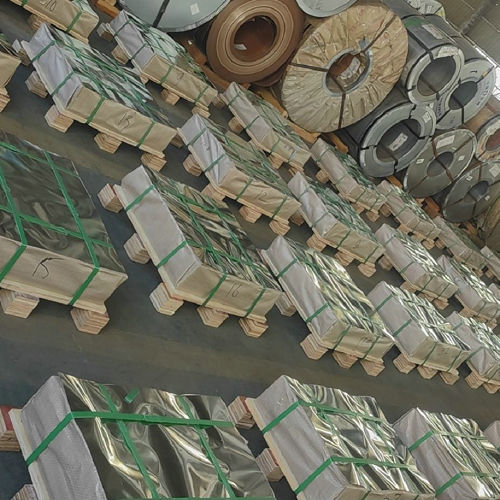
Huaxiao Metal supplies the complete range of BA and CA tinplate temper grades for global can-making operations:
- BA temper grades: T1, T2, T3, T4, T5 — all in stock with 2–3 week lead time for standard gauges (0.18–0.35 mm)
- CA temper grades: DR8, DR9, TH550, TH570, TH620, TH660 — standard stock for DR8/TH550, special order for DR9/TH660
- Coating classes: #25, #50, #75, #100 including differential coating combinations
- Surface finishes: Bright, Stone, Silver, Matte — all compatible with all temper grades
- Documentation: MTC per EN 10204 3.1 documenting HR30T hardness values, yield strength, elongation, and coating weight per coil
- Quality assurance: ISO 9001:2015 certified, SGS third-party inspection available on request
- Technical support: Our metallurgical team provides free temper grade selection consultation based on your can-making line parameters
Frequently Asked Questions
What is the difference between tinplate temper grades T3 and T4?
T3 and T4 are both BA temper grades, but T3 (HR30T 57±3) is softer and more formable than T4 (HR30T 61±3). T3 has yield strength 300–350 MPa and elongation 25–35%, making it suitable for general can drawing and forming operations. T4 has higher yield strength 350–410 MPa and lower elongation 18–28%, making it stiffer and better suited for can ends, lids, and shallow-draw containers. The 4-point HR30T difference means T3 can achieve approximately 25–35% deeper draws than T4 before cracking. For general-purpose food cans, T3 is the standard choice; specify T4 only when increased container rigidity or lid stiffness is required.
When should I choose DR8 over T3 for my can production line?
Choose DR8 instead of T3 when your production line meets these conditions:
(1) You produce 3-piece welded cans (not 2-piece deep-drawn);
(2) Your welding line speed exceeds 200 cans/min;
(3) Your current rejection rate with T3 exceeds 1.5% due to weld inconsistency;
(4) You need a 1–2 week lead time (CA is faster to produce than BA). DR8 provides ±0.5 HR30T hardness uniformity vs T3’s ±2–3 HR30T, enabling stable welding without mid-run parameter adjustments. Do NOT choose DR8 if your cans are 2-piece deep-drawn (draw ratio >1.3) — DR8’s 63 HR30T hardness and CA microstructure will cause cracking. In that case, use T3 or T2.
What temper grade is best for deep drawing into 2-piece cans?
For 2-piece deep-drawn cans (DRD or DWI process), the optimal temper grade depends on your draw ratio: For very deep draws (ratio >1.8) with complex shapes, use BA T1 (HR30T 49±3) or BA T2 (HR30T 53±3) — these soft grades provide maximum ductility (35–45% elongation) for extreme forming. For standard 2-piece food cans (draw ratio 1.3–1.8), BA T3 (HR30T 57±3) is the optimal choice, offering sufficient formability (25–35% elongation) while maintaining adequate finished-can strength. For shallow 2-piece cans (draw ratio <1.3), BA T4 or CA TH550/TH570 can be used to reduce material cost. Never use DR grades (DR8/DR9) for 2-piece deep drawing — their CA microstructure and higher hardness will cause sidewall cracking.
What does HR30T mean in tinplate temper specifications?
HR30T is the Rockwell hardness test standard used to measure tinplate temper. The ‘H’ stands for Rockwell hardness, ‘R’ indicates use of a 1/16-inch (1.5875 mm) steel ball indenter, ’30’ indicates a 30 kgf total test load (3 kgf minor load + 27 kgf major load), and ‘T’ denotes testing on a 0.006-inch (0.152 mm) minimum thickness specimen. For tinplate specifically, HR30T is specified in ASTM A623, EN 10203, and JIS G3303 standards. The test measures the depth of indentation after removing the major load, with softer materials producing deeper indentations and lower HR30T values. HR30T is directly correlated with yield strength and formability: lower HR30T = softer steel = higher formability; higher HR30T = harder steel = lower formability but higher strength.
How do I correctly specify temper grade on my tinplate purchase order?
A complete tinplate temper grade specification on your purchase order must include 5 elements: (1) Temper grade designation — e.g., T3, T4, DR8, TH550; (2) Annealing type — BA or CA; (3) Applicable standard — ASTM A624/A624M, EN 10203, or JIS G3303; (4) HR30T target value and tolerance — e.g., HR30T 57±3; (5) Thickness — in mm. Example complete specification: “Tinplate T3 BA per ASTM A624, HR30T 57±3, thickness 0.25 mm, #50/#25 differential coating, Bright finish, coil form, 950 mm width.” Always include HR30T tolerance (±3 for BA, ±3 for CA) to avoid ambiguity. For CA grades, also specify whether the designation follows EN (TH550) or US (DR8) convention. Contact Huaxiao Metal’s technical team for specification assistance specific to your production line.
Need Help Selecting the Right Temper Grade?
Send us your can type, production line speed, and draw ratio — our metallurgical specialists will recommend the optimal temper grade and provide a quotation with full MTC documentation within 24 hours.
Last updated: July 2026 | Reviewed by Huaxiao Metal Quality Team
Data sources: ASTM A623-21 (Standard Specification for Tin Mill Products, General Requirements), ASTM A624/A624M-20 (ETP Single-Reduced), ASTM A626/A626M-20 (ETP Double-Reduced), EN 10203:2024 (Electrolytic Tinplate), JIS G3303:2025 (Tinplate and Blackplate), customer production data (with permission)
ISO 9001:2015 Certified | SGS Verified | MTC per EN 10204 3.1 | 500+ tons delivered to 27 countries