Quick Answer: How to Choose Tinplate — The 8-Step Selection Framework
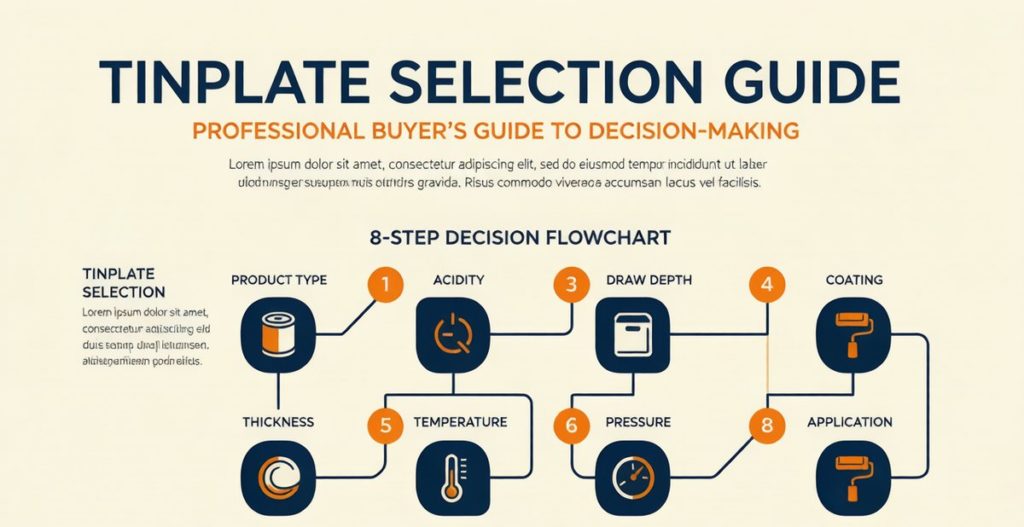
Selecting the correct tinplate specification is a multi-parameter optimization problem. The wrong choice in any single parameter — temper, coating weight, annealing type, or surface finish — can result in can body cracking, weld failure, premature corrosion, or unnecessary material costs. This 8-step buyer’s guide provides a systematic decision framework that walks you through each parameter layer in the correct logical sequence:
(1) define your product type,
(2) assess product acidity,
(3) determine draw depth,
(4) evaluate line speed,
(5) select annealing type,
(6) specify temper grade,
7) choose coating weight,
and (8) pick surface finish.
Follow these 8 steps in order, complete the 12-parameter supplier checklist at the end, and you will arrive at a fully specified tinplate order that matches your production requirements and regulatory obligations.
Step 1: Define Your Product Type — What Are You Manufacturing?
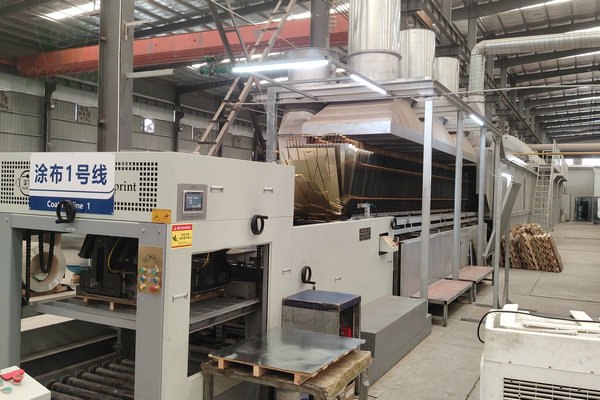
The first and most fundamental decision in tinplate selection is your end product type. Different container formats impose fundamentally different requirements on the tinplate’s mechanical properties, surface characteristics, and coating protection:
| Product Type | Can Format | Forming Process | Critical Tinplate Properties | Common Specification Range |
|---|---|---|---|---|
| Canned vegetables (peas, beans, corn) | 3-piece welded can | Body blank → roll form → weld → flange → double seam | Weldability, moderate formability, adequate corrosion resistance | DR8 or T3, #50/#25, 0.22–0.28 mm |
| Canned fruits (peaches, pineapples) | 2-piece DRD can | Deep draw → redraw → trim → flange | Deep drawability, differential coating for acidity, lacquer adhesion | T3 BA, #75/#25 or #100/#25, 0.20–0.24 mm |
| Canned meat/seafood (tuna, sardines, chicken) | 3-piece welded can | Body blank → weld → flange → double seam | Sulfur-resistant lacquer compatibility, weld consistency, moderate corrosion resistance | DR8 or TH550, #50/#25, 0.22–0.28 mm |
| Carbonated beverages | 2-piece DWI can | Cup → draw → redraw → wall iron → trim | Wall ironing formability, internal pressure resistance, bright surface for printing | T2.5–T3 BA, #25–#50, 0.22–0.28 mm |
| Aerosol containers | 3-piece welded + drawn base | Body weld + base drawn separately → double seam | Pressure resistance (up to 12 bar), hardness consistency, corrosion resistance | DR9 or TH660, #50–#75, 0.30–0.40 mm |
| Decorative gift tins (cookies, tea) | 2-piece drawn + lithographed | Draw → emboss → lithograph print → curl | Soft temper for embossing, bright surface for high-quality printing, moderate formability | T1–T2 BA, #25, 0.22–0.28 mm |
| Paint / chemical containers | 3-piece welded or drawn | Roll form → weld or draw → seal | Chemical resistance, rigid body, secure closure compatibility | T4–T5 BA or TH660, #50–#75, 0.28–0.35 mm |
| Crown caps / twist-off lids | Stamped closure | Blank → stamp → form → line with plastisol | Spring-back control, consistent hardness, good lacquer adhesion | T3–T4 BA, #25–#50, 0.18–0.25 mm |
Decision output for Step 1: Based on your product type, identify your can format (2-piece drawn, 3-piece welded, or stamped closure) and the critical forming process. This determines the primary mechanical demands on your tinplate. Proceed to Step 2 to refine based on product chemistry.
Step 2: Assess Product Acidity — pH Determines Corrosion Protection Needs
Your product’s acidity level is the primary driver of coating weight selection. The pH scale dictates how aggressively the contents will attack the tin coating — and whether differential coating is cost-justified:
| Acidity Level | pH Range | Corrosion Risk | Min. Interior Coating | Differential Coating | Interior Lacquer | Example Products |
|---|---|---|---|---|---|---|
| Non-corrosive / dry | N/A (dry) | None | #25 equal | Not needed | Optional | Milk powder, coffee, tea, biscuits, cereals |
| Neutral / low-acid | 5.0–7.0 | Minimal | #50 equal or #50/#25 | Optional — cost-saving | Standard epoxy-phenolic | Vegetables, meat, seafood, pet food, soups |
| Mildly acidic | 4.0–5.0 | Low | #50 equal or #50/#25 | Optional | Standard epoxy-phenolic | Beer, carbonated soft drinks (carbonic acid) |
| Moderately acidic | 3.5–4.2 | Moderate | #75 equal or #75/#25 | Recommended — 25–33% tin savings | Epoxy-phenolic, possible double-coat | Peaches, pears, apples, apricots, tomato products |
| Highly acidic | 2.8–3.8 | High | #100 equal or #100/#25 | Strongly recommended — 37.5% savings vs #100/#100 | Double-lacquer or acid-resistant system | Pineapple, citrus, berries, grapefruit, pickled products |
Practical measurement tip: If you don’t know your product’s exact pH, measure it with a calibrated pH meter on 3–5 representative samples. pH can vary significantly between product batches (e.g., tomatoes range from 3.9 to 4.6 depending on variety and ripeness). When in doubt, use the lowest (most acidic) pH measurement for coating specification. The cost of over-specification (~$70–90/ton differential per coating class) is trivial compared to the risk of under-specification corrosion failure.
Decision output for Step 2: Note your product’s pH range and minimum recommended interior coating class. Proceed to Step 3 to evaluate forming requirements.
Step 3: Determine Draw Depth — Matching Formability to Your Forming Process
The depth and complexity of the forming operation determines the minimum temper grade softness you need. Deeper draws require softer, more ductile temper grades. The draw ratio (blank diameter / cup diameter) is the key engineering parameter:
| Forming Process | Typical Draw Ratio | Formability Demand | Required Temper Grade | Annealing Type |
|---|---|---|---|---|
| Very deep drawing + embossing | >1.8 | Maximum — 35–45% elongation needed | T1 (HR30T 49) or T2 (HR30T 53) | BA only — CA cannot achieve this ductility |
| Deep drawing (2-piece DRD) | 1.5–1.8 | High — 25–35% elongation needed | T2 (HR30T 53) or T3 (HR30T 57) | BA — CA equivalents lack sufficient formability |
| Standard drawing (2-piece cans) | 1.3–1.5 | Moderate — 20–30% elongation | T3 (HR30T 57) — standard BA workhorse | BA is dominant; TH550 possible for shallow range |
| Shallow drawing / body forming | 1.1–1.3 | Low-Moderate — 15–25% elongation | T3 (HR30T 57) or TH550 (HR30T 55) | BA or CA — depends on welding needs |
| 3-piece welding only (no drawing) | <1.1 (roll form only) | Minimal — 5–15% elongation sufficient | DR8 (HR30T 63) — preferred for high-speed lines | CA — tighter hardness uniformity ±0.5 HR30T |
Critical calculation: Draw Ratio = Blank Diameter / Cup Diameter. If your blank is 140 mm and your finished cup is 80 mm, your draw ratio is 140/80 = 1.75 — classifying as deep drawing, requiring BA T2 or T3 at minimum. Do NOT use DR8 for draw ratios above 1.3 — the resulting cracking rates will exceed 5%, far above the 1–1.5% acceptable rejection rate in commercial can-making.
Decision output for Step 3: Calculate your draw ratio. Map it to the required temper grade range and annealing type (BA for deep draws, BA or CA for shallow draws). Proceed to Step 4.
Step 4: Evaluate Line Speed — Matching Tinplate to Your Production Throughput
Your production line speed determines whether you need the hardness uniformity of CA tinplate or whether BA’s formability advantage is more important. High-speed lines demand consistent material properties to avoid production stoppages and tooling adjustments:
| Line Speed (cans/min) | Production Scale | Recommended Annealing + Temper | Reasoning |
|---|---|---|---|
| <100 cans/min | Small batch / specialty | BA T3–T4 — formability prioritized over weld speed | At low speeds, BA’s ±2–3 HR30T variation is manageable. Prioritize formability. |
| 100–200 cans/min | Medium volume | BA T3 or CA TH550/TH570 — transitional zone | Either annealing type works. TH550 offers compromise: improved hardness uniformity over BA, adequate formability. |
| 200–300 cans/min | High volume | DR8 or TH550 — CA strongly preferred | BA ±2–3 HR30T variation causes weld parameter drift at these speeds. CA ±0.5 HR30T enables stable welding. |
| 300–400 cans/min | Very high volume | DR8 only — CA mandatory | Maximum welding speed requires DR8’s extreme hardness uniformity and optimized welding response. BA is not viable at these speeds. |
| >400 cans/min | Ultra-high volume | DR8 with premium surface finish specs | Dedicated ultra-high-speed lines require additional specifications: micro-cleanliness, controlled surface roughness (Ra 0.3–0.6 μm), tightened thickness tolerance. |
Practical consideration for lines currently running BA at >200 cans/min: If your rejection rate exceeds 1.5% and you attribute it to inconsistent weld quality, transitioning from BA T3 to DR8 could reduce rejection to 0.5–1.0% and enable a 10–20% line speed increase. See our BA vs CA transition guide for the 4-step validation protocol before committing to the switch.
Decision output for Step 4: Based on your line speed, confirm or revise your annealing type preference from Step 3. High speed drives toward CA; deep drawing drives toward BA. Resolve conflicts in Step 6.
Step 5: Select Annealing Type — BA vs CA Decision
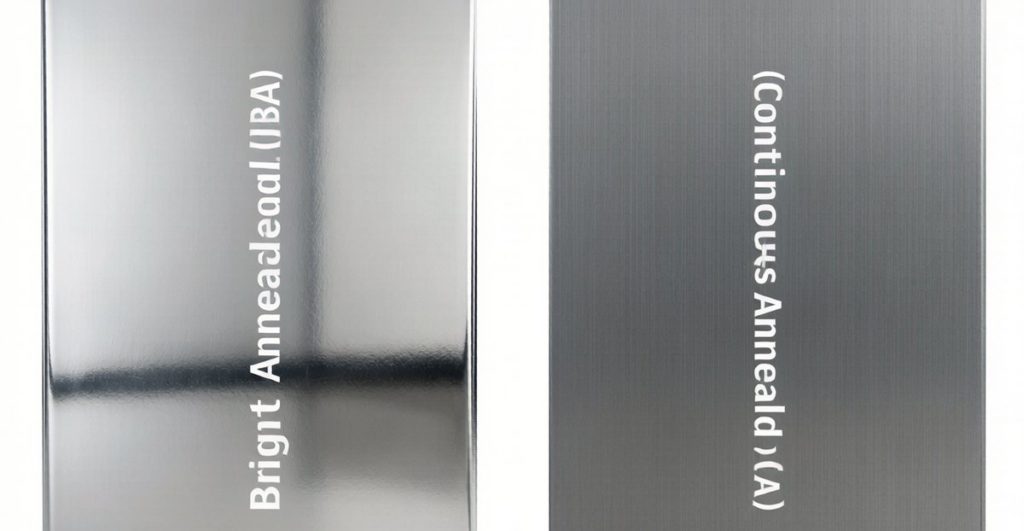
With your product type (Step 1), draw depth (Step 3), and line speed (Step 4) determined, you now have all the data needed to make the BA vs CA annealing type decision. Here is the synthesis framework:
| Your Parameters | Decision | Why |
|---|---|---|
| 2-piece deep-drawn can (any speed) | BA | CA temper grades lack sufficient formability for deep drawing. Draw ratios >1.3 require BA ductility. |
| 3-piece welded can + speed >200 cpm | CA (DR8/TH550) | High-speed welding demands CA’s hardness uniformity (±0.5 HR30T vs BA’s ±2–3 HR30T). Lower rejection rates and faster throughput. |
| 3-piece welded can + speed 100–200 cpm | BA or CA — application-dependent | If product requires some forming (flanging, beading), BA T3 provides margin. If pure welding only, TH550/DR8 for consistency. |
| Decorative/embossed (any speed) | BA (T1–T3) | Embossing demands maximum ductility. BA’s coarse grain structure enables intricate pattern formation without cracking. |
| Aerosol/pressure container (any speed) | CA (TH660/DR9) | Pressure resistance demands high yield strength and consistent hardness. CA’s 66–70 HR30T range is optimized for this. |
| Large volume + short lead time | CA preferred | CA’s continuous process enables 1–2 week lead time vs 3–4 weeks for BA. Large orders benefit from faster supply chain. |
If parameters conflict: When draw depth demands BA but line speed demands CA, prioritize the factor with the higher cost of failure. A deep-draw can that cracks 5% of the time (CA) is worse than a weld line that runs 10% slower (BA). Use the cost of non-conformance analysis: (rejection rate × cost per rejected can × annual production) + (line slowdown cost × hours/year) = total cost. Choose the annealing type with lower total cost.
For a complete BA vs CA comparison including 10-dimension analysis, transition risk assessment, and real customer case studies, see our BA vs CA Tinplate: Complete Comparison Guide →
Decision output for Step 5: Finalize annealing type: BA or CA. Proceed to Step 6 to specify the exact temper grade within your chosen annealing type.
Step 6: Specify Temper Grade — Translating Requirements into Exact Grade
With your annealing type selected, specify the exact temper grade from the appropriate designation system. Use the parameter combinations below as a starting point — always validate with a production trial of minimum 50 units on your actual tooling:
| Annealing | Temper Grade | HR30T | Best For (Product + Process Combo) | Alternative If Unavailable |
|---|---|---|---|---|
| BA | T1 | 49 ± 3 | Very deep drawing (ratio >1.8) + complex embossing + thin decorative tins | T2 (15–20% less formability, but most extreme draws can accommodate) |
| BA | T2 | 53 ± 3 | Deep drawing (ratio 1.5–1.8) + decorative embossing + gift tins with moderate forming | T3 (acceptable if draw ratio <1.6, but test embossing quality) |
| BA | T3 | 57 ± 3 | General 2-piece cans (ratio 1.3–1.5) + standard food can drawing + crown caps | TH550 CA (85% of T3 formability; OK for shallow draws only) |
| BA | T4 | 61 ± 3 | Can ends/lids + easy-open ends + shallow-draw containers + rigid bodies | TH620 CA (80–90% of T4 formability; adequate for can ends) |
| BA | T5 | 65 ± 3 | Industrial containers + closures + structural components + strapping | TH660 CA (similar hardness, better uniformity) |
| CA | TH550 | 55 ± 3 | 3-piece welded cans (medium speed) + containers needing some formability | BA T3 (more formability, less welding consistency) |
| CA | TH620 | 62 ± 3 | Can ends + crown caps + aerosol cone tops + rigid bodies | BA T4 (slightly better formability) |
| CA | TH660 | 66 ± 3 | Aerosol bodies (6–10 bar) + pressure containers + chemical packaging | DR8 (lower hardness, only for <8 bar; check pressure margin) |
| CA | DR8 | 63 ± 3 | 3-piece welded cans (200–400 cpm) — global standard for high-speed food can lines | TH620 (lower hardness, requires welding parameter adjustment) |
| CA | DR9 | 70 ± 3 | High-pressure aerosols (>10 bar) + thin-wall rigid containers + ultra-lightweight cans | TH660 (lower hardness, less pressure resistance) |
Decision output for Step 6: Specify exact temper grade designation with HR30T range (e.g., “T3 BA, HR30T 57±3” or “DR8, HR30T 63±3”).
For complete temper grade specifications including formability ratings, yield strength, and elongation data, see our Tinplate Temper Grades Selection Guide →
Step 7: Choose Tinplate Coating Weight — Balancing Corrosion Protection and Cost
Combine your product chemistry from Step 2 with the following additional factors to finalize coating weight selection:
| Additional Factor | Impact on Coating Weight | Recommendation |
|---|---|---|
| Shelf life >3 years | Upgrade one coating class above minimum | Example: Standard vegetables normally need #50; for 3+ year shelf life, specify #75 |
| Hot-fill process (>85°C) | Higher temperature accelerates tin dissolution | Upgrade one coating class + double-lacquer system for hot-fill products |
| Tropical climate storage | High humidity + high temperature accelerate external corrosion | Upgrade exterior coating from #25 to #50 for export to Southeast Asia, Africa, Latin America |
| Marine/coastal transport | Salt spray accelerates external corrosion | Minimum exterior #50 + VCI (Volatile Corrosion Inhibitor) packaging for sea freight >30 days |
| No interior lacquer (plain tinplate) | Direct food-to-tin contact increases coating demand | Upgrade 1–2 coating classes. Example: #100 interior minimum for lacquer-free acidic food cans |
| Infant food / sensitive product | Zero tolerance for tin dissolution or off-taste | Maximum coating (#100 interior) + full lacquer + migration testing on every batch |
Coating weight specification format: Equal coating: “#50/#50” (or simply “#50”). Differential coating: “#100/#25” where first number = interior (product side) and second number = exterior. Always specify which side is heavier on your purchase order if using differential coating.
For complete coating weight specifications including ASTM A624 classes, corrosion life tables by environment, and cost-performance analysis, see our Tinplate Coating Weight Chart →
Decision output for Step 7: Specify coating class and configuration. Example: “#75/#25 differential coating (75 interior / 25 exterior) per ASTM A624.”
Step 8: Pick Surface Finish — Aesthetics, Printability, and Functional Requirements
Surface finish is often treated as an afterthought but directly affects print quality, lacquer adhesion, and consumer perception of your finished can. Tinplate surface finishes are produced by controlling the reflow melting process after tin plating:
| Surface Finish | Process | Appearance | Print Quality | Lacquer Adhesion | Best Applications |
|---|---|---|---|---|---|
| Bright | Full reflow — tin melted to molten state then rapidly cooled | Mirror-like reflective surface, smooth microstructure | Excellent — best for 4–6 color offset lithography, highest ink gloss | Good — polished surface requires slightly higher lacquer bake temperature | Lithographed food cans, beverage cans, decorative tins requiring high-quality printed graphics, brand-prominent packaging |
| Stone | Controlled partial reflow — specific thermal cycle timing | Textured, non-reflective surface with characteristic ‘stone’ pattern | Very good — diffuse reflection reduces glare, good for photography | Excellent — textured surface provides mechanical keying for lacquer anchoring | General food cans without high-gloss graphics, aerosol bodies, industrial containers, applications prioritizing lacquer adhesion over visual gloss |
| Silver | Intermediate reflow — between Stone and Bright parameters | Soft silvery sheen, moderate reflectivity, uniform appearance | Very good — balanced between Bright’s gloss and Stone’s readability | Very good — optimal balance of printability and adhesion | Pharmaceutical containers, high-end cosmetic packaging, cans requiring both print quality and reliable lacquer coverage |
| Matte | No reflow — tin surface remains in as-plated dendritic state | Flat, non-reflective, consistent matte appearance | Fair — limited ink gloss, better for simple 1–2 color designs | Excellent — maximum surface roughness provides best mechanical adhesion | Non-printed containers, internal can parts, industrial packaging, applications where print quality is secondary to functional performance |
Surface finish compatibility: All four surface finishes are available with both BA and CA annealing types, and with all coating classes (#25–#100 including differential). Bright finish achieves the highest quality offset printing result but demands higher lacquer application control. Stone finish is the most commonly specified for general food cans — it provides the best balance of printability and lacquer adhesion.
Decision output for Step 8: Specify surface finish. Example: “Bright finish (for lithographed cans)” or “Stone finish (for general food cans).”
Now compile all 8 steps into your complete tinplate specification — proceed to the Supplier Checklist.
Supplier Checklist — 12 Parameters to Include in Your RFQ
Before sending a Request for Quotation (RFQ) to your tinplate supplier, verify that your specification includes all 12 parameters. Missing any parameter increases the risk of receiving material that does not meet your production requirements:
| # | Parameter | Your Specification | Example |
|---|---|---|---|
| 1 | Thickness (mm) | Nominal thickness with tolerance (typically ±0.01 mm for ≤0.30 mm) | 0.25 mm ±0.01 mm |
| 2 | Width (mm) | Coil width or sheet dimensions with tolerance | 950 mm coil width, tolerance +0/-2 mm |
| 3 | Annealing Type | BA or CA | BA (Batch Annealed) |
| 4 | Temper Grade | Grade designation + standard system + HR30T range | T3 per ASTM A624, HR30T 57±3 |
| 5 | Coating Weight | Coating class + format (equal or differential) + per-side designation | #75/#25 differential (75 interior / 25 exterior) per ASTM A624 |
| 6 | Surface Finish | Bright, Stone, Silver, or Matte | Stone finish |
| 7 | Passivation Type | Cr³⁺ (standard) or Cr-free (special request) | Cr³⁺ passivation, 5–15 mg/m², Cr⁶⁺-free certificate required |
| 8 | Oil Film | Oil type + weight range (typically DOS, 2–8 mg/m²) | DOS oil, 3–5 mg/m² |
| 9 | Form of Supply | Coil or sheet + packaging specifications + coil ID/weight | Coil, ≤5 tons per coil, VCI anti-corrosion packaging, coil ID labeling |
| 10 | Applicable Standard | ASTM A624 / EN 10203 / JIS G3303 | ASTM A624/A624M (ETP Single-Reduced) |
| 11 | Compliance Requirements | Regulatory documentation: FDA, EU 1935/2004, REACH, PPWR | FDA 21 CFR 175.300 compliance + EU 1935/2004/EC DoC + REACH SVHC communication |
| 12 | Testing & Certification | MTC type + third-party testing + additional certificates | MTC per EN 10204 3.1 + SGS migration testing for FDA/EU + PPWR recyclability verification |
Example complete specification: “Tinplate 0.25 mm ±0.01 × 950 mm coil, BA T3 per ASTM A624, HR30T 57±3, #75/#25 differential coating per ASTM A624 (75 g/m² interior / 25 g/m² exterior), Stone finish, Cr³⁺ passivation 5–15 mg/m² (Cr⁶⁺-free certified), DOS oil 3–5 mg/m², VCI packaging ≤5 ton per coil with labeled coil ID. MTC EN 10204 3.1, FDA 21 CFR 175.300 compliance package, EU 1935/2004/EC DoC, REACH SVHC communication, PPWR recyclability verification. FOB Shanghai, incoterms 2020.”
3 Common Mistakes in Tinplate Specification — and How to Fix Them
Based on Huaxiao Metal’s experience supplying tinplate globally since 2018, here are the three most frequent specification errors and their corrective actions:
Mistake #1: Specifying Temper Grade Without Annealing Type — A purchase order that says “Tinplate T3” is ambiguous. T3 without the BA designation could be interpreted as either BA T3 (HR30T 57) or TH550 CA (HR30T 55) — two different materials with vastly different formability characteristics (BA T3 has 25–35% elongation vs TH550’s 20–30%).
Fix: Always specify both temper grade AND annealing type: “T3 BA” or “TH550 CA” or “DR8”. The annealing type should never be implied from the temper designation.
Mistake #2: Ignoring Differential Coating Cost Savings — Many buyers specify equal coating (#75/#75 or #100/#100) for products where differential coating would be equally effective and significantly cheaper. A #100/#25 differential coating saves 37.5% of tin compared to #100/#100 equal coating — approximately $110–130 per ton, or $55,000–65,000 per year for a 500-ton annual order.
Fix: Evaluate differential coating for any product where the interior faces an aggressive environment but the exterior faces a mild one. The interior (product contact) side needs the protection; the exterior (label side) typically does not.
Mistake #3: Under-specifying Coating Weight for Export to Tropical/Coastal Markets — A specification developed for products sold in temperate climates (Europe, North America) may be inadequate when exported to tropical or coastal regions. A #50 coating that provides 3–4 year shelf life in Germany may corrode within 12–18 months in Singapore, Lagos, or Mumbai due to high humidity and temperature.
Fix: For export to tropical zones (SE Asia, Africa, Latin America, Middle East coastal), upgrade exterior coating to minimum #50 and use VCI (Volatile Corrosion Inhibitor) packaging. Consider upgrading interior coating one class if shelf-life expectations are the same as temperate markets. The incremental cost is $70–130 per ton — a fraction of the cost of product returns or brand reputation damage from corroded cans on tropical retail shelves.
Where to Source Tinplate — Huaxiao Metal's Full Specification Range
When you have completed your 8-step specification, Huaxiao Metal can fulfill your tinplate order with the full range of parameters you need:
- Thickness: 0.13–0.50 mm, any width 600–1,200 mm (coil) or custom sheet dimensions
- Annealing: BA (T1–T5) and CA (DR8, DR9, TH550, TH570, TH620, TH660) — all grades in stock or short lead time
- Coating: #10, #25, #50, #75, #100 — equal or any differential combination
- Surface: Bright, Stone, Silver, Matte — any finish with any annealing type and coating class
- Passivation: Cr³⁺ standard (5–15 mg/m²) or Cr-free alternative on request
- Documentation: MTC EN 10204 3.1, FDA compliance package, EU 1935/2004 DoC, REACH SVHC communication, PPWR recyclability verification, SGS third-party testing on request
- Quality: ISO 9001:2015 certified, in-line XRF coating monitoring, coil-level traceability, BRCGS Issue 9-compatible documentation
- Global delivery: FOB Shanghai, CIF to major ports in 15–25 days, 27 countries served
Frequently Asked Questions
How do I determine the right tinplate thickness for my cans?
Tinplate thickness selection depends on three factors: can format, internal pressure, and target can weight. For standard 3-piece welded food cans (no internal pressure), use 0.22–0.28 mm (body) and 0.18–0.22 mm (lid). For 2-piece deep-drawn cans (DRD), use 0.20–0.24 mm — the deep drawing process requires thinner starting gauge due to wall thickening during forming. For aerosol cans (4–12 bar internal pressure), use 0.30–0.40 mm, with higher pressures requiring thicker gauges. For lightweight/ultra-lightweight applications, DR9 at 0.18–0.20 mm enables down-gauging while maintaining strength.
Start with our recommended range, then optimize through production trial: reduce thickness by 0.01 mm increments until can performance (burst pressure, axial load) approaches your minimum specification. Never specify thickness without confirming with temper grade — thin gauges with soft tempers risk buckling; thick gauges with hard tempers waste material.
Can I order tinplate without knowing all 12 specification parameters?
While technically possible, ordering tinplate with incomplete specifications significantly increases the risk of receiving material unsuitable for your production line. The minimum viable specification includes 6 parameters: thickness, width, annealing type (BA/CA), temper grade, coating weight, and surface finish. The remaining 6 (passivation type, oil film, form of supply, applicable standard, compliance requirements, testing requirements) can be defaulted to industry standards but should still be confirmed.
Huaxiao Metal’s technical team will work with you to complete all 12 parameters based on your product type and production line details. However, providing a complete 12-parameter specification from the start ensures faster quotation turnaround (within 24 hours) and eliminates the risk of assumptions that don’t match your actual requirements.
What's the difference between ordering tinplate by coil versus by sheet?
Coil and sheet supply formats each have distinct advantages: Coils (600–1,200 mm wide, typically 2–8 tons each) are preferred for high-volume can-making lines with coil-fed presses or slitting lines.
Advantages: lower cost per ton (no shearing charge), continuous production (no coil change interruption every few thousand cans), and greater flexibility for different can sizes on the same line.
Disadvantages: requires handling equipment (decoiler), minimum order quantity may be higher, storage requires racking. Sheets (cut to your exact dimensions) are preferred for smaller operations, punch-press lines, or when you lack coil handling capability.
Advantages: ready to use, no slitting equipment needed, easier to inspect, lower minimum order. Disadvantages: 5–10% price premium for shearing, edge condition may affect forming (burr direction), and more frequent material loading. If annual volume exceeds 500 tons, coil supply is typically more economical.
How long does it take to receive tinplate after placing an order?
Lead time depends on annealing type, specification complexity, and shipping destination: BA tinplate: 3–4 weeks production (longer annealing cycle) + 15–25 days sea freight (FOB Shanghai to major ports). CA tinplate: 1–2 weeks production (continuous process is faster) + 15–25 days sea freight. Pure BA is always slower due to the 30–40 hour batch annealing cycle per coil stack. For urgent orders, Huaxiao Metal maintains stock inventory of the most common specifications (T3 BA 0.25 mm #50/#50 Stone, DR8 0.25 mm #50/#50 Bright) for shipment within 1 week.
Non-standard combinations (e.g., T1 BA 0.15 mm #100/#25 Silver) require full production lead time. Custom widths, tight tolerances, or special passivation may add 1–2 weeks. Total CIF delivery time: approximately 4–8 weeks from order to arrival at your factory depending on specification and destination.
How do I validate that the tinplate I received matches my specification?
Perform incoming quality inspection on every received coil or batch using these steps:
(1) Verify MTC data against your purchase order — check every parameter: thickness, width, temper, HR30T, coating weight per side, surface finish, passivation, oil film.
(2) Measure thickness (micrometer, 5 points across width), width (tape measure or laser), and hardness (Rockwell HR30T tester, minimum 5 readings across strip).
(3) Verify coating weight via either in-house coulometric method (ASTM A630) or send samples to an accredited lab for XRF analysis.
Minimum testing: one sample per coil or one sample per 5 tons.
(4) Inspect surface finish visually against reference standards (Bright/Stone/Silver/Matte reference panels) under standardized lighting.
(5) Verify temper grade through a simple bend test (180° bend, check for cracking) or cup-drawing test for ductility verification.
(6) Retain samples of each coil receipt for traceability per BRCGS Issue 9 requirements.
Discrepancy protocol: Document deviation, notify supplier within 7 days, quarantine affected material, and request root cause analysis before accepting replacement or credit.
Ready to Place Your Tinplate Order?
Send us your completed 12-parameter specification, or let our technical team help you finalize it based on your product type and production line details. Quotation with full MTC and compliance documentation within 24 hours.
Last updated: July 2026 | Reviewed by Huaxiao Metal Quality Team
Data sources: ASTM A624/A624M-20 (ETP Single-Reduced), ASTM A623-21 (General Requirements for Tin Mill Products), EN 10203:2024 (Electrolytic Tinplate), JIS G3303:2025 (Tinplate and Blackplate), BRCGS Packaging Materials Issue 9 (February 2026), customer production data (with permission), Huaxiao Metal order specification database (2018–2026)
ISO 9001:2015 Certified | SGS Verified | MTC per EN 10204 3.1 | Coil-Level Traceability | 500+ tons delivered to 27 countries