Carbon structural steel, one of the most widely used metal materials in modern industry and infrastructure, is often called the “backbone of industry.” Its excellent mechanical properties and cost-effectiveness make it a top choice for engineers and procurement professionals, from modern buildings, bridges, steel structures, warehouses and logistics, large machinery frameworks, and precision machinery components.
However, faced with a complex web of global standards and grades (such as China’s Q235, the United States’ A36, and Europe’s S235), accurately understanding their performance differences, selecting the right material, and finding reliable, high-quality suppliers are crucial to the success of every project.
Huaxiao Metal, a leading global steel supplier, leverages over a decade of industry experience and a deep understanding of global standards to present this comprehensive guide to carbon structural steel grades through 2026. This article not only details the definition, grades, and chemical composition of carbon structural steel, but also explores international standard comparisons, providing efficient and reliable Huaxiao Metal procurement strategies.

The Definition, Core Properties, and Classification System of Carbon Structural Steel
What is Carbon Structural Steel?
Carbon Structural Steel primarily refers to steel whose main alloying element is carbon and that meets the requirements for structural applications. Its key characteristics include: relatively low to medium carbon content, good plasticity, excellent weldability, and workability, while possessing the required mechanical properties for structural load-bearing and safety.
In steel classification, the lower the carbon content, the better the steel’s plasticity and weldability; conversely, higher carbon content increases strength and hardness but reduces plasticity and weldability.
Regarding the term “Anti-Carbon Structural Steel” (understood as “Corrosion-Resistant Carbon Structural Steel” or “High-Durability Carbon Structural Steel”), the focus is on selecting the appropriate grade, optimizing the chemical composition, strictly controlling harmful impurities (such as S and P content), and applying reliable anti-corrosion or weathering treatments. Huaxiao Metal’s structural steel products are engineered to withstand the durability challenges posed by heavy-load, harsh environments, industrial plants, and bridge projects.
Grade Classification in Chinese National Standards (GB)
In Chinese national steel standards, Carbon Structural Steel is divided into two main categories, with the designation system primarily based on Yield Strength:
Ordinary Carbon Structural Steel (GB/T 700):
Designation Method: Starts with “Q” (for Qu Fu – Yield Strength), followed by the minimum yield strength value (in MPa).
Example: Q235 indicates a minimum yield strength of 235 MPa. This is the most widely used structural steel in China, known for its good plasticity, weldability, and balanced mechanical properties. Q19, Q21, Q23, Q25, Q275
Quality Grade Classification (A/B/C/D): Each grade can be further divided into different quality levels (A, B, C, D), which mainly differ in their Impact Energy Requirements and the strictness of control over harmful impurities like Sulfur and Phosphorus. Grade D offers the highest quality and best impact toughness, suitable for low-temperature environments.
Example: Q235-C denotes Grade C killed steel (deoxidation method).
- High-Quality Carbon Structurcal Steel (GB/T 699):
High-quality carbon structural steel has lower impurity (sulfur and phosphorus) content and has higher requirements for mechanical properties and chemical composition uniformity. It is primarily used in the manufacture of important mechanical parts such as shafts, gears, connecting rods, and bolts.
Grade Characteristics: A two- or three-digit number represents the steel’s average carbon content in parts per million. For example, a high-quality carbon structural steel with a carbon content of approximately 0.45% is designated “45.”
Influence of Manganese Content: If the manganese content in the steel is high (e.g., >0.7%), “Mn” is added after the number, such as “20Mn.”
Common Grades and Their Interpretations:
- 08F, 10F: Low-carbon rimmed steels with good plasticity and toughness, used for stamping parts.
- 20#: Commonly used case-hardened steel with high core strength and high surface hardness, used for shafts and pins.
- 45#: Commonly used medium-carbon steel. After quenching and tempering, it exhibits excellent overall mechanical properties and is used for important shafts, gears, etc.
| Grade Category | Typical Grade | Yield Strength (MPa) | Primary Applications |
| Ordinary Structural Steel | Q235 | 235 | Industrial buildings, bridges, towers (Most common) |
| High-Strength Structural Steel | Q345 | 345 | High-load structures, large machinery frames |
| High-Quality Structural Steel | 45# | – | High-strength shafts, gears (Requires heat treatment) |
Carbon Structural Steel Grades
Carbon structural steel can be divided into five grades: Q19, Q21, Q23, Q25, Q5, and Q27, with a carbon content range of 0.6-38%. Each grade is divided into several grades according to the different content of harmful impurities such as sulfur and phosphorus.
The representation methods of AISI and SAE (American Society of Automotive Engineers) standard structural steel grades are roughly the same, except that the prefix symbols of the grades are slightly different. SAE standard structural steel grades are generally represented by 4 digits, the first two digits represent the grade of steel, and the last two digits represent the average carbon content of steel (in parts per thousand).
High-quality carbon structural steel grades are represented by two digits, which represent the average carbon mass fraction in steel. For example, 45 steel means that the average carbon mass fraction in steel is 45%. If the manganese content in the steel is high, the symbol of the chemical element manganese is added after the two digits.
Carbon tool steel is mainly used to manufacture various cutting tools, measuring tools, and molds. Carbon tool steel grades are represented by “T” plus numbers. The number in thousands indicates the average carbon mass fraction in the steel. For example, T8 steel is a carbon tool steel with an average carbon mass fraction of 8%.
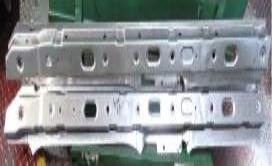
Global Carbon Structural Steel Grades Overview
Below is a quick reference of the most commonly used structural steel grades:
| China (GB) | USA (ASTM) | Europe (EN) | Key Feature |
|---|---|---|---|
| Q235 | A36 | S235JR | General structural use |
| Q345 | A572 Gr50 | S355JR | High strength |
| Q390 | A572 Gr60 | S420 | Heavy engineering |
| Q420 | A573 Gr65 | S460 | High-load structures |
👉 This table is widely used in international procurement and engineering design selection.
Which Parts of The Carbon Structural Steel Grade Composition?
The carbon structural steel grade consists of four parts in sequence: the letter representing the yield point, the yield point value, the quality grade symbol, and the deoxidation method symbol. For example, Q235-AF represents A-grade boiling steel with a yield point of 235Mpa, and Q235-C represents C-grade static steel with a yield point of 235Mpa.
Quality Carbon Structural Steel Grades
Commonly used welding low-carbon steel (containing C ≤ 25%) and medium carbon steel (containing C = 25%-60%); high-quality carbon structural steel (011223344). Q23 is a more commonly used grade of carbon structural steel, with a carbon content between 20% and 35%. It is a national unified basic steel grade. The suffix code of the grade indicates the characteristics of the material.
High-quality carbon structural steel is divided into 32 grades, which are divided into three groups: low manganese steel (25%~50%), ordinary manganese steel (35%~80%), and high manganese steel (70%~20%). The expression form is the average carbon content in ten thousand parts and the mark of manganese content-deoxidation degree.
Low carbon steel grades include: 05F, 08F, 010F, 115F, 120F, 2220Mn, 25Mn, etc.; medium carbon steel grades include: 334455630Mn, 40Mn, 50Mn, 60Mn, etc.; high carbon steel grades include: 6765Mn, etc.
High-quality carbon structural steel hot-rolled thin steel plates and strips are used in industrial sectors such as automobiles and aerospace industries. The grades include boiling steel: 08F, 10F, 15F; precipitation steel: 008AL, 1122334450.
The main use of high-quality carbon structural steel is bars. The selection of high-quality carbon structural steel is based on mechanical properties (mechanical properties). As the carbon content increases, the strength increases, but the plasticity and toughness decrease. The commonly used high-quality carbon structural steel grade is 45 steel.
Global Comparison of Key Carbon Structural Steel Grades
In global trade, understanding the corresponding relationships between different national and regional standards is crucial. Huaxiao Metal is capable of supplying products that meet global mainstream standards, not just the Chinese GB standards.
China (GB) vs. United States (ASTM/ASME)
The US standards primarily follow ASTM (American Society for Testing and Materials) specifications.
| Chinese Grade (GB) | US Equivalent (ASTM) | Key Features & Applications | Huaxiao Metal Supply Capability |
| Q235B/C | A36 | Internationally common low-carbon structural steel, known for good weldability. Yield strength approx. 250 MPa (36 Ksi). | A36 is a readily available stock item at Huaxiao Metal, supplied as plate, shape, and pipe. |
| Q345B | A572 Gr.50 | High-Strength Low-Alloy Steel (HSLA), offers higher load-bearing capacity. | A572 series, we supply high-strength levels such as Gr.50 and Gr.60. |
| 45# | 1045 | Typical medium-carbon steel, used for structural or mechanical parts, responds well to heat treatment. | 1045 bar and plate, with high precision control. |
China (GB) vs. Europe (EN/DIN)
The European standard (EN 10025) designation system is based on yield strength and impact toughness temperature.
| Chinese Grade (GB) | European Equivalent (EN 10025) | European Grade Interpretation | Huaxiao Metal Supply Capability |
| Q235B/C | S235JR | S-Structural Steel, 235-Yield Strength, JR-Room Temperature (20℃) impact requirement. | S235 series, all quality levels supplied, available with 3.1/3.2 certificates. |
| Q345B | S355JR | S-Structural Steel, 355-Yield Strength. | S355 series, Huaxiao’s recommended European high-strength steel. |
China (GB) vs. Japan (JIS)
| Chinese Grade (GB) | Japanese Equivalent (JIS G3101) | Key Features & Applications | Huaxiao Metal Supply Capability |
| Q235B/C | SS400 | Minimum tensile strength is 400 MPa, highly interchangeable with Q235 performance. | SS400 is often supplied for projects exporting to Asia and Southeast Asia. |
| Q345B | SM490 | Steel for welded structures (SM), performance similar to Q345, with emphasis on weldability. | SM490 series, specialized for high-strength welded structures. |
Chemical Composition
The performance of carbon structural steel depends largely on its chemical composition. Small differences in carbon, manganese, or silicon can significantly affect its mechanical behavior, weldability, and toughness.
| Grade | C (%) | Mn (%) | Si (%) | S (%) | P (%) | Notes |
|---|---|---|---|---|---|---|
| Q235 / A36 / S235 | ≤0.22 | ≤1.40 | ≤0.35 | ≤0.045 | ≤0.045 | Low carbon for good weldability |
| Q345 / A572 / S355 | ≤0.25 | 1.00–1.60 | ≤0.55 | ≤0.040 | ≤0.040 | Medium carbon, higher strength |
| St52 / SM490 | ≤0.23 | 1.10–1.70 | ≤0.55 | ≤0.040 | ≤0.040 | Balanced strength and ductility |
Key Element Effects:
Carbon (C): Increases strength and hardness but reduces weldability and toughness.
Manganese (Mn): Enhances strength, ductility, and resistance to wear.
Silicon (Si): Improves strength and elasticity.
Sulfur (S) and Phosphorus (P): Usually impurities; excessive amounts can reduce toughness and ductility.
At Huaxiao Metal, our carbon steels are strictly tested to ensure stable composition and reliable performance for demanding projects.
Mechanical Properties
The mechanical properties determine how the steel behaves under load, which is crucial for engineering and structural applications.
| Grade | Yield Strength (MPa) | Tensile Strength (MPa) | Elongation (%) | Hardness (HB) | Impact Energy (J) |
|---|---|---|---|---|---|
| Q235 / A36 / S235 | 235 | 370–500 | 26 | ≤160 | 27 (at 20°C) |
| Q345 / A572 / S355 | 345 | 470–630 | 21 | ≤180 | 34 (at 20°C) |
| St52 / SM490 | 355 | 490–650 | 22 | ≤185 | 47 (at 20°C) |
Performance Insights:
Yield Strength determines the load before permanent deformation.
Tensile Strength indicates the maximum stress before breaking.
Elongation reflects ductility and formability.
Hardness represents resistance to surface deformation.
Impact Energy shows the material’s toughness under sudden load.
Huaxiao Metal’s high-quality structural steel ensures consistent strength and mechanical stability, suitable for bridges, machinery, and construction industries.
Physical & Processing Properties
| Property | Typical Value | Notes |
|---|---|---|
| Density | 7.85 g/cm³ | Standard for carbon steels |
| Thermal Conductivity | 50 W/m·K | Good heat dissipation |
| Electrical Conductivity | ~7% IACS | Lower than copper, suitable for mechanical use |
| Weldability | Excellent for low carbon (Q235) | Preheating recommended for thicker sections |
| Formability | Good for all low–medium carbon grades | Ideal for bending and cold forming |
| Machinability | Moderate | Improved by controlled sulfur addition |
| Corrosion Resistance | Moderate | Can be enhanced via galvanization or coating |
Huaxiao Metal offers processing services including cutting, welding, forming, and surface treatment to meet diverse client requirements.
Whether you need hot-rolled plates, beams, or structural bars, we deliver with precision and consistency.
Key Technical Indicators and Selection Essentials for Structural Steel
Correct material selection requires balancing mechanical properties, processing performance, and project costs. Below are the selection criteria summarized by Huaxiao Metal based on extensive project experience:
Core Mechanical Properties
Yield Strength: The defined value used in structural design, measuring the material’s ability to resist permanent deformation.
Tensile Strength: The maximum load the material can withstand before fracture under tension.
Elongation / Reduction of Area: Measures the steel’s plasticity and toughness, relating to formability and cold working performance.
Impact Toughness and Fatigue Strength: Especially important for bridges, heavy-load, and dynamic structures. Particular attention must be paid to impact test temperature requirements.
Chemical Composition and Durability Optimization
| Component | Role and Impact | Selection Tip |
| Carbon (C) | Influences steel hardness and strength. Higher carbon content increases strength but reduces plasticity and weldability. | Low carbon (C < 0.25%) is ideal for welding; medium carbon (C = 0.25%~0.60%) is suitable for heat treatment. |
| Sulfur (S), Phosphorus (P) | Harmful impurities. Should be kept low to ensure steel weldability and toughness. Premium grades have extremely low S and P content. | For high-requirement structures and low-temperature environments, select high-quality grades (e.g., Q235 Grade C/D). |
| Manganese (Mn), Silicon (Si) | Deoxidizers and solid solution strengthening elements, affecting strength and toughness. | Appropriate Mn content can enhance strength. |
Durability/Corrosion Resistance (“Anti-Carbon Structural Steel”): For outdoor, humid, and highly corrosive environments (such as coastal areas or chemical plants), consider:
Weathering Steel (Cor-Ten): Such as Q355NH, which uses alloying elements like Cr, Cu, and Ni to form a dense protective layer on the surface.
Anti-Corrosion Treatment: Galvanization, heavy-duty anti-corrosion coatings, etc. Huaxiao Metal can provide complementary anti-corrosion solutions tailored to your needs.
Welding and Processing Performance
Welding: Low-carbon structural steel (e.g., Q235/A36) is widely used in construction due to its low carbon content, fewer impurities, and ease of welding. Medium or high-carbon structural steel (e.g., 45#) is more difficult to weld and requires preheating and appropriate filler materials.
Cold/Hot Working: The formability of plates, sections, and tubes must be adaptable to engineering requirements. Huaxiao Metal offers precision processing services to ensure optimal workability.
How to Select the Right Carbon Structural Steel for Your Project
Step 1: Identify Your Project Requirements
- Structural Application: Building Frame, Bridge, Factory, Warehouse, Tower, etc.
- Loading Conditions: Static, Dynamic, Fatigue Loads?
- Environmental Conditions: Indoor, Outdoor, Coastal, High, Low Temperatures?
- Processing/Welding Requirements: Will there be extensive welding, profiles, plates, pipes, or custom work?
Step 2: Select the Appropriate Grade and Standard
- If you require excellent weldability and deformability, low-carbon structural steel (such as Q235/A36) is recommended.
- If you require high load-bearing capacity, choose a higher-grade structural steel (such as Q345, Q355, or foreign equivalents).
- If your customer is exporting to Europe or the United States, you should clearly identify the required standards (ASTM, EN, JIS, etc.).
Step 3: Confirm the Supplier’s Capabilities and Certifications
- Is the supplier certified for management systems such as ISO 9001/ISO 14001?
- Is a material test report (MTC, Mill Test Certificate) provided?
- Does the supplier support third-party testing (such as SGS, BV)?
- Does the supplier provide factory chemical composition analysis, mechanical property reports, and welding reports?
Step 4: Consider Logistics/Processing Services
- Material Forms: Plates, Profiles, Tubes, Bars
- Processing Services: Cutting, Drilling, Welding, Heat Treatment
- Packaging, International Shipping, and Customs Brokerage Support
Procurement Guide: Core Advantages of Choosing Huaxiao Metal
When procuring structural steel, quality, certification, and delivery time are vital lifelines. Huaxiao Metal is a deeply rooted supplier in the metal materials industry, committed to providing global customers with a one-stop, high-quality Carbon Structural Steel solution.
Breadth and Depth of Supply: Comprehensive Inventory to Meet All Your Needs
We offer a product line covering major global grades (GB/ASTM/EN/JIS), ranging from low-carbon, conventional structural steel to high-strength structural steel (e.g., Q235, Q345, ASTM A36). Our inventory includes:
Plates/Coils: Meeting various thickness requirements, including hot-rolled and cold-rolled.
Structural Shapes: H-beams, I-beams, angles, channels, and other structural profiles.
Pipes/Tubes: Carbon steel seamless and welded pipes, conforming to standards like API SPEC 5L for the oil and gas industry.
Bars/Rods: High-quality carbon structural steel bars (e.g., 20#, 45#), suitable for machining or forging.
International Standard Support and Authoritative Certification (Quality Assurance)
Comprehensive Standards: Products can be manufactured and supplied according to global mainstream standards such as GB, ASTM, EN, and JIS, fulfilling global project requirements.
Quality Assurance: All steel products leaving the factory are accompanied by an authoritative MTC (Mill Test Certificate), providing chemical composition analysis and mechanical performance test reports.
Third-Party Inspection: We support third-party inspections from international bodies like SGS and BV, and can provide EN 10204 3.1 or 3.2 Certificates.
Customized Processing Services
We supply not just raw materials, but “semi-finished” solutions through our advanced processing center:
Cutting Services: Laser cutting, flame cutting, plasma cutting, etc., ensuring high-precision sizing.
Deep Processing: Drilling, bending, beveling, etc., reducing your on-site workload.
Surface Treatment: Sandblasting (Sa2.5 grade), anti-rust primer coating, galvanization, and other anti-corrosion treatments.
Optimized Supply Chain and Rich Export Experience
Quick Response: Common specifications are held in stock to ensure rapid dispatch.
Export Expertise: Years of supplying structural steel to customers in Europe, America, Southeast Asia, and Latin America, with familiarity in export procedures, customs declaration, international logistics packaging, ensuring a worry-free experience for the client.
Professional Packaging: Strict adherence to international standards (e.g., moisture-proof, anti-rust, and reinforcement) to guarantee that the steel is undamaged during international transit.
Competitive Pricing and Cost Optimization Consulting
Leveraging large-volume procurement and efficient inventory management, Huaxiao Metal offers highly competitive market pricing. Furthermore, our technical team can recommend the most economical alternative grades that meet performance standards, helping you maximize cost savings while ensuring quality.
Premium Customer Service and Technical Support
We offer 7×24 hour response, dedicated account managers, and one-stop supporting services, making procurement convenient and highly efficient.
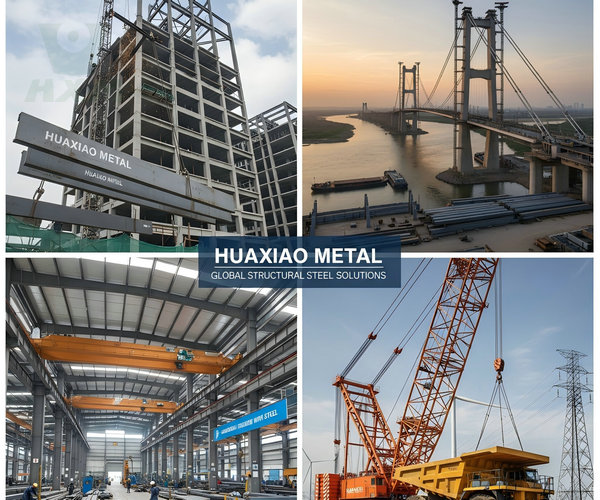
Application Scenarios and Huaxiao Metal's Typical Project Case Studies
Building Structural Frames and Industrial Plants
- Material Selection: Low-carbon structural steels such as Q235/A36.
- Example: Huaxiao Metal has provided plate and H-beam steel for numerous large-scale industrial plant projects in Southeast Asia, with customer feedback regarding convenient welding and timely delivery.
Bridges and High-Load Structures
- Material Selection: High-strength structural steels such as Q345/Q355 or S355, requiring stringent impact toughness (C/D grades).
- Example: We can provide customized plate materials, precise chemical composition control, full MTC and third-party inspections based on project requirements, for applications in viaducts and rail transit structures.
Heavy Machinery Frames and Towers
- Material Selection: Medium-carbon, high-quality steel (such as 45#) or high-strength low-alloy steel.
- Key Points: The steel must possess high strength, vibration resistance, and fatigue resistance. Huaxiao Metal’s technical team can assist customers with material selection and provide necessary processing and heat treatment recommendations.
Prefabricated Buildings and Modular Factories
- Key Points: Requires precise dimensions, weldability, and convenient processing.
- Services: Our panels/profiles support precision processing, cut-to-length, and punched delivery, effectively shortening on-site installation cycles.
Frequently Asked Questions (FAQ)
What is the difference between carbon structural steel and low-alloy structural steel?
Carbon structural steel primarily contains carbon as the alloying element, has a low degree of alloying, and is relatively low in cost. Low-alloy structural steel (such as HSLA) contains small amounts of alloying elements (copper, nickel, vanadium, niobium, etc.) to enhance strength, toughness, or corrosion resistance.
My project requires welding. Which grade should I choose?
If welding is frequent and deformation processing is extensive, low-carbon structural steel (such as Q235/A36) is recommended for its excellent weldability and high deformability.
I see grades such as "Q19" and "Q21." What do these mean?
hese are related to certain domestic standards or notational conventions. For example, “Q19” may indicate structural steel with a yield strength of 190 MPa. The approximate carbon content range has been mentioned in a blog post.
However, in actual procurement, it is recommended to confirm the steel’s chemical composition and mechanical properties with the manufacturer to avoid confusion.
Why can prices vary so significantly?
Factors influencing price include: steel grade (strength, alloy content), chemical composition, impurity control, standards/certifications, degree of processing customization, quantity, logistics destination, and shipping conditions. Huaxiao Metal can provide you with transparent quotes and clear specifications.
What specifically does "carbon-resistant structural steel" refer to?
If it refers to the “carbon structural steel” product itself (i.e., carbon steel for structural use), the material selection range is as described above. If it refers to resistance to “carbonization,” “carbon corrosion,” high temperature, or environmental damage, further details regarding the specific environment (e.g., high-temperature environments, hydrogen environments, marine environments) and any special steel treatments (e.g., weathering, galvanizing, spray coating, anti-carbonization coating, etc.) are required. Huaxiao Metal can provide customized recommendations based on project needs.
Which structural steel grade is strongest?
Q420 / S460 grades offer the highest strength among common structural steels.
What is the cheapest structural steel grade?
Q235 / A36 / S235 are the most cost-effective options.
Can structural steel be welded easily?
Yes, low and medium carbon structural steels have excellent weldability.
What is the difference between Q235 and Q345?
Q345 has higher strength and is used for more demanding structural applications.
In Conclusion
Structural steel is the foundation of project safety and service life. Selecting the right carbon structural steel grade and quality supplier is crucial to project success. As your reliable partner, Huaxiao Metal consistently adheres to the principles of “Quality First, Service First, and Customer Satisfaction,” providing reliable carbon structural steel products to customers worldwide. Let’s work together to build a solid foundation for your structural projects.
Contact us today for a quote and technical support.