In the world of machinery and manufacturing, choosing between AISI 1045 carbon steel and AISI 4140 alloy steel is a decision that impacts both the performance and the bottom line of your project. While both are widely used in the production of shafts, gears, and bolts, they belong to different “weight classes” in terms of mechanical properties.
As a leading supplier of industrial steel raw materials, Huaxiao Metal provides this in-depth technical comparison to help engineers and procurement managers make the most cost-effective decision.
The Fundamental Difference: Carbon vs. Alloy
The primary distinction lies in their chemical “DNA.”
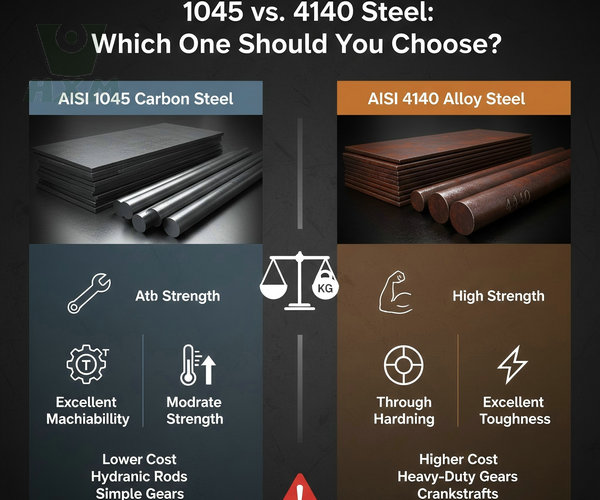
AISI 1045: This is a medium-carbon steel. It relies primarily on its 0.45% carbon content for strength. It contains no significant alloying elements, making it an economical, straightforward workhorse.
AISI 4140: This is a Chromium-Molybdenum (Chromoly) alloy steel. It contains Chromium (Cr) and Molybdenum (Mo), which act as “performance boosters.” These elements allow the steel to achieve much higher toughness and hardenability than plain carbon steel.
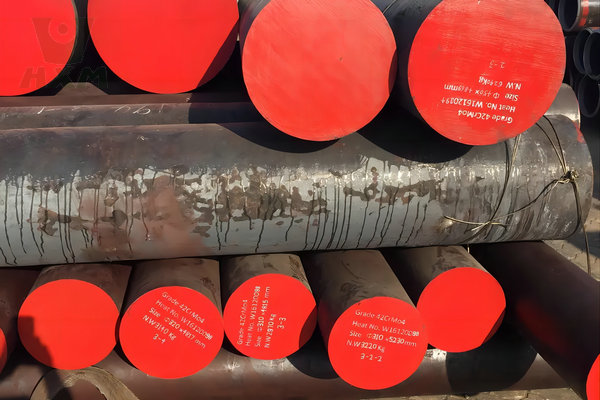
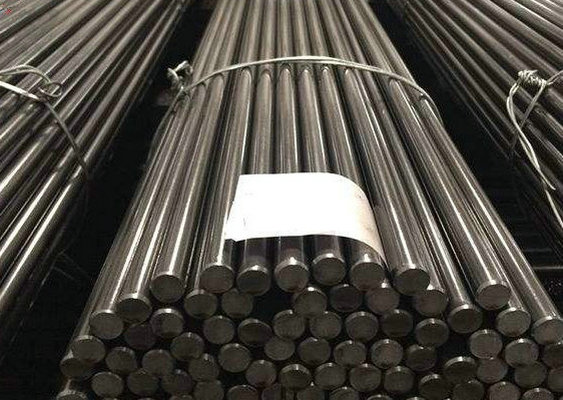
1045 vs 4140 Steel: Side-by-Side Comparison
| Property | 1045 Steel | 4140 Steel |
|---|---|---|
| Steel Type | Medium carbon steel | Alloy steel (Cr-Mo) |
| Carbon Content | ~0.45% | ~0.40% |
| Strength | Medium | High |
| Toughness | Moderate | Excellent |
| Machinability | Better | Lower than 1045 |
| Heat Treatment Response | Limited | Excellent |
| Cost | Lower | Higher |
| Typical Use | General machinery | High-load applications |
From a sourcing perspective:
1045 steel is easier to find in large volumes and offers faster lead times, while 4140 steel may require more precise specification and heat treatment control.
Hardenability: The "Thick Section" Problem
This is the most critical technical factor for engineers.
1045 Steel has low hardenability. When you quench a 1045 bar, only the outer shell gets hard. The core remains relatively soft. This is perfect for parts like hydraulic rods where you want a hard surface but a ductile core.
4140 Steel has high hardenability. The Chromium and Molybdenum allow the entire cross-section (even in large diameters) to achieve uniform hardness. If you are manufacturing a thick, heavy-duty gear, 4140 is the only reliable choice.
Machinability and Weldability
Machinability
1045 Steel: Known for its excellent machinability (approx. 70% of 1212 steel). It achieves a superior surface finish and is easier on cutting tools.
4140 Steel: While still machinable (approx. 65%), it is tougher on tools because of its alloy content. However, it provides very stable dimensions after machining.
Weldability
Both grades require caution. Because of their carbon levels, both are prone to cracking if welded cold.
Pre-heat is mandatory: 1045 requires 200°C–300°C, while 4140 often requires higher pre-heat and post-weld stress relief to maintain its alloy properties.
Cost Comparison: 1045 vs 4140 Steel
Material cost is one of the biggest differences.
1045 steel → Lower raw material and processing cost
4140 steel → Higher cost due to alloying elements and heat treatment
💡 Buyer tip:
If your design does not explicitly require alloy steel performance, choosing 4140 may lead to unnecessary cost increases.
Global Equivalents: Sourcing 1045 and 4140 Internationally
Navigating international standards is key for global procurement. At Huaxiao Metal, we ensure our materials meet or exceed the following equivalent standards:
| Region | Standard | 1045 Equivalent | 4140 Equivalent |
| USA | ASTM / AISI | 1045 | 4140 |
| Europe | EN / DIN | 1.1191 / C45E | 1.7225 / 42CrMo4 |
| Japan | JIS | S45C | SCM440 |
| China | GB | 45# | 42CrMo |
| UK | BS | EN8 | EN19 |
The Impact of Processing: Cold Drawn vs. Hot Rolled
It’s not just about the grade; it’s about the condition.
Cold Drawn (CD) 1045: Provides higher yield strength and tighter tolerances (h9, h11), ideal for precision machining of small parts.
Hot Rolled (HR) 4140: Often preferred for large-diameter shafts where the bar will be Quenched & Tempered (Q&T) later.
Pro Tip: If your design requires high fatigue resistance (e.g., a part spinning at 3000 RPM), 1045 in any condition will fail much sooner than 4140 due to the latter’s Chromium-Molybdenum structure.
Application Scenarios: Where to Use Which?
When to Choose AISI 1045 (The Cost-Effective Choice):
Hydraulic Shafts & Rods: Where surface hardness is more important than core strength.
General Purpose Bolts: When high tensile strength (above Grade 8.8) is not required.
Simple Gears: For light-duty machinery.
Axles: For agricultural equipment where cost-per-unit is a major factor.
When to Choose AISI 4140 (The High-Performance Choice):
Heavy Duty Gears & Pinions: Where the part faces extreme torque and shock loads.
Crankshafts: In high-performance engines.
Oil & Gas Components: Like drill collars where high fatigue resistance is required.
High-Strength Fasteners: Grade 10.9 or 12.9 bolts.
FAQ: 1045 vs 4140 Steel
Is 4140 always "better" than 1045?
“Better” depends on the application. 4140 has better mechanical properties, but it is roughly 1.5 to 2 times more expensive than 1045. If 1045 can meet your load requirements, using 4140 is an unnecessary expense.
Can I replace 4140 with 1045 to save costs?
Only if the part is thin or the load is light. For thick sections (over 50mm), 1045 cannot match the core strength of 4140. Always consult an engineer before downgrading materials.
Which one is more readily available in plates and bars?
Both are staple products at Huaxiao Metal. However, 1045 is more common in a wider variety of formats (like narrow strips and wire rods), while 4140 is predominantly sold as round bars and heavy plates.
Does 4140 rust slower than 1045?
No. Despite the Chromium content, 4140 is not stainless steel. Both will rust if not properly coated or oiled.
Which steel has better fatigue life for repetitive stress?
4140 wins significantly. The Chromium-Molybdenum alloy creates a refined grain structure that resists micro-cracking far better than the plain carbon structure of 1045, making it the standard for crankshafts and aircraft landing gears.
Can 1045 replace 4140 in high-temperature environments?
No. 4140 contains Molybdenum, which significantly improves “creep strength” (resistance to deformation at high temperatures). 1045 will lose its strength rapidly above 300°C, whereas 4140 can maintain its integrity at much higher thermal loads.
Do you provide Ultrasonic Testing (UT) for 4140 plates?
Yes. At Huaxiao Metal, all our 4140 alloy steel plates and heavy bars undergo UT testing to Class C/c or D/d standards to ensure there are no internal cracks or inclusions, a critical step that many standard traders skip.
Which steel is better for heat treatment?
4140 steel has a much better response to quenching and tempering.
Sourcing Strategies for 1045 and 4140
When importing from China, the key is verifying the Heat Treatment Condition.
Verify the MTC: Ensure the Mill Test Certificate clearly states whether the material is Annealed, Normalized, or Quenched & Tempered (Q&T).
Tolerance Matters: For 1045 bars, cold-drawn (h9) is standard for CNC work. For 4140, hot-rolled and peeled is more common for large diameters.
Bundle Your Orders: Since Huaxiao Metal stocks both, bundling 1045 and 4140 in the same container can significantly reduce your logistics costs.
Buyer’s Resource: For more tips on sourcing carbon steel, check our Carbon Steel Products Page.
Conclusion: Making the Final Call
If your priority is cost-efficiency and ease of machining for standard parts, AISI 1045 is the king of the shop floor. But if your project demands high fatigue strength, uniform hardness, and extreme durability, the investment in AISI 4140 is mandatory.