In the world of metalworking and knife manufacturing, 1095 vs 1075 steel are two of the most popular high-carbon steels used globally. While they belong to the same category of high-carbon steel, they have distinct differences in carbon content, hardness, toughness, and applications. Understanding these differences is crucial for choosing the right material for knives, tools, and industrial applications.
At Huaxiao Metal, we supply both 1095 and 1075 steel with premium quality for industrial, knife, and tool manufacturing purposes.
In this guide, Huaxiao Metal explains:
Chemical composition differences
Hardness and heat treatment behavior
Mechanical performance comparison
Application suitability
Industrial purchasing considerations
What is 1095 Carbon Steel?
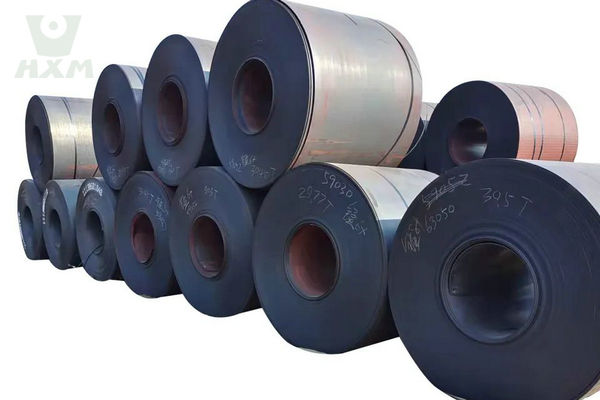
1095 steel is a high carbon steel containing approximately 0.95% carbon. It is renowned for its excellent hardness and ability to hold an edge and is often used in the manufacture of high-performance knives and tools.
Key Features of 1095 Steel:
- High carbon content: ~0.95%
- Excellent hardness and wear resistance
- Moderate toughness (more brittle than lower carbon steels)
- Suitable for heat treatment to reach HRC 58–65
Looking for 1095 steel suppliers or manufacturers? Get a quote from Huaxiao Metal today
What is 1075 Carbon Steel?
1075 steel contains about 0.75% carbon and is slightly less hard than 1095, but still has good strength and toughness, making it suitable for applications that require a certain degree of flexibility.
Key Features of 1075 Steel:
- Carbon content: ~0.75%
- Higher toughness than 1095
- Good hardness after heat treatment (HRC 50–58)
- Easier to weld and machine
Check 1075 steel manufacturers or request 1075 steel price today.
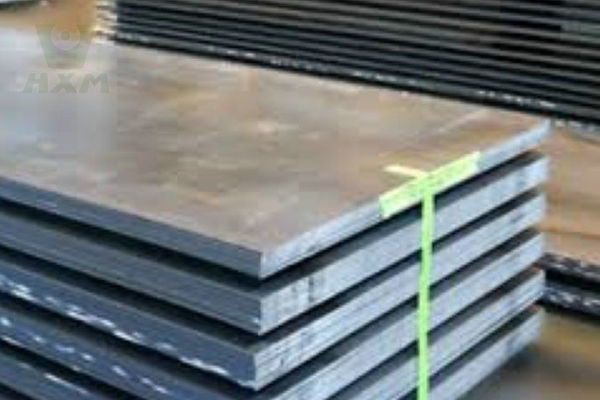
What is the Difference Between 1095 vs 1075 Steel?
The primary difference between 1075 and 1095 carbon steel lies in their carbon content, which significantly impacts their hardness, toughness, and overall suitability for various applications. Here’s a detailed comparison:
Chemical Compositions of 1095 vs 1075 Steel
Element | 1095 Steel | 1075 Steel |
|---|---|---|
C | 0.95% | 0.75% |
Mn | 0.30% – 0.50% | 0.60% – 0.90% |
P | ≤0.04% | ≤0.04% |
S | ≤0.05% | ≤0.05% |
1095 steel: High carbon content increases hardness but reduces ductility.
1075 steel: Slightly lower carbon gives better toughness and easier heat treatment.
The higher carbon content in 1095 steel increases hardness but also increases brittleness compared to 1075.
1095 and 1075 Steel Equivalent Grades
| Carbon Steel | AISI / SAE | DIN | EN | JIS | GB |
|---|---|---|---|---|---|
| 1095 | 1095 | C75 | 10270-1 C95 | SK95 | 1095 |
| 1075 | 1075 | C70 | 10270-1 C75 | SK75 | 1075 |
Performance Comparison of 1095 vs 1075 Steel
Wear Resistance:
1095 steel: Due to its high carbon content, it has excellent wear resistance and is suitable for cutting tools and other high-wear environments.
1075 steel: It has relatively low wear resistance, but in some applications, its toughness makes it more resistant to impact.
Processability:
1095 steel: It is difficult to process, and the heat treatment process requires precise control to prevent the material from being too hard or brittle.
1075 steel: It is relatively easy to process and is suitable for a variety of forming and heat treatment methods.
Hardness and Sharpness: The Absolute Advantage of 1095
Due to its higher carbon content, 1095 steel develops a more martensitic structure after quenching and low-temperature tempering, achieving a higher hardness (typically 2-4 HRC higher than 1075).
1095 Steel: Strives for extreme hardness and excellent edge retention (how long it maintains its sharpness). It is well-suited for knives requiring a fine edge, such as high-performance kitchen knives, carving knives, and surgical tools.
1075 Steel: Its good hardness (reaching 58-60 HRC) makes it suitable for most moderate cutting tasks, but its edge retention is slightly inferior to 1095.
Toughness and Impact Resistance: The Safety Guarantee of 1075
Toughness, or the material’s ability to resist fracture, is key to a high-carbon steel’s ability to survive impact.
1075 Steel: Due to its low carbon content, residual stress is relatively low, resulting in exceptionally high toughness. 1075 steel blades or tools are less prone to chipping or breaking when used for high-impact tasks like chopping and chiseling. Therefore, it’s a preferred choice for survival knives, machetes, and spring steel blades.
1095 steel: High hardness, but lower toughness. 1095 steel blades are more susceptible to chipping when subjected to lateral stress or severe impact, especially when its hardness is pushed to its limits.
Corrosion Resistance and Grindability
Both steels are common high-carbon steels with poor corrosion resistance, requiring strict rust prevention. Regarding grinding:
1095 steel: Despite its high hardness, its relatively pure carbon steel structure makes it easier to grind than alloy steels, quickly developing a sharp edge.
1075 steel: Its slightly lower hardness makes it slightly easier to grind, making it more user-friendly for beginners.
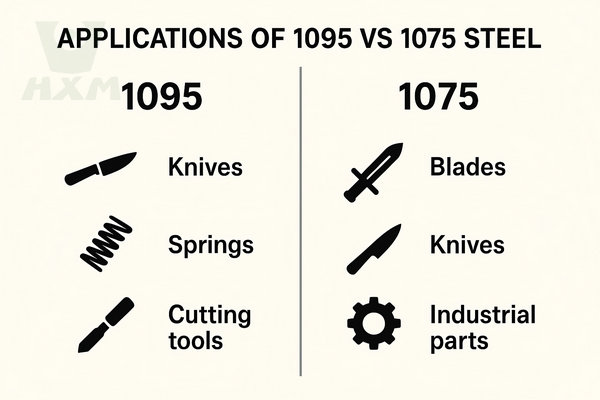
Applications of 1095 vs 1075 Steel
Choose 1095 Carbon Steel:
High-performance knives, outdoor tools, and razors.
Cutting tools for military and industrial use.
Choose 1075 Spring Steel:
Suitable for knives, swords, tools, and small mechanical parts.
Suitable for applications requiring a certain strength and toughness.
Price Difference: Is 1095 More Expensive Than 1075?
Generally, 1095 steel is slightly more expensive than 1075 steel due to its higher carbon content and performance level.
1095 steel: Usually more expensive due to its high carbon content and the complex heat treatment process required, suitable for the high-end market.
1075 steel: Lower cost, suitable for mass production and cost-sensitive applications, with high-cost performance.
The specific price is affected by the market, quantity, etc., and the prices given by different carbon steel manufacturers are also different. Please contact us for the most accurate price.
Welding Performance of 1095 vs 1075 Steel
1095 steel: Poor weldability, because its high carbon content is prone to brittleness during welding, so special welding technology and preheating measures are required.
1075 steel: Relatively good weldability, suitable for conventional welding methods. Its toughness makes it more able to withstand stress after welding and reduces the risk of cracks.
Toughness and Impact Resistance
1075 Steel:
Higher manganese content enhances toughness.
Suitable for outdoor knives, tactical knives, and spring applications.
Can endure impacts and stress better than 1095 steel.
1095 Steel:
Harder and sharper but less resilient.
Prone to cracking under heavy stress or impact.
Heat Treatment and Machinability
1095 Steel:
Requires precise heat treatment to prevent brittleness.
Carbon content may lead to carbide formation and micro-cracking if not properly quenched.
Machining requires high-quality tools and experience.
- 👉 Explore Technical Specs: 1095 Carbon Steel Properties
1075 Steel:
More forgiving during heat treatment.
Easier to achieve uniform martensitic structure with fewer risks of cracking.
Suitable for beginner and intermediate knife makers.
- 👉 Order Now: Premium 1075 Spring Steel Sheets & Coils
Price & Suppliers Guide
Price Range: Depends on quantity, form (sheet, bar, or coil), and supplier. Generally, 1095 steel is slightly more expensive than 1075 due to higher carbon content.
Suppliers & Manufacturers: Huaxiao Metal is a leading 1095 & 1075 steel supplier in China, providing global shipping and competitive prices.
Is 1095 Carbon Steel better than 1075 Carbon Steel?
1095 steel and 1075 steel each have their characteristics and are suitable for different application needs.
1095 steel has excellent hardness and wear resistance due to its high carbon content, making it the best choice for high-performance knives and cutting tools.
On the other hand, 1075 steel excels in toughness and weldability, making it more suitable for applications that require impact or welding.
Choosing the right material should be based on specific usage scenarios and requirements to ensure the best performance and results. Whether it is a knife that pursues sharpness or a tool that requires durability, understanding the characteristics of these two steels will help you make the right decision.
At Huaxiao Metal, we supply both 1075 and 1095 steel in sheet, coil, plate, strip, and customized sizes for global buyers.
Why choose Huaxiao Metal's 1095/1075 high-carbon steel?
Choosing high-carbon steel isn’t just about choosing a grade; it’s also about choosing the material’s stability and the supplier’s expertise. Huaxiao Metal isn’t just a high-carbon steel supplier; we’re your material solutions partner.
Strict Chemical Composition Control
Every batch of 1095 and 1075 steel supplied by Huaxiao Metal undergoes spectral analysis and chemical composition retesting. We ensure that the concentrations of key elements such as carbon, manganese, phosphorus, and sulfur fall precisely within standard narrow limits, eliminating heat treatment failures or performance deviations caused by unstable composition. This ensures your products are internationally competitive from the start.
Professional Customization Services
Whether you require 1095 steel in specific thickness, width, coil, or plate, or require customized 1075 steel with modified hardenability, Huaxiao Metal offers professional-level custom rolling and pre-heat treatment preparation services. We understand the individual needs of each customer for their “heat treatment window” and provide expert material recommendations to maximize your production efficiency.
Quality System Certification and Traceability
As a leading metal supplier in the industry, all our products comply with ISO 9001 and other quality system certification standards. Each coil of steel comes with a complete quality traceability report, allowing you to fully verify every kilogram of steel you purchase.
Huaxiao Metal promises: We provide not just ordinary steel, but stable, predictable, and high-quality raw materials that add value to your products.
FAQ – 1095 vs 1075 Steel
What is the main difference between 1095 steel and 1075 steel?
The main difference lies in carbon content. 1095 steel contains 0.90%-1.03% carbon, while 1075 steel contains 0.70%-0.80%. This results in 1095 steel being harder, making it suitable for applications where a sharp edge must be retained; while 1075 steel is tougher and better suited for applications that withstand impact.
Which steel is better for knives?
For sharp, long-lasting edges → 1095.
For durability and impact resistance → 1075.
Which steel is more suitable for beginners?
1075 steel is more suitable for beginners due to its better machinability and heat treatment tolerance.
Do 1095 steel knives require special care?
Yes, 1095 steel knives require regular sharpening and rust protection to maintain their excellent performance.
Do 1075 steel knives rust easily?
1075 steel knives rust relatively easily and require regular cleaning and application of rust-proofing oil.
Is 1095 steel more susceptible to rust than 1075 steel?
Yes. Both are high-carbon steels with poor corrosion resistance. However, due to 1095’s higher carbon content, it may contain more carbides in its microstructure, making it generally slightly more susceptible to corrosion than 1075 in humid environments. Both 1095 and 1075 require appropriate coatings, surface treatments (such as bluing), or rigorous routine maintenance on finished knives or tools.
When should you choose 1075 over 1095 in knife manufacturing?
1075 should be chosen when your product is primarily intended for heavy-duty applications and needs to withstand impact or lateral loads. Examples include survival tools, large cleavers, or tools with strict thickness restrictions but requiring resistance to bending. 1075 trades a slight trade-off in edge retention for greater toughness (fracture resistance).
How does Huaxiao Metal ensure the consistent quality of 1095/1075 steel?
Huaxiao Metal ensures consistent quality through the following three core steps:
Metallurgical Control: Advanced metallurgical techniques are used to ensure that key elements (such as carbon) remain within extremely narrow tolerances.
Rolling Consistency: Strict control of rolling temperature and speed ensures a uniform grain structure and extremely tight dimensional tolerances.
Batch Testing: Each batch of steel undergoes hardness, chemical composition, and ultrasonic testing before shipment to ensure highly consistent performance from roll to roll.
Is there a significant price difference between 1095 and 1075 steel?
The basic cost difference is generally small. Pricing depends primarily on the specifications, thickness tolerance, surface quality, and order volume. Because 1095 steel requires slightly higher heat treatment and quality control, custom 1095 steel may cost slightly more than the same 1075 steel. Please feel free to contact the Huaxiao Metal sales team for an up-to-date, accurate quote tailored to your needs.
Who are reliable suppliers or manufacturers?
Huaxiao Metal is a trusted steel supplier and manufacturer with global shipping. Contact us for a quote.
In Conclusion:
Choosing the right material and supplier for your specific needs is crucial. 1095 and 1075 steel each have their advantages, and the decision about whether to choose 1095 or 1075 depends on your specific application:
1095 Steel: Best for high-hardness, sharp-edge knives that require excellent wear resistance. Suitable for kitchen knives and precision cutting tools.
1075 Steel: Best for impact-resistant applications like outdoor knives, tactical tools, and springs. Easier to forge and heat-treat.
At Huaxiao Metal, we supply premium 1095 and 1075 steel with guaranteed quality. Whether you need sheets, bars, or custom-cut steel, we can meet your requirements.
Contact Huaxiao Metal today to inquire about pricing or request a quote for 1095 or 1075 steel. Our experts are ready to provide guidance tailored to your project.