When selecting carbon steel for industrial manufacturing or tooling applications, 1060 steel and 1080 steel are two commonly used high-carbon steel grades. Both belong to the AISI carbon steel series and offer excellent hardness and heat-treating capabilities.
However, the difference in carbon content, hardness, toughness, and wear resistance means that each grade is better suited for different applications.
Understanding the differences between 1060 vs 1080 steel helps engineers, manufacturers, and purchasing managers choose the most suitable material for their production needs.
In this guide, we compare these two steel grades in terms of:
Chemical composition
Mechanical properties
Heat treatment behavior
Applications
Purchasing considerations
What is 1060 Steel?

1060 steel is a medium-high carbon steel containing approximately 0.55–0.66% carbon. This carbon level allows the material to achieve good hardness after heat treatment while still maintaining reasonable toughness.
Because of this balanced performance, 1060 steel is widely used in industrial machinery and mechanical components.
What Is 1080 Steel?
1080 steel is a high carbon steel containing around 0.75–0.88% carbon. This higher carbon content allows it to achieve greater hardness and edge retention compared with 1060 steel.
However, increased hardness usually comes with reduced toughness and ductility.
Quick Comparison Table: 1060 vs 1080 Steel
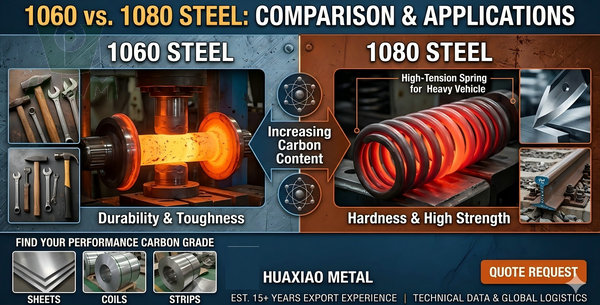
Before diving deeper, here is a quick comparison.
| Property | 1060 Steel | 1080 Steel |
|---|---|---|
| Carbon Content | ~0.60% | ~0.80% |
| Hardness | High | Very High |
| Toughness | Better | Lower |
| Wear Resistance | Good | Excellent |
| Typical Applications | Springs, shafts, machinery | Blades, cutting tools |
Key takeaway
1060 steel offers a better balance between strength and toughness.
1080 steel provides higher hardness and wear resistance.
1060 vs 1080 Steel: Chemical Composition
The main difference between the two steels lies in their carbon content.
| Element | 1060 Steel | 1080 Steel |
|---|---|---|
| Carbon (C) | 0.55–0.66% | 0.75–0.88% |
| Manganese (Mn) | 0.60–0.90% | 0.60–0.90% |
| Phosphorus (P) | ≤0.040% | ≤0.040% |
| Sulfur (S) | ≤0.050% | ≤0.050% |
Key Insight
Higher carbon content generally results in:
higher hardness
greater wear resistance
lower ductility
This explains why 1080 steel is harder, while 1060 steel is tougher.
Mechanical Properties Comparison
The mechanical performance of these steels varies depending on heat treatment conditions.
| Property | 1060 Steel | 1080 Steel |
|---|---|---|
| Tensile Strength | 620–800 MPa | 750–900 MPa |
| Hardness (HB) | 170–250 | 200–300 |
| Toughness | Higher | Lower |
| Wear Resistance | Good | Excellent |
Summary
1080 steel provides superior hardness and wear resistance.
1060 steel offers better resistance to impact and mechanical stress.
Heat Treatment Differences
Both steels respond well to heat treatment, but their results differ due to carbon levels.
Heat Treatment of 1060 Steel
Typical process:
Austenitizing temperature: 820–860°C
Quenching medium: water or oil
Tempering temperature: 400–650°C
After proper heat treatment, 1060 steel achieves a balanced combination of hardness and toughness.
Heat Treatment of 1080 Steel
Typical process:
Austenitizing temperature: 800–830°C
Quenching medium: oil
Tempering temperature: 150–350°C
This process produces very high hardness, making the steel ideal for cutting tools.
Machinability and Weldability
Generally, as carbon content increases, weldability and machinability decrease.
1060 steel is easier to machine and form in its annealed state.
1080 steel requires more precise temperature control during heat treatment to avoid quenching cracks.
Hardness and Wear Resistance
1080 steel is a “high-carbon” grade that excels in hardness. After heat treatment, it achieves a significantly higher Rockwell hardness than 1060. If your application involves high-friction environments or requires a sharp, lasting edge (such as industrial blades or heavy-duty springs), 1080 is the superior choice.
Corrosion Resistance
Both 1060 steel and 1080 steel are plain carbon steels, meaning they do not contain chromium or nickel.
As a result, they do not offer natural corrosion resistance.
To prevent rust, manufacturers commonly apply protective treatments such as:
oil coating
painting
electroplating
powder coating
Proper storage and maintenance can significantly extend service life.
Applications of 1060 vs 1080 Steel
Because of their different properties, these steels are used in different industries.
Applications of 1060 Steel
1060 steel is widely used for components requiring strength and toughness.
Typical applications include:
springs
shafts
agricultural tools
machine components
industrial hardware
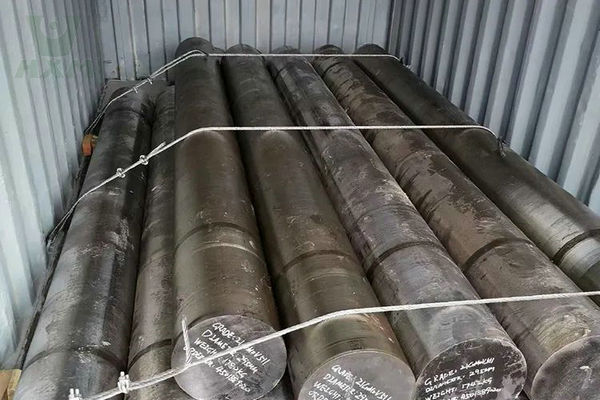
Many manufacturers prefer 1060 carbon steel bars for machining parts.
Applications of 1080 Steel
Because of its higher hardness, 1080 steel is more suitable for high-wear tools.
Common uses include:
cutting tools
blades and knives
high-wear mechanical parts
industrial springs
How to Choose Between 1060 and 1080 Steel
Choosing the right steel grade depends on the requirements of your project.
Choose 1060 steel if you need
Better toughness
Higher impact resistance
Machinery components
Mechanical parts and springs
Choose 1080 steel if you need
Higher hardness
Better edge retention
Cutting tools or blades
Maximum wear resistance
For many industrial manufacturing applications, 1060 steel is often the preferred option due to its balanced mechanical performance.
Request a Quote for 1060 or 1080 Steel
Selecting the right carbon steel is essential for ensuring product quality and manufacturing efficiency.
Huaxiao Metal supplies a wide range of 1060 steel and 1080 steel materials, including:
steel bars
steel plates
steel sheets
Our advantages include:
custom sizes and specifications
stable global supply
competitive manufacturer pricing
fast delivery for bulk orders
If you are looking for reliable 1060 steel or 1080 steel suppliers, our team is ready to assist with your project.
Why Source from Huaxiao Metal?
Choosing the right material is only half the battle; the other half is ensuring consistent quality and reliable delivery.
Expertise in Standards: We provide full chemical and mechanical property reports according to ASTM, EN, and AISI standards.
Global Logistics: With 15+ years of experience, we specialize in high-standard exports to Europe and competitive shipping solutions for South America.
Matrix Inventory: We maintain a robust supply of both 1060 steel and 1080 steel in various forms, including sheets, coils, and strips.
FAQ: 1060 vs 1080 Steel
Is 1080 steel harder than 1060 steel?
Yes. Because 1080 steel contains more carbon, it can achieve higher hardness after heat treatment.
Which grade is better for industrial springs?
1080 steel is the industry standard for high-performance springs. Its high carbon content provides the necessary elastic limit and fatigue resistance required for coil and leaf springs. While 1060 can be used for light-duty springs, 1080 offers superior longevity under repeated stress.
How does the price of 1060 compare to 1080 steel?
The base material cost is often similar, but 1080 steel may carry a slight premium due to its more intensive processing requirements and higher demand in specialized tool manufacturing. At Huaxiao Metal, we leverage our 15+ years of export experience to provide competitive tier-pricing for both grades in the South American and European markets.
Which steel is better for cutting tools?
1080 steel is generally better for cutting tools because it provides higher hardness and edge retention.
Is 1060 steel easier to machine?
Yes. Compared with 1080 steel, 1060 steel has slightly better machinability.
Is 1080 steel stronger than 1060 steel?
Yes, in terms of tensile strength and hardness. 1080 steel contains more carbon (approx. 0.80%), which allows it to reach higher hardness levels after heat treatment compared to 1060 steel (approx. 0.60%). However, 1060 steel is generally “tougher” and less prone to brittle fracture under sudden impact.
Can 1060 and 1080 steel be welded?
Both grades are weldable but require pre-heating and post-weld heat treatment (PWHT). Due to the higher carbon content, 1080 steel is more susceptible to “cold cracking” in the heat-affected zone (HAZ) than 1060. For structural welding, 1060 is often preferred for its slightly better weldability.
Are these steels corrosion-resistant?
No. Both 1060 and 1080 are plain carbon steels and will rust if exposed to moisture or corrosive environments. We recommend a protective coating, oiling, or plating for international sea freight.
Conclusion: 1060 vs 1080 Steel
Both 1060 steel and 1080 steel are excellent carbon steels with strong heat-treating capability.
The main difference lies in their carbon content, which directly affects hardness, toughness, and wear resistance.
1060 steel offers a balanced combination of strength and toughness, making it suitable for mechanical components and springs.
1080 steel provides higher hardness and wear resistance, making it ideal for cutting tools and high-wear applications.
Understanding these differences helps engineers and buyers select the most suitable steel for their manufacturing needs.