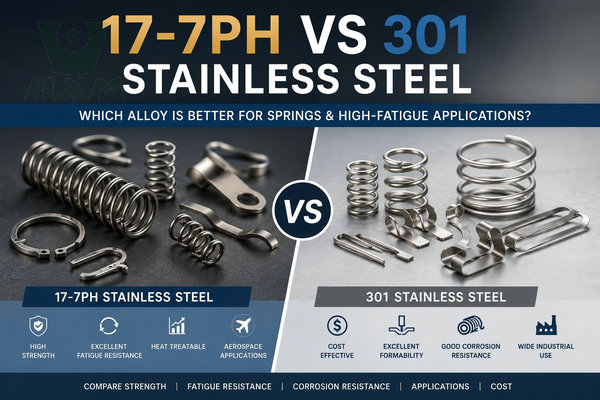
When selecting stainless steel for springs, retaining rings, diaphragms, and precision components, engineers often compare 17-7PH (AISI 631) and 301 stainless steel.
While both alloys provide reliable corrosion resistance for spring applications, they differ significantly in yield strength, fatigue life, heat treatment response, and high-temperature stability. Choosing the wrong material can lead to premature spring failure or unnecessary costs.
In this guide, we provide a deep-dive technical comparison of 17-7PH vs 301 stainless steel to help you determine which high-strength alloy meets your specific engineering requirements.”
17-7PH vs 301 Stainless Steel: Technical Comparison Table
| Feature | 301 Stainless Steel | 17-7PH (AISI 631) | Why it Matters |
|---|---|---|---|
| Material Type | Austenitic Stainless Steel | Precipitation Hardening | 17-7PH belongs to a higher grade of precipitation hardening steel. |
| UNS Number | S30100 | S17700 | To facilitate engineers in verifying standard numbers |
| Hardening Method | Cold Work (Work Hardening) | Heat Treatment (Precipitation) | 17-7PH achieves its final strength through heat treatment. |
| Heat Treatable | No | Yes (Condition A, C, RH, TH) | 17-7PH heat treatment results in greater dimensional stability. |
| Strength Level | Moderate to High | Very High (Condition CH900) | 17-7PH has a higher upper limit for yield strength. |
| Fatigue Resistance | Good | Excellent (Superior) | 17-7PH has a longer lifespan under cyclic loading. |
| Spring Performance | Standard | Superior (High Precision) | The 17-7PH model offers more precise rebound and more reliable performance. |
| Max Service Temp | Up to 550°F (287°C) | Up to 600°F+ (315°C+) | 17-7PH is more suitable for high-temperature environments such as aviation. |
| Formability | Excellent (in soft states) | Superior (in Condition A) | 17-7PH is easier to process into complex shapes before hardening. |
| Cost & Value | Lower (More Economical) | Higher Performance/Cost | 301 has low cost, while 17-7PH has high value. |
One of the biggest advantages of 17-7PH is that it can be formed in a relatively soft state (Condition A) and then hardened. This eliminates the massive ‘spring-back’ issues common with Full Hard 301, allowing for much tighter tolerances in complex precision stampings.
What Is 17-7PH (AISI 631) Stainless Steel?
Unlike standard alloys, 17-7PH offers superior dimensional stability and elastic recovery, making it the industry standard for:
- Aerospace springs and retaining rings.
- Precision diaphragms and aircraft components.
- High-cycle industrial fasteners.
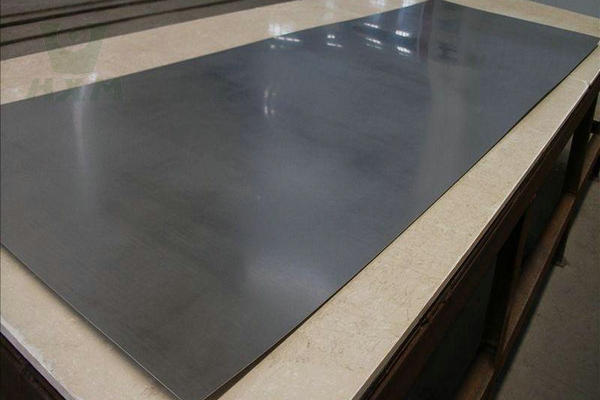
What Is 301 (UNS S30100) Stainless Steel?
In contrast, Type 301 is an austenitic stainless steel that gains its strength exclusively through cold-work hardening. It is a versatile and cost-effective material that provides reliable spring properties at room temperature.
While 301 lacks the extreme heat resistance of 17-7PH, it is highly valued for its excellent formability in standard industrial applications, such as:
Standard clips, brackets, and stampings.
General-purpose industrial springs.
Automotive trim and consumer hardware.
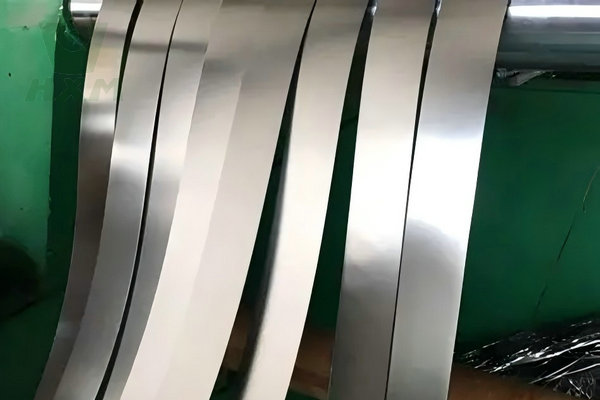
Explore our 301 Stainless Steel Sheet, Strip, and Coil solutions here
17-7PH vs 301 Stainless Steel: In-Depth Property Comparison
Strength Comparison
17-7PH (AISI 631): After aging heat treatment, it achieves extremely high tensile and yield strength (up to 260 ksi). It is ideal for aerospace spring systems, high-load retaining rings, and environments requiring superior elastic recovery.
- 301 Stainless Steel: Strength is increased solely through cold rolling. While “Full Hard” 301 performs well in many applications, it generally cannot match the ultra-high strength of properly heat-treated 17-7PH.
Fatigue Resistance Comparison
17-7PH Stainless Steel: Specifically designed for high-cycle fatigue. It resists micro-cracking and “set” (permanent deformation) under repeated loading, making it the standard for precision diaphragms and aircraft components.
- 301 Stainless Steel: Provides reliable performance for standard industrial springs and consumer products. However, under high stress, 17-7PH offers a much longer service life.
Heat Treatment & Dimensional Stability
17-7PH Stainless Steel: It is heat-treatable (Precipitation Hardening). Engineers can form complex parts in the soft Condition A, then harden them (TH1050, RH950, or CH900). This process ensures excellent dimensional stability and minimizes “spring-back” issues.
- 301 Stainless Steel: Not precipitation hardenable. Its properties are fixed by the level of cold rolling. Once formed, its mechanical properties cannot be further adjusted.
Formability Comparison
| Application | Better Choice |
|---|---|
| Deep Drawing | 301 (Annealed) |
| Complex Stamping | 301 (Lower Tempers) |
| Precision Spring Forming | 17-7PH (Condition A) |
| High Elastic Recovery | 17-7PH (Heat Treated) |
301 is more economical for simpler shapes, while 17-7PH allows for high-precision forming of complex parts before hardening.
Temperature & Corrosion Resistance
Max Temperature: 301 relaxes and loses tension above 500°F (260°C). 17-7PH maintains its spring force up to 600°F (315°C).
- Corrosion: Both offer good resistance in atmospheric environments. However, 17-7PH is preferred for demanding industrial and aerospace environments due to its AMS specification compliance.
Cost Comparison
| Material | Relative Cost |
|---|---|
| 301 Stainless Steel | Lower |
| 17-7PH Stainless Steel | Higher |
301 is often chosen for:
- Cost-sensitive projects
- Large-volume production
- General industrial use
17-7PH is usually selected when performance requirements justify the higher material cost.
Typical Application Comparison
| Application | Recommended Material |
|---|---|
| Aerospace Springs | 17-7PH |
| Retaining Rings | 17-7PH |
| Precision Diaphragms | 17-7PH |
| Standard Industrial Springs | 301 |
| Consumer Product Springs | 301 |
| General Stampings | 301 |
| High-Fatigue Components | 17-7PH |
Which Stainless Steel Is Better for Springs?
The answer depends on the application.
Choose 17-7PH Stainless Steel If You Need:
- High fatigue resistance
- Aerospace-grade performance
- Superior spring recovery
- High strength after heat treatment
- Precision spring applications
Choose 301 Stainless Steel If You Need:
- Lower material cost
- Excellent formability
- General-purpose spring performance
- Easier fabrication
- Large-volume production
At Huaxiao Metal, with 15+ years of export experience, we help engineers select the right grade for their specific application. Whether you need the cost-efficiency of 301 or the aerospace-grade performance of 17-7PH, contact our technical team for a quote.
Why More Engineers Upgrade from 301 to 17-7PH
As industrial equipment becomes:
- Lighter
- Faster
- More precise
- More fatigue-sensitive
Many manufacturers are upgrading from standard spring stainless steels like 301 to high-performance alloys such as 17-7PH.
The improved:
- Fatigue resistance
- Elastic recovery
- Mechanical stability
can significantly improve long-term component reliability.
Huaxiao Metal: Professional 17-7PH Stainless Steel Supplier
Huaxiao Metal supplies:
- 17-7PH stainless steel sheet
- Precision strip
- Coil
- Foil
for aerospace, spring manufacturing, and precision engineering applications.
We support:
- Custom sizes
- Precision slitting
- AMS / ASTM standards
- Export packaging
- Fast quotation service
FAQ about 17-7PH vs 301 Stainless Steel
Can 17-7PH replace 301 for springs?
Yes, it is a superior upgrade. While more expensive, it offers better fatigue life and easier forming in its annealed state.
Can 301 stainless steel achieve the same strength as 17-7PH?
In short, no. While 301 can reach high tensile strength through heavy cold working (e.g., Full Hard or Extra Hard tempers), 17-7PH achieves significantly higher strength and hardness through precipitation hardening (heat treatment). Furthermore, 17-7PH maintains better ductility and toughness at these high strength levels compared to 301.
Which material is better for complex spring designs?
17-7PH is superior for complex forming. 301 gains strength before you form it, making it “springy” and difficult to bend without cracking or spring-back issues. 17-7PH can be formed in its annealed state (Condition A), which is relatively soft, and then heat-treated to its final spring temper, allowing for much more intricate geometries.
Is 17-7PH more corrosion-resistant than 301?
Yes. 17-7PH generally offers superior corrosion resistance in a wider range of environments, especially in its hardened condition. While 301 is excellent for general atmospheric conditions, 17-7PH is the preferred choice for aerospace and chemical processing environments where stress-corrosion cracking resistance is critical.
How do the magnetic properties differ between the two?
Both grades are primarily non-magnetic in the annealed state. However:
301 becomes magnetic through cold working.
17-7PH becomes strongly magnetic through heat treatment (transformation to martensite). If your application requires a strictly non-magnetic high-strength material, you may need to consider other alloys like Nitronic series or specialized titanium grades.
Why is 17-7PH more expensive than 301?
The price difference is driven by alloying elements and manufacturing complexity. 17-7PH contains Aluminum (Al) for precipitation hardening and requires more precise metallurgical control. Additionally, 17-7PH is often produced to much stricter aerospace (AMS) standards compared to the commercial-grade 301.
Can I weld 17-7PH and 301?
Both are weldable, but 17-7PH is more complex. Because it is a precipitation-hardening steel, welding 17-7PH requires post-weld heat treatment to restore the strength in the Heat Affected Zone (HAZ). 301 is easier to weld, but the welding process will anneal the material at the joint, significantly reducing its strength if it was previously work-hardened.
Conclusion
Type 301 remains the most cost-effective solution for general-purpose springs, automotive trim, and standard industrial clips where operating temperatures are stable and stress levels are moderate.
17-7PH (AISI 631) is the definitive choice for critical, high-performance applications. Its ability to be formed in a soft state and subsequently hardened makes it indispensable for complex aerospace components, high-precision diaphragms, and springs that must withstand extreme fatigue and temperatures up to 600°F.