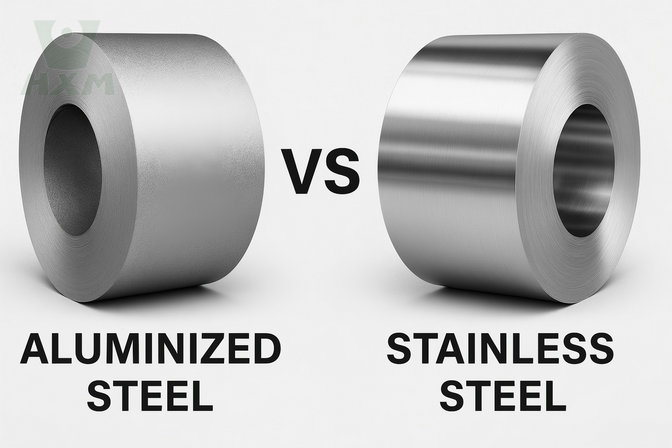
Choosing the right material for your project is crucial—especially when it comes to choosing between aluminized steel vs stainless steel. Both materials excel in industrial, automotive, and architectural applications, but they have very different properties, costs, and uses. In this article, Huaxiao Metal will help you understand these differences and choose the right option.
What Is Aluminized Steel?
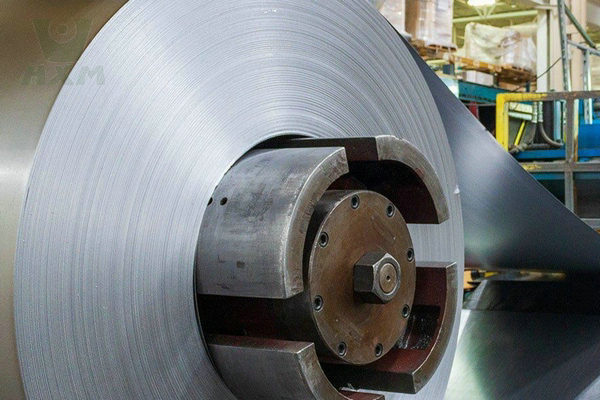
Aluminized steel is a cold-rolled carbon steel substrate coated with an aluminum-silicon alloy (approximately 90% aluminum, 10% silicon) via a hot-dip coating process. The silicon ensures good adhesion of the aluminum coating to the substrate.
Features: It combines the strength and cost advantages of carbon steel with the excellent high-temperature oxidation resistance and heat reflectivity of the aluminum coating.
Key Grades: Type 1 (T1) is primarily used for heat resistance and features a thicker coating; Type 2 (T2) has a thinner coating and is primarily used for atmospheric corrosion resistance. This article focuses on Type 1.
What Is Stainless Steel?
Stainless steel is an alloy steel whose key element is chromium, which should be present at a minimum of 10.5%. Chromium forms a strong, self-healing passive layer on the surface, which is the fundamental source of its excellent corrosion resistance.
Characteristics: Excellent corrosion resistance, high strength, and an aesthetically pleasing surface.
Key Grades: T304 (the most commonly used, austenitic stainless steel containing 18% Cr and 8% Ni); T316 (a 304 stainless steel with the addition of molybdenum, significantly enhancing chloride corrosion resistance and suitable for marine environments).
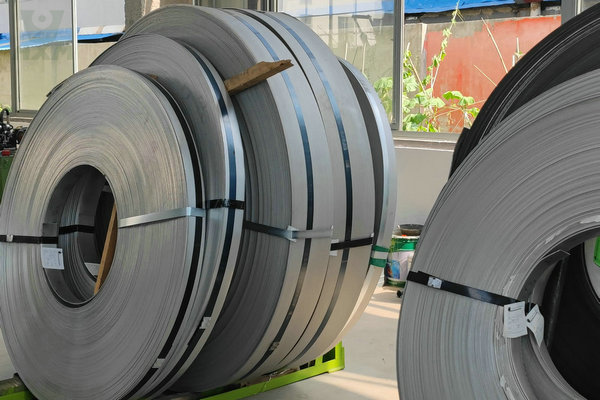
Aluminized Steel vs Stainless Steel Difference
Chemical Composition: Aluminized Steel vs Stainless Steel
| Element | Aluminized Steel (Type 1) | Stainless Steel (304 Grade) |
|---|---|---|
| Base Metal | Carbon Steel | Iron (Fe) |
| Coating | ~90% Aluminum, ~10% Silicon | None (Solid Alloy) |
| Cr | 0% | ~18% |
| Ni | 0% | ~8% |
| C | 0.05–0.1% | ≤ 0.08% |
| Si | ~10% (in coating) | ≤ 1% |
Data source: ASTM A463/A463M and ASTM A240/A240M standards
Physical Properties: Aluminized Steel vs Stainless Steel
| Property | Aluminized Steel | Stainless Steel (304) |
|---|---|---|
| Density (g/cm³) | ~7.85 | 8.0 |
| Thermal Conductivity (W/m·K) | 73–85 (coated) | ~16.2 |
| Electrical Resistivity (µΩ·m) | 0.16 | 0.72 |
| Melting Point (°C) | 600–660°C (coating) | ~1400–1450°C |
| Magnetic | Yes | Slight (non-magnetic in the annealed state) |
Mechanical Properties: Aluminized Steel vs Stainless Steel
| Property | Aluminized Steel | Stainless Steel (304) |
|---|---|---|
| Tensile Strength (MPa) | 300–600 MPa | 520–750 MPa |
| Yield Strength (MPa) | 200–400 MPa | 205–450 MPa |
| Elongation (%) | ~20–30% | ~40–50% |
| Hardness (HB) | ~70–100 | ~140–190 |
| Formability | Good | Excellent |
Other Properties: Aluminized Steel vs Stainless Steel
Corrosion Resistance: Stainless steel can self-passivate, and its corrosion resistance is much higher than that of aluminum-coated steel.
Surface Appearance: Stainless steel is bright and beautiful, suitable for visible structures; aluminum-coated steel has a grayish-white surface and is more suitable for hidden parts.
Weldability: Both can be welded, but the aluminum coating needs to be treated after welding to avoid local corrosion.
Maintenance: Stainless steel is more durable and easier to clean; aluminum-coated steel needs to be regularly checked for coating integrity.
If you want to know more about other differences or don’t know how to choose the right material for your project, it is recommended to contact Huaxiao Metal directly for professional advice and quotes!
Typical Application of Aluminized Steel vs Stainless Steel
| Industry | Aluminized Steel | Stainless Steel |
|---|---|---|
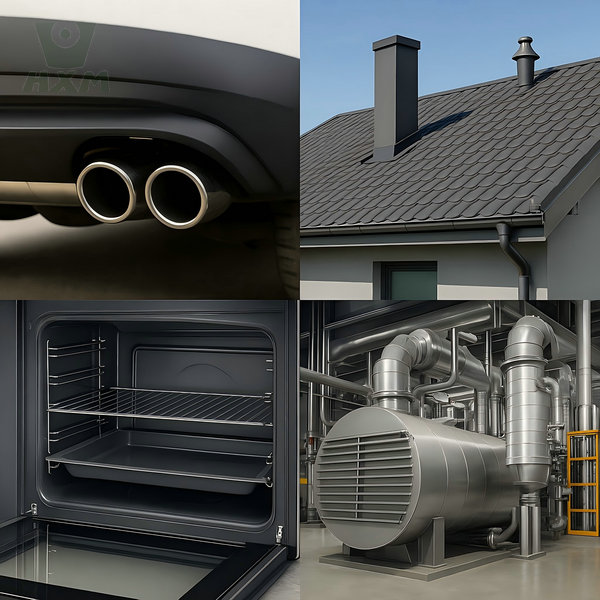
| Automotive | Exhaust systems, mufflers | Fuel tanks, structural frames |
| HVAC | Air ducting, heaters | Corrosive ventilation components |
| Kitchenware | Not common | Sinks, counters, cookware |
| Construction | Roofing underlay | Handrails, cladding, structural parts |
| Appliances | Oven interiors | Refrigerator interiors, washer drums |
Price & Cost Consideration
Aluminized Steel is cheaper than stainless steel.
Aluminized Steel: Lower price, suitable for cost-sensitive projects that do not require complete corrosion resistance
Stainless Steel: More expensive, but provides longer life and better performance
Aluminized steel is suitable for short-term or medium-term applications where cost is sensitive and the main requirements are high temperature resistance and a mild corrosion environment. Stainless steel is ideal for long-term investment projects with extremely high requirements for life, corrosion resistance, and hygiene.
Contact Us for Steel Pricing and Availability
Whether you need aluminized steel sheets, stainless steel coils, or more, Huaxiao Metal offers aluminized steel and stainless steel products in a variety of specifications and shapes.
Contact us today for a free quote!
Performance Analysis: Aluminized Steel vs Stainless Steel
These are the two most critical factors when selecting a material, and they also represent the most significant differences between the two.
Heat Resistance – Aluminized Steel’s Strength
Aluminized Steel (T1): The Al-Si coating forms a dense protective layer of aluminum oxide (Al2O3). Aluminized steel maintains excellent oxidation resistance even at continuous high temperatures of 450-650°C, making it an ideal choice for high-temperature applications such as furnaces and exhaust systems.
Stainless Steel (T304): 304 stainless steel has an oxidation resistance temperature of approximately 870°C. While its temperature limit is higher, aluminized steel provides adequate thermal protection at a lower cost in applications below 450°C.
Corrosion Resistance – Stainless Steel’s Strength
Stainless steel: Relying on its self-healing passivation layer, it offers uniform corrosion resistance throughout. Type 316 stainless steel, in particular, offers excellent resistance to pitting and crevice corrosion. Suitable for use in humid, chemically aggressive environments or in food processing environments.
Aluminized steel: Relies on an external Al-Si coating for protection. Once this coating is damaged by scratches, welding, or cut edges, the base carbon steel will rust rapidly. Its corrosion resistance is significantly lower than that of stainless steel, making it unsuitable for long-term exposure to harsh outdoor or marine environments.
Thermal Reflectivity
Aluminized Steel: The aluminum-coated surface has extremely high thermal reflectivity (reflecting over 80% of incoming heat), making it an ideal material for ovens, heaters, and stovetop covers, as it reflects heat back into the heating chamber or away from sensitive components.
Stainless Steel: Its thermal reflectivity is relatively low, typically absorbing heat and then conducting it away.
Thermal Conductivity and Thermal Expansion
Thermal Conductivity: Aluminized steel is based on carbon steel, which has high thermal conductivity (73-85 W/m⋅K) and can quickly transfer heat. Stainless steel (304, approximately 16.2 W/m⋅K) has poor thermal conductivity but is effective at retaining heat.
Application Implications: Aluminized steel is suitable for applications requiring rapid heating/cooling; stainless steel is suitable for applications requiring uniform heating or insulation (such as cookware bases and stove bodies).
Thermal Expansion: Stainless steel (especially 304/316 austenitic) has a higher coefficient of thermal expansion than the carbon steel substrate of aluminized steel. Stainless steel structures are more susceptible to expansion and deformation during extreme temperature fluctuations, requiring special consideration for stress relief during design.
Stress Corrosion Cracking (SCC)
Stainless Steel (Austenitic): Austenitic stainless steels (304 and 316) are highly susceptible to SCC in environments with tensile stresses, high temperatures (above 60 ∘ C), and chloride ions. This is the biggest limitation for the use of austenitic stainless steels in high-pressure hot water piping or swimming pool equipment.
Aluminized Steel/Ferritic Stainless Steel (430): Aluminized steel and 430 ferritic stainless steel have high resistance to SCC. Ferritic steel may be a safer alternative to 304 in certain hot water or humid environments where the risk of SCC is high.
Engineering Tip: Do not use 304 stainless steel in marine, coastal, or industrial cleaning agent environments (>60 ∘ C). Upgrade to T316 stainless steel or consider other alloys that are resistant to SCC.
Magnetic Properties
Magnetism is one of the most visible and critical physical distinctions between aluminized steel and various stainless steel grades. Material magnetism becomes a decisive selection criterion in applications requiring magnetic shielding or the use of electromagnetic sensors.
| Material Type | Magnetic Status | Physical Reason | Application Implication |
| Aluminized Steel | Magnetic | The base metal is carbon steel (ferritic structure), which is ferromagnetic. | Suitable for automated production lines where magnetic sensors are used. |
| Austenitic Stainless Steel (304/316) | Non-Magnetic or Weakly Magnetic | The austenitic structure is non-magnetic in the annealed state; cold working may induce some martensite, leading to weak magnetism. | Ideal for use in sensitive environments like medical, electronic, and defense industries. |
| Ferritic Stainless Steel (430) | Magnetic | Possesses a ferritic structure, which is inherently ferromagnetic, similar to regular steel. | A lower-cost magnetic stainless steel option. |
Engineering Tip: The quickest way to distinguish between 304 (non-magnetic) and 430 (magnetic) stainless steel is by using a magnet. Strong magnetic attraction typically indicates that the material is either carbon steel (like aluminized steel) or a ferritic stainless steel (like 430).
Confronted with material selection challenges? Does your project require simultaneous high temperature and corrosion resistance? Contact Huaxiao Metal for customized material selection recommendations for T316 stainless steel and Type 1 aluminized steel.
Welding and Processing Performance Comparison: Aluminized Steel vs Stainless Steel
Understanding the material’s processing characteristics is crucial for structural component fabrication.
Welding Performance
Stainless Steel (304/316): Excellent weldability. TIG or MIG welding is commonly used, but heat input must be controlled to prevent intergranular corrosion (e.g., sensitization of 304).
Aluminized Steel: Weldable, but the heat can cause the aluminum coating to burn away during welding. The weld area loses protection, becoming a starting point for corrosion. Engineering Recommendation: After welding aluminized steel, additional coating repair is required to restore corrosion resistance.
- Professional Advice: After welding aluminized steel, the exposed weld must be protected by spraying a high-aluminum-content aluminum-rich paint or similar heat-resistant coating to maintain the material’s corrosion and high-temperature resistance.
Formability
Stainless steel has significantly higher elongation and ductility than aluminized steel. Stainless steel exhibits superior performance, particularly in complex forming operations such as drawing and deep drawing. While aluminized steel exhibits good formability, care must be taken during processing to avoid coating cracking.
Fabrication Guidelines: Cutting and Surface Preparation
Professional fabrication techniques directly impact the ultimate performance and lifespan of the material.
Cutting and Forming
Aluminized Steel: Easy to shear and punch. During bending and deep-drawing operations, ensure the die surface is smooth to avoid scratching the aluminum coating.
Stainless steel: Due to its higher strength and hardness, it requires more power when cutting and causes faster tool wear. However, its excellent ductility makes it suitable for complex deep drawing and forming.
Surface Finish and Aesthetics
Stainless steel: Available in a variety of surface finishes, from No. 1 (hot-rolled rough finish) to 2B (cold-rolled bright finish) to No. 8 (mirror polish). The final appearance of stainless steel is a key factor in its popularity.
Aluminized steel: The surface is matte gray. While paintable, it is primarily used for functional and concealed applications and rarely for aesthetic purposes.
Which One Should You Choose? Aluminized Steel vs Stainless Steel
If you need cost efficiency and good heat protection, aluminized steel is your choice. If your application demands high corrosion resistance and a clean finish, stainless steel is a better investment.
Choose aluminized steel if:
Your primary goal is cost-effectiveness.
The application is subject to continuous high temperatures (450-650°C) and low corrosion.
The material is for internal parts (such as oven liners), and aesthetics are not a priority.
Choose stainless steel if:
Your project requires the highest corrosion resistance (humidity, chemicals, marine environments).
You require high mechanical strength and excellent formability.
Your application is food-grade, medical, or requires a durable and aesthetically pleasing exterior.
Need help choosing the right material? Contact Huaxiao Metal today for expert advice and competitive pricing.
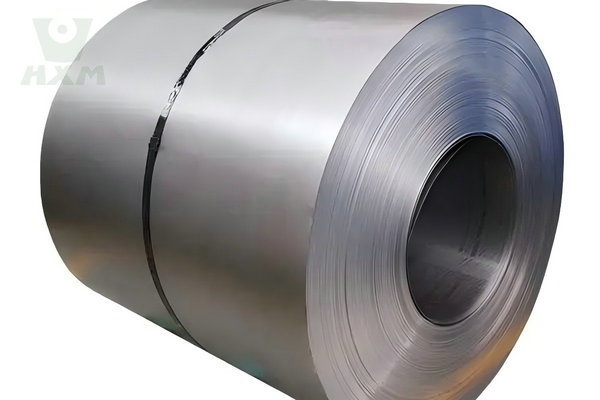
Aluminized Steel
Aluminized Steel Supplier | Aluminized Steel Manufacturer – Huaxiao Metal Aluminized Steel is a type of steel with high corrosion and heat resistance. It is
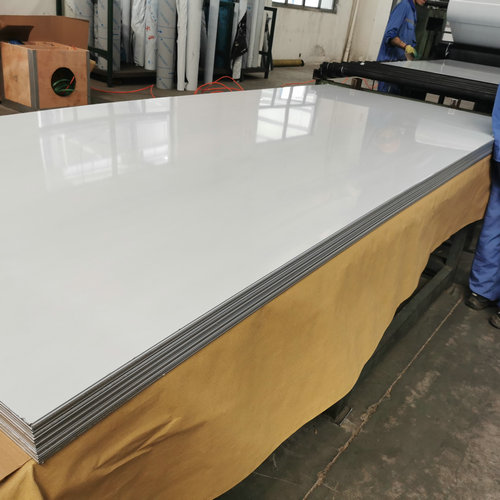
Stainless Steel
Stainless Steel Suppliers From China Huaxiao Metal is one of the leading stainless steel suppliers & manufacturers in China, we can provide stainless steel plates,
Why Choose Huaxiao Metal as Your Steel Supplier?
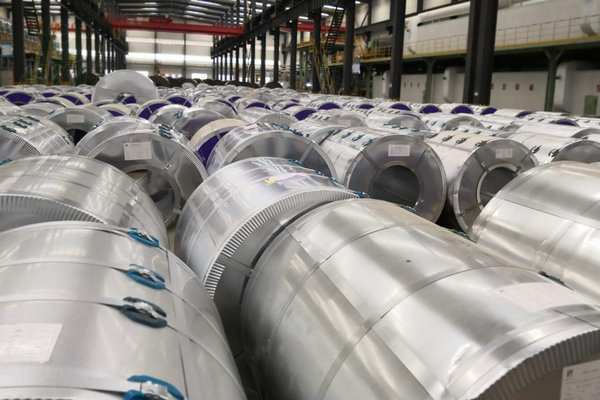
At Huaxiao Metal, we stock aluminized and stainless steel products in various grades and specifications. With competitive prices, strict quality control, and fast global shipping, we help our customers find the best steel solution.
✅ Large Inventory
✅ Custom Sizing
✅ Export Experience
✅ Reliable Quality
FAQs
Which is more corrosion-resistant, Type 1 or Type 2 aluminized steel?
Type 2 is more corrosion-resistant because it has a thinner coating and higher aluminum purity. It is designed for atmospheric corrosion and is commonly used in building roofs. While Type 1 also offers corrosion resistance, its primary advantage is high-temperature resistance, where the coating is more stable.
What is the difference between galvanized steel and aluminized steel?
Galvanized steel provides excellent sacrificial corrosion protection, but its high-temperature resistance is poor (the zinc coating loses its effectiveness around 200°C). Aluminized steel is designed for high-temperature resistance, but it is not as good as galvanized steel in harsh corrosive environments.
Can aluminized steel replace 304 stainless steel for outdoor use?
Not recommended. Aluminized steel’s coating is easily damaged and will rust quickly once the base material is exposed. Stainless steel’s passivation layer is self-healing and more suitable for long-term outdoor use.
Which material should be chosen for the internal combustion chamber of a gas water heater?
Type 1 aluminized steel should be chosen. Its core requirements are high-temperature oxidation resistance and heat reflectivity. Aluminized steel offers excellent cost-effectiveness in the medium- and high-temperature range.
What are the cost-performance trade-offs between 430 stainless steel and 304 stainless steel?
430 stainless steel offers lower cost (nickel-free), is magnetic, and has better resistance to stress corrosion cracking, but its corrosion resistance and mechanical strength are lower than 304 stainless steel. 430 stainless steel is suitable for dry indoor environments or mildly corrosive environments.
Is aluminized steel rust-proof?
It is rust-resistant but not as corrosion-proof as stainless steel.
Can aluminized steel be welded?
Yes, but welding may reduce corrosion resistance near welds.
Which is better for outdoor use?
Stainless steel is more suitable for long-term outdoor exposure.
Which steel is better for exhaust systems?
Aluminized steel is preferred due to its heat resistance and cost-efficiency.
Does Huaxiao Metal offer stainless steel coils in custom thicknesses and widths?
Yes. We offer custom-sized cutting and splitting services for both aluminized and stainless steel to meet your project’s specific specifications.
In Conclusion:
Aluminized steel and stainless steel are both excellent metal materials, but they play irreplaceable roles in different fields. Understanding the essential differences between high-temperature resistance (aluminized steel’s strength) and corrosion resistance (stainless steel’s strength) is key to making the right investment.
Understanding the differences between aluminized steel and stainless steel helps you make the right decision for performance and budget. At Huaxiao Metal, we provide both materials in bulk with expert advice and international shipping. Contact us today for pricing and supply information.