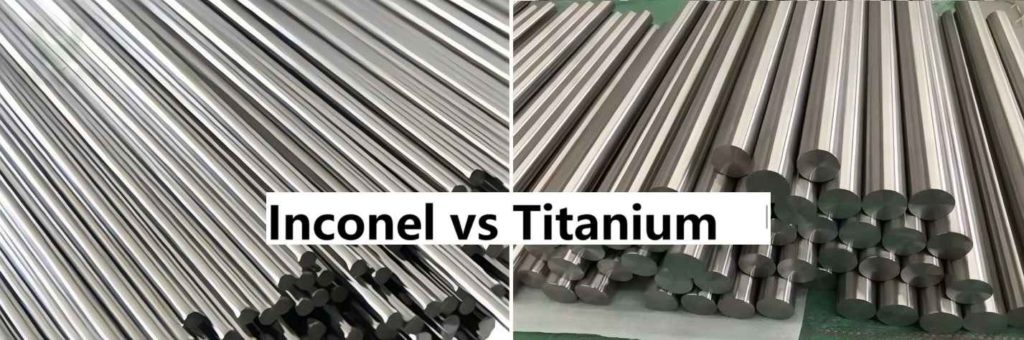
Inconel vs Titanium is widely regarded as high-specification metal materials with superior performance in industrial applications. Whether used in aerospace, medical devices, or chemical equipment, they can perform well under extreme conditions. So, how to choose these two metals according to specific needs?
If you are looking for suppliers of Inconel and Titanium alloys at this moment and don’t know which material to choose, this article will deeply analyze their definitions, characteristics, differences, and applications to help you make the right choice.
Looking for professional Inconel or Titanium suppliers? Contact Huaxiao Metal today for the best prices and technical support.
What is Inconel Alloy?
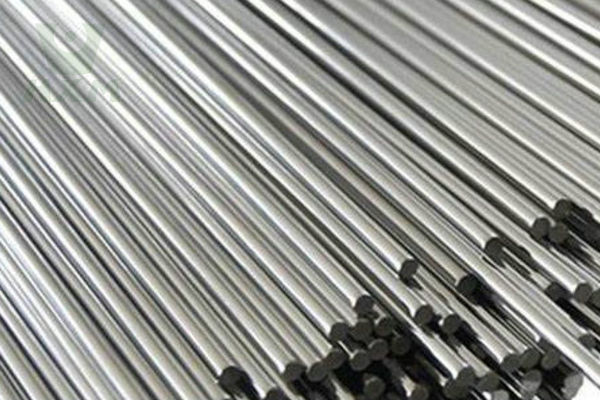
Inconel Alloy
Inconel Alloys — High-Performance Nickel-Based Superalloy Supplier | Huaxiao Metal We specialize in providing high-quality Inconel alloys to meet the needs of various industrial applications.
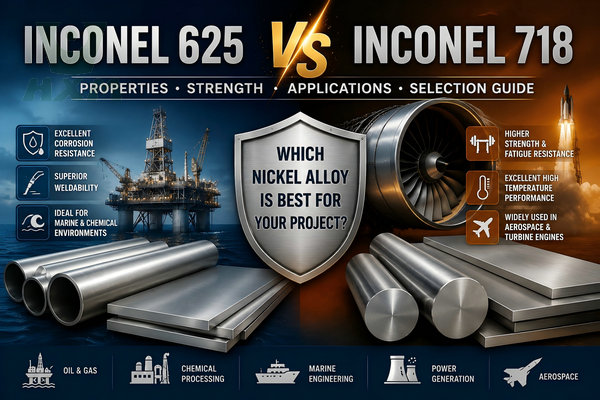
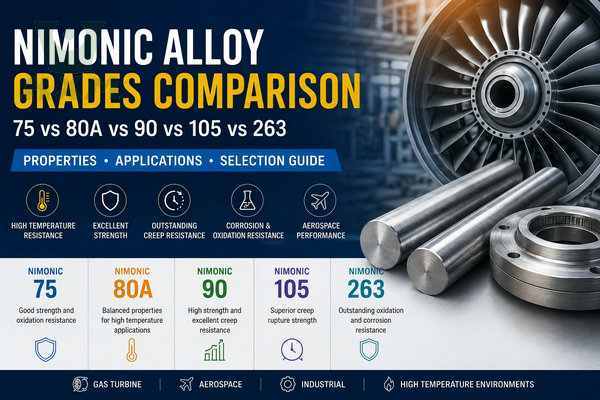
Inconel is a nickel-based superalloy known for its excellent high temperature resistance and corrosion resistance. It is widely used in high temperature and highly corrosive environments such as gas turbines, nuclear reactors and heat exchangers.
What is Titanium Alloy?
Titanium is a pure metal or titanium alloy that is lightweight and strong. Pure titanium is often used in the medical industry, while titanium alloys such as Ti-6Al-4V have increased hardness and corrosion resistance through the addition of aluminum and vanadium.
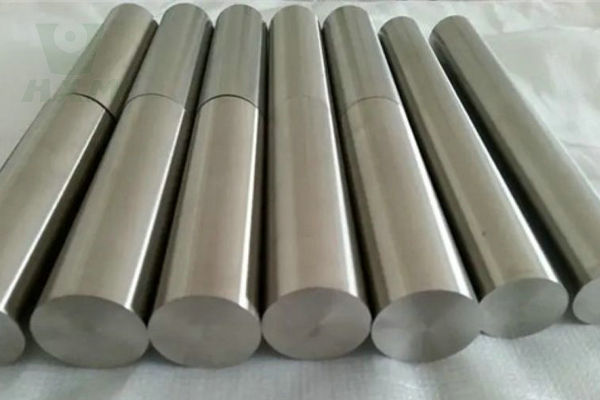
Titanium Alloy
Titanium Alloy Supplier: Grade 1-5 & Ti-6Al-4V Bars, Sheets, Plates | Huaxiao Metal Huaxiao Metal is a premier titanium alloy manufacturer and supplier with ISO9001
Inconel vs Titanium: What Are Their Differences?
Equivalent Grades and Composition Comparison
| Property | Inconel | Titanium |
|---|---|---|
| Common Grades | Inconel 625, Inconel 718 | Ti Grade 2, Ti-6Al-4V (Grade 5) |
| Main Composition | Nickel (50%-70%), Chromium, Molybdenum, Iron | Titanium (99%+), Titanium-Aluminum-Vanadium alloy |
| Density | 8.5 g/cm³ | 4.5 g/cm³ |
Mechanical Properties Comparison
| Property | Inconel (e.g., 625) | Titanium (e.g., Ti-6Al-4V) |
|---|---|---|
| Tensile Strength | 758 MPa | 900 MPa |
| Yield Strength | 414 MPa | 880 MPa |
| Density | 8.4 g/cm³ | 4.43 g/cm³ |
| Melting Point | 1,350–1,400°C | 1,660°C |
| Temperature Resistance | Excellent up to 982°C | Good up to 600°C |
Note: Inconel is heavier but offers exceptional high-temperature performance, while titanium provides a high strength-to-weight ratio.
Corrosion Resistance and Environmental Adaptability
| Property | Inconel | Titanium |
|---|---|---|
| Oxidation Resistance | Excellent (high temperature, chlorinated environments) | Excellent (especially in marine and biological environments) |
| Acid Resistance | Strong, suitable for acidic industrial environments | Relatively weak, susceptible to acid corrosion |
Selection tip:
Choose Inconel for high-temperature oxidation and chemical processing.
Choose Titanium for marine, offshore, and corrosion-critical environments.
Weight and Density Comparison
Titanium has half the density of Inconel, making it more advantageous in weight-sensitive applications:
| Metal | Density (g/cm³) | Typical Applications |
|---|---|---|
| Inconel | 8.5 | High-temperature turbine components |
| Titanium | 4.5 | Aircraft structures, medical implants |
Machining and Cost Analysis: Inconel vs Titanium
| Property | Inconel | Titanium |
|---|---|---|
| Machining Difficulty | High, requires specialized tools | Easier, but prone to machining cracks |
| Cost | Higher | Lower |
Inconel alloy price is generally higher due to high nickel content and complex manufacturing processes.
Titanium alloy price is moderate but depends heavily on grade, form, and certification requirements.
Please note that the cost varies according to quantity, size, material, and other factors.
For specific Inconel and Titanium costs, please send us a detailed inquiry and we will respond with a quote within 24 hours.
Welding Performance
- Inconel: Good weldability, suitable for high-temperature equipment parts.
- Titanium: Strong weldability, but requires an inert gas environment to avoid oxidation.
Application Areas: Inconel vs Titanium
| Application Area | Inconel | Titanium |
|---|---|---|
| Aerospace | Turbine blades, exhaust systems | Aircraft fuselage, landing gear components |
| Chemical Industry | Heat exchangers in corrosive environments, high-temperature pipes | Corrosion-resistant storage tanks, low-temperature pipes |
| Medical | Not commonly used | Bone implants, dental restoration materials |
| Marine Applications | Deep-sea equipment | Hull components, submarine hulls |
Not sure which alloy suits your industry? Let our team guide your material selection.
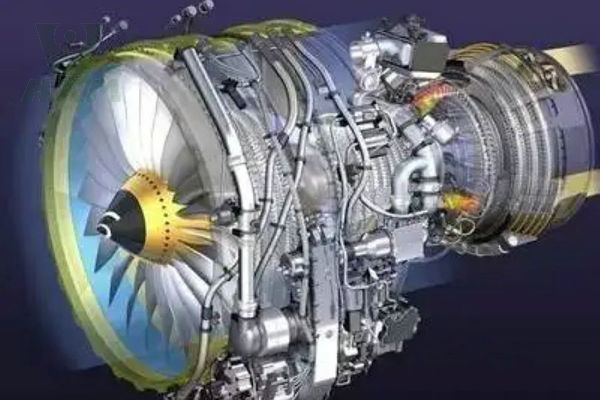
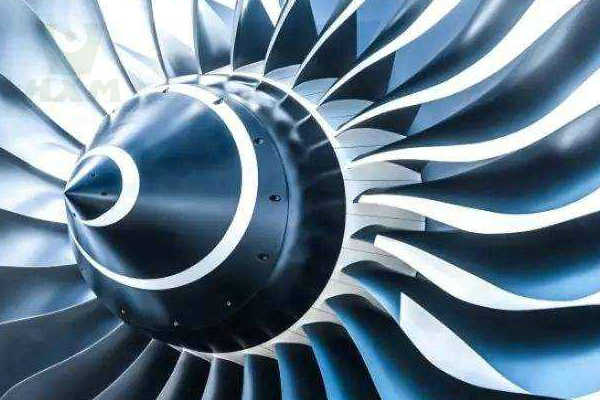
Inconel vs Titanium: Which One to Choose?
Choose Inconel:
- High-temperature environments (>600°C), such as gas turbines, and chemical equipment.
- Strong corrosive media environment, such as chlorine, acidic gas, etc.
Choose Titanium:
- Weight-sensitive scenarios, such as aerospace or automotive parts.
- Applications that emphasize biocompatibility or marine corrosion resistance.
If your project involves extremely high temperature or strong acid environment, choose Inconel; if you need to reduce weight or improve corrosion resistance, choose Titanium. If necessary, you can consult Huaxiao Metal for professional advice and quotation.
After understanding the Inconel and Titanium differences, why should I choose Huaxiao Metal as Your supplier?
When choosing a material supplier, the following factors make us your top choice:
Expert Knowledge & Support: As you’ve read, our understanding of materials is profound. Our team of experts can recommend the most accurate and cost-effective material grades and specifications for your specific application, whether it’s aerospace, chemical engineering, or high-performance racing.
Uncompromising Quality Assurance: All Inconel and Titanium materials we supply are 100% compliant with international standards (such as ASTM, AMS, and ISO). Every shipment is accompanied by a complete material test certificate (MTC/3.1 Certificate) to ensure traceability and guaranteed performance. For demanding industries, quality and reliability are our top priority.
Extensive Application Experience: Our products have been successfully used in a variety of fields, including aerospace, military, medical, and marine engineering. Whether it’s high-temperature, high-pressure environments or seawater corrosion, we have a wide range of solutions to meet your diverse needs.
Customized Services: We can provide tailored solutions based on your specific needs. Whether you require material specifications, custom sizes, or special technical requirements, we offer flexible adjustments to provide the precise material match for your project.
Timely Delivery and Excellent After-Sales Service: We are committed to on-time delivery and comprehensive after-sales support. Our technical team will respond quickly to any questions you may have, ensuring your product is ready for use.
Competitive Pricing: We are committed to providing cost-effective products at reasonable prices, allowing you to maintain quality while reducing costs. Choosing us means not only high-quality materials, but also excellent customer service and competitive pricing.
Choosing us means you will receive professional product support, technical support, and a superior customer experience. If you have any questions or require more information, please feel free to contact us.
Inconel vs Titanium: FAQ
Is Inconel stronger than Titanium?
It depends on the specific environment. At room temperature, many titanium alloys (such as Grade 5, 6Al-4V) have a superior strength-to-weight ratio than most Inconel alloys. However, Inconel’s core advantage is its ability to maintain strength at extremely high temperatures, far exceeding titanium alloys at temperatures exceeding 600°C (1100°F).
Which is more corrosion-resistant?
Inconel is superior in extreme chemical environments, and Titanium is excellent in marine settings.
Which alloy is better for aerospace?
Both—Titanium for structure, and Inconel for engine components.
Can Titanium replace Inconel?
Only in low-heat environments; Inconel remains better for high-temperature uses.
Which is better for high-performance exhaust systems?
Both are excellent choices, but they serve different purposes. Titanium is favored for its extreme lightweightness, making it suitable for racing cars that pursue extreme performance. Inconel, on the other hand, is more commonly used in turbochargers, manifolds, and other parts closest to the engine core where temperatures reach extremely high levels, due to its excellent resistance to high temperatures and thermal cycling fatigue.
Inconel vs Titanium: Which is more expensive?
Inconel is generally more expensive than titanium. This is primarily because it contains a high amount of nickel (typically over 50%), which is an expensive metal. Furthermore, Inconel is more difficult to machine and weld, further increasing manufacturing costs.
Which material is harder to machine and weld?
While both are challenging, Inconel is generally considered more difficult to machine. Inconel rapidly hardens during cutting, placing significant strain on cutting tools. While titanium welding requires a very clean environment (inert gas shielding) to prevent contamination, welding Inconel is more prone to cracking and requires more specialized processes and consumables.
In Conclusion:
Inconel and titanium alloys differ in several key ways. Inconel is a high-temperature, nickel-based superalloy that is well-suited for extreme heat and high-stress environments. Titanium, on the other hand, is a lightweight, corrosion-resistant metal with an excellent strength-to-weight ratio, making it ideal for aerospace and medical applications.
Inconel excels in high-temperature and corrosive environments, while titanium is better suited for weight-sensitive applications due to its lower density. Both materials offer unique advantages depending on application requirements, such as weldability, strength, and corrosion resistance.
Contact Huaxiao Metal now to get professional advice and competitive prices for Inconel and Titanium alloys. We ship worldwide and support custom specifications.