Selecting the right type of steel is critical to ensuring product quality, durability, and cost-effectiveness. Two common types of steel used in a variety of applications are 1008 vs 1018 steel. This blog post dives into the specifics of these two steels, compares their properties, and provides insights to help you make an informed decision for your manufacturing needs.
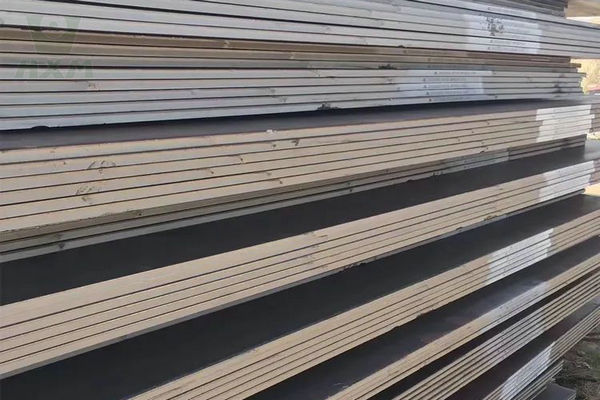
1018 Steel
AISI 1018 Steel Suppliers and Manufacturer Are you looking for a low-carbon steel that combines exceptional weldability with superior surface finish? AISI 1018 carbon steel

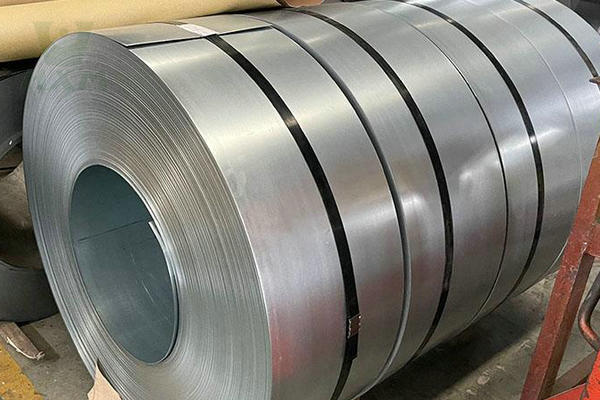
1008 Steel
1008 Steel Supplier & Manufacturer – Premium Low Carbon Steel from Huaxiao Metal Huaxiao Metal is a professional AISI 1008 steel supplier and manufacturer, providing
As a professional metal materials supplier, Huaxiao Metal will provide you with an in-depth analysis of the core differences between 1008 and 1018 steel from a professional perspective, and help customers choose the most suitable steel according to their needs. We also offer spot inventory and quotation services.
Need reliable 1008 or 1018 steel materials? Contact Huaxiao Metal for sourcing and custom cutting services.
1008 vs 1018 Steel: Basic Overview and Grade Definitions
Both 1008 and 1018 steels belong to carbon structural steel and are classified as low-carbon steel (or mild steel). Their main characteristics are low carbon content, good ductility, machinability, and weldability.
AISI 1008 Steel: A Representative of Deep-Drawing Low-Carbon Steel
Definition and Characteristics: 1008 steel is one of the most common low-carbon steels in the American Iron and Steel Institute (AISI) and Society of Automotive Engineers (SAE) standards. Its core characteristic is its extremely low carbon content (typically below 0.10%).
Application Tendencies: Its excellent cold formability and ductility make it the preferred material for parts requiring complex bending, deep drawing, or cold heading.
AISI 1018 Steel: The Benchmark of High-Strength Free-Machining Low-Carbon Steel
Definition and Characteristics: 1018 steel is another widely used low-carbon steel, with higher carbon content (0.15% – 0.20%) and manganese content (0.60% – 0.90%) than 1008 steel.
Application Preferences: The increased carbon and manganese content gives it higher strength, hardness, and superior machinability (free machinability), making it ideal for shafts, pins, and machine parts.
1008 vs 1018 Steel: What’s the Difference?
1008 vs 1018 Steel Equivalent Grades:
| Country/Standard | 1008 Equivalent | 1018 Equivalent |
|---|---|---|
| ASTM/SAE | SAE 1008 | SAE 1018 |
| China (GB) | 08F / Q195 (similar) | 15 / Y15 |
| EU (EN) | DC01 | C15E / C16 |
| Germany (DIN) | St12 | C15E |
| Japan (JIS) | S08C / SPCC | S15C |
| Russia (GOST) | 08kp | 15 steel |
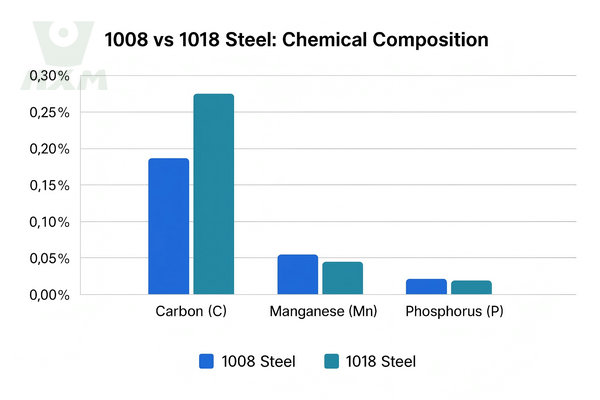
Chemical Composition of 1008 vs 1018 Steel:
The main difference between 1008 and 1018 steels is their carbon content, a difference that affects their mechanical properties and applications.
Element | 1008 Steel | 1018 Steel |
C | 0.08%max | 0.15-0.20% |
Mn | 0.30-0.50% | 0.60-0.90% |
P | 0.04%max | 0.04%max |
S | 0.05%max | 0.05%max |
Fe | Balance | Balance |
Comparison of Mechanical Properties: 1008 vs 1018 Steel
Understanding the mechanical properties of 1008 and 1018 steel is critical to choosing the right material for your application. This comparison will help you choose the right carbon steel for your specific needs!
| Property | 1008 Steel | 1018 Steel |
|---|---|---|
| Carbon Content | 0.08-0.10% | 0.14-0.20% |
| Tensile Strength | 340-440 MPa | 440-560 MPa |
| Yield Strength | 170-300 MPa | 370 MPa |
| Elongation | Approximately 25-35% | Approximately 15-25% |
| Hardness (Brinell) | 95-125 HB | 126-179 HB |
| Machinability | Good | Good |
| Weldability | Excellent | Excellent |
| Formability | Excellent | Good |
| Applications | Cold-headed fasteners, wire, and deep drawing applications | Shafts, pins, gears, and machinery parts |
Both steels offer good machinability and weldability, with specific properties making them suitable for different applications.
Comparison of Physical Properties: 1008 vs 1018 Steel
Property | 1008 Steel | 1018 Steel |
|---|---|---|
Density | 7.87 g/cm³ | 7.87 g/cm³ |
Thermal Conductivity | 51.9 W/m·K | 51.9 W/m·K |
Specific Heat Capacity | 486 J/kg·K | 486 J/kg·K |
Electrical Resistivity | 0.0000159 Ω·cm | 0.0000159 Ω·cm |
Modulus of Elasticity | 200 GPa | 200 GPa |
Poisson’s Ratio | 0.29 | 0.29 |
Melting Point | 1426-1538°C | 1426-1538°C |
The physical properties of 1008 and 1018 steels are almost identical. They have the same density, thermal conductivity, specific heat capacity, resistivity, elastic modulus, Poisson’s ratio, and melting point. This similarity means that both steels perform similarly in terms of physical behavior under thermal and electrical conditions, as well as elastic deformation.
The main differences between 1008 and 1018 steels are their chemical composition and mechanical properties, which affect their applications and performance in different environments.
Application of 1008 vs 1018 Steel
Selecting the right steel for your application is essential to ensure optimal performance, durability, and cost-effectiveness. Here, we compare typical applications of 1008 and 1018 steel grades to help you make an informed decision.
Application | 1008 Steel | 1018 Steel |
Automotive Parts | Body panels, tanks, brackets, and frames | Axles, gears, and engine parts |
Mechanical Parts | Low-stress mechanical parts | High-stress parts such as shafts, pins, and machine parts |
Construction | Roofing, siding, and structural panels | Structural supports, bolts, and fasteners |
Furniture | Lightweight frames and decorative elements | Structural components such as brackets and supports |
Welding | Components requiring extensive welding | Parts requiring moderate welding and machining |
Pipes and Tubing | Low-pressure piping | Hydraulic pipe, tubing, and mechanical piping |
Wire Products | Wire mesh, fencing, and nails | Wire, springs, precision wire |
Electrical Components | Low-stress electrical applications | Terminals, connectors, and electrical enclosures |
Machinability of 1008 vs 1018 Steel
Machinability is an important property to consider when selecting steel for a manufacturing process, as it affects production efficiency and the quality of the final product.
Machinability of 1008 Steel
With a lower carbon content, 1008 steel is generally softer and therefore easier to form. This makes it particularly suitable for applications that require a lot of forming or shaping. The low carbon content reduces the likelihood that the steel will harden during deformation, making it less likely to crack or deform under machining stress. However, this same property may result in a surface that is not as smooth or clean as one made with harder steels.
Machinability of 1018 Steel
In contrast, 1018 steel, which has a slightly higher carbon content, has better machinability than 1008 steel. It tends to produce a better surface finish and retains a sharper edge and more precise dimensions after machining. The increased carbon content makes the surface harder, which is beneficial for reducing cutting tool wear and extending tool life. However, this hardness may make it more difficult to machine than 1008 steel.
Weldability of 1008 vs 1018 Steel
Weldability is a key factor in selecting steel for construction, manufacturing, and various engineering projects, as it directly affects the integrity and quality of the final assembly.
1008 Steel Weldability
This steel is considered an excellent material for welding due to its low carbon content, which minimizes the risk of creating brittle welds. The lack of excess carbon ensures that the weld area is less susceptible to cracking under stress, a common problem with higher carbon steels. 1008 steel is well suited for projects that require a lot of welding and is often used in welding applications for automotive body parts and sheet metal.
1018 Steel Weldability
1018 steel also has very good weldability, but its higher carbon content can present some challenges, such as increasing the risk of cracking if it is not properly preheated or cooled too quickly. Despite this, 1018 steel can be welded effectively with proper technique and is often used in manufacturing environments where its higher strength and hardness are required.
Formability of 1008 vs 1018 Steel
Formability is a key characteristic in steel selection, especially in industries where steel must be shaped into complex shapes without compromising structural integrity.
Formability of 1008 Steel
Due to its lower carbon content, 1008 steel has excellent ductility and formability. It is more ductile and easier to bend into a variety of shapes, making it a top choice for parts that involve deep drawing, bending, or complex forming operations. This property is especially valuable when manufacturing parts that require a high degree of deformation without the risk of cracking.
Formability of 1018 Steel
While 1018 is still formable, it is not as ductile as 1008 steel. The higher carbon content makes it slightly harder, which reduces its ability to be formed into complex shapes without heating. However, it has a higher strength than 1008 steel, which is an advantage for applications that require more structural integrity after forming.
Heat Treatment & Case Hardening
Neither 1008 nor 1018 can be through-hardened due to low carbon levels. However, 1018 is much better suited for case hardening (carburizing). It can achieve a hard, wear-resistant outer shell while maintaining a tough, ductile core. 1008 is rarely used for hardening applications.
Cost of 1008 vs 1018 Steel
When choosing a manufacturing or construction material, cost is a key factor that influences the decision.
Raw Material Prices
Market prices for 1008 and 1018 steel can fluctuate, but typically, 1008 steel is slightly cheaper due to its lower carbon content.
Manufacturing Costs
While raw material costs are an important factor, manufacturing costs will vary depending on the specific processes involved. 1018 steel may incur higher processing costs but may be more economical in the long run due to its durability and performance.
Compare 1008 vs 1018 steel prices now. Contact Huaxiao Metal for a free quotation.
1008 vs 1018 Steel: Which Low-Carbon Grade Should You Choose?
| Requirement | Recommended Steel |
|---|---|
| Cost Efficiency | 1008 |
| High Strength | 1018 |
| Better Machinability | 1018 |
| Formability | 1008 |
| General Purpose | Both |
Choose 1008 Steel if: You need maximum ductility for deep drawing, extreme bending, or welding thin-wall tubes.
Choose 1018 Steel if: You are machining precision parts, need a better surface finish, or require a balance of strength and cost-efficiency.
FAQs: 1008 vs 1018 Steel
What is the main difference between 1008 and 1018 steel?
The main difference lies in the carbon content. The carbon content of 1018 steel (0.15-0.20%) is significantly higher than that of 1008 steel (≤0.10%). This gives 1018 steel higher strength and better machinability, while 1008 steel has superior ductility, formability, and weldability.
Which applications is 1018 steel best suited for?
Due to its high strength and good machinability, 1018 steel is often used for parts that require higher mechanical strength and good surface finish, such as shafts, pins, gears, studs, and general mechanical parts.
What are the unique processing advantages of 1008 steel?
1008 steel is a typical deep-drawing steel. Due to its extremely low carbon content, it has excellent cold formability and deep-drawing properties, making it very suitable for manufacturing body panels, gaskets, and low-stress parts that require a lot of bending or complex shapes.
Can 1008 and 1018 steels be substituted for each other?
Direct substitution is not recommended, but it depends on the specific application. If the application requires high strength and hardness (such as machine shafts), 1008 steel lacks sufficient strength and cannot replace 1018; if the application requires deep drawing or complex forming, 1018 steel lacks sufficient ductility and cannot replace 1008. Their application focuses are different.
Does 1018 steel require heat treatment?
1018 steel can be used in the annealed or hot-rolled state. However, to obtain extremely high surface hardness, wear resistance, and fatigue strength (e.g., for gears, pins), 1018 steel is usually carburized or carbonitrided, followed by quenching and tempering. This is its most common application strengthening method.
How to distinguish between 1008 and 1018 steel?
It is difficult to distinguish them by visual inspection or simple physical testing alone. The most reliable method is to perform chemical composition analysis using a spectrometer (such as OES) to accurately measure the carbon (C) and manganese (Mn) content, or to differentiate them through professional hardness testing.
How does Huaxiao Metal ensure the quality of these two types of steel?
Huaxiao Metal employs a strict quality control system:
Raw material inspection upon arrival: Ensuring that the chemical composition of each batch of steel meets standards.
Process quality monitoring: Strictly monitoring processing steps such as cold rolling, hot rolling, and cutting.
MTC certificate: Official material certificates are provided for each batch of materials leaving the factory, and the data is traceable.
Does the lower yield strength of 1008 steel mean it is not durable?
Not entirely. A lower yield strength means it is more prone to plastic deformation, but it has higher toughness (ductility), allowing it to absorb more energy without immediately breaking when subjected to impact or bending. For low-stress applications requiring bending and impact absorption, 1008 steel is extremely durable.
Is 1018 stronger than 1008 steel?
Yes, 1018 steel has higher strength and hardness due to higher carbon content.
Which one is better for welding?
Both weld well. 1008 is slightly better for deep draw + welding applications.
Can I harden 1008 steel like 1018?
Neither grade can be “through-hardened” because they lack sufficient carbon. However, 1018 steel responds much better to case hardening (carburizing). While you can technically carburize 1008, the results are less consistent than 1018, which is specifically designed to achieve a hard wear-resistant “case” while maintaining a tough core.
Can 1008 and 1018 steel be welded together?
Yes. Both grades are low-carbon steels with excellent weldability. They can be joined using most standard welding methods (MIG, TIG, Stick) without the need for pre-heating or post-weld heat treatment, as the risk of cracking is extremely low.
Which grade is better for CNC machining?
1018 steel is significantly better for machining. 1008 steel is often considered “gummy” during cutting because it is so soft, which leads to poor surface finishes and tool wear. 1018 steel, especially in its cold-drawn state, provides much cleaner chips and a superior polished finish, making it the industry standard for screw machine stocks.
When should I choose 1008 over 1018?
You should choose 1008 steel if your project requires:
Extreme cold-forming or deep drawing (e.g., complex wire shapes or stamped parts).
Maximum magnetic permeability.
The lowest possible material cost for non-structural applications.
Choose 1018 steel if you need:
Precision-machined parts with tight tolerances.
Higher structural integrity for shafts, pins, or rods.
A material that performs well under case-hardening processes.
Which steel is cheaper?
1008 steel is cheaper than 1018.
Can Huaxiao Metal supply both 1008 and 1018 steel?
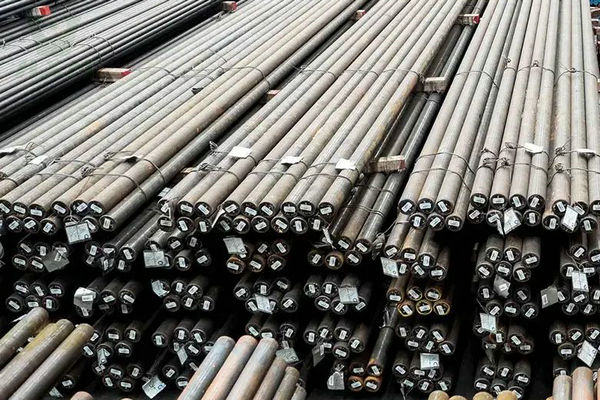
Yes — sheet, coil, bar, round bar, wire, custom cuts available.
In Conclusion:
Selecting the right type of steel requires balancing several factors, including mechanical requirements, cost, and the specific needs of the application. 1008 vs 1018 steels, both expertly processed by China TuoFa CNC Machining Services, have their place in the steel world.
1008 is suitable for parts that require extensive forming and welding, while 1018 excels in applications where strength and durability are critical. Each steel has unique advantages, and it should be selected to meet the specific needs of your project to ensure optimal performance and cost-effectiveness.