[email protected]

24/7 Customer Support

+86-13761906384

24/7 Customer Support

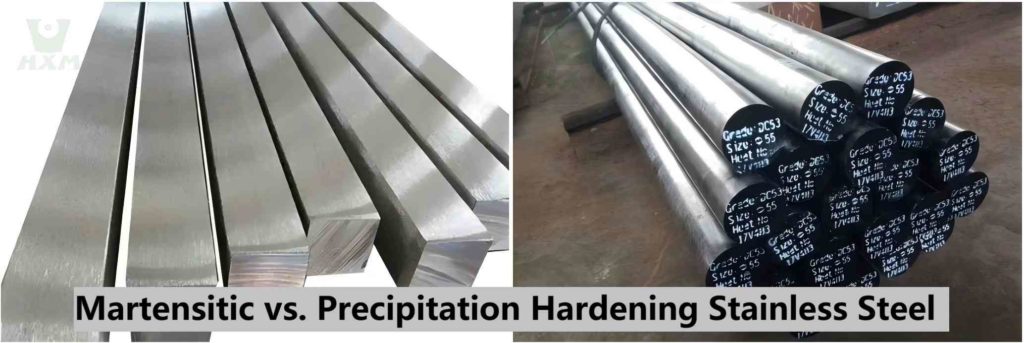
Martensitic Stainless Steel vs. Precipitation Hardening Stainless Steel: Which High-Strength Alloy is Right for Your Project?

In the stainless steel family, martensitic stainless steel vs. precipitation hardening stainless steel are two unique categories known for their unique properties, processing methods, and applications. Choosing the right material for your project is crucial as these steels meet different performance requirements.

Although both materials offer high strength, they differ significantly in:

  • corrosion resistance
  • toughness
  • machinability
  • cost
  • heat treatment response

This guide explains the differences and helps engineers and buyers choose the right material for demanding projects.

Martensitic Stainless Steel vs. Precipitation Hardening Stainless Steel

What is Martensitic Stainless Steel?

Martensitic Stainless Steel is a type of stainless steel characterized by its ability to form a martensitic structure through heat treatment. This category is well-known for:

  • High strength and hardness after quenching and tempering.
  • Moderate corrosion resistance compared to other stainless steels.
  • Applications in environments requiring wear resistance.
  • Composition: Higher carbon content (0.1–1.2%) and chromium content (12–18%).
  • Heat Treatment: Requires quenching and tempering for hardness adjustment.
  • Common Grades: 410, 420, 440C.

What is Precipitation Hardening Stainless Steel?

Precipitation Hardening (PH) Stainless Steel is designed to achieve high strength through the precipitation of alloying elements like aluminum, copper, and titanium during heat treatment. This steel offers:

  • Superior strength compared to martensitic steel.
  • Excellent corrosion resistance.
  • Versatility across various industrial applications.
  • Composition: Lower carbon content (0.03–0.07%) with alloying elements to enable precipitation hardening.
  • Heat Treatment: Solid solution treatment followed by aging for enhanced properties.
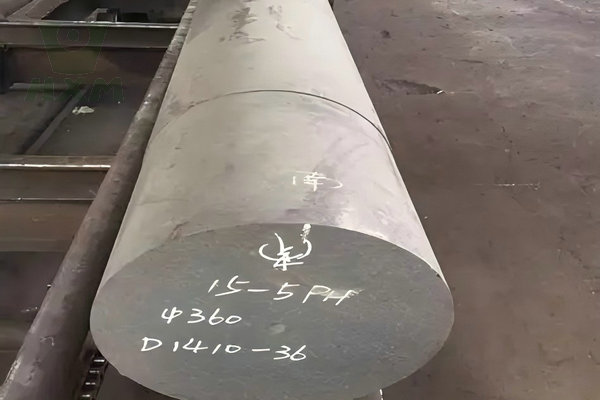
  • Common Grades: 17-4PH(UNS S17400), 15-5PH.

Martensitic Stainless Steel vs. Precipitation Hardening Stainless Steel: What Are Their Differences?

FeatureMartensitic Stainless Steel (e.g., 410/420) Precipitation Hardening Stainless Steel(e.g., 17-4 PH)
MicrostructureMartensiticAustenitic/Martensitic with precipitates
StrengthHigh, but less than PHVery high (17-4 PH up to 1100 MPa UTS)
HardnessVery High (up to 60 HRC for 440C)High (typically 35-45 HRC)
Corrosion ResistanceModerate (Susceptible to atmospheric rust)Excellent (Comparable to 304 Austenitic)
Heat TreatmentQuench + temperSolution → quench → aging
CostGenerally lowerHigher, but better performance
ApplicationsKnives, pumps, surgical toolsAerospace, chemical, marine industries
WeldabilityPoor (Prone to cracking; requires pre-heat)Good (Easily weldable with matching fillers)
Dimensional StabilityLow (High risk of warping during quenching)High (Minimal distortion during low-temp aging)
Typical Grades410, 420, 431, 440C17-4 PH (630), 15-5 PH, 17-7 PH

Martensitic Stainless Steel vs. Precipitation Hardening Stainless Steel Chemical Composition:

ElementMartensitic Stainless Steel (e.g., 420)Precipitation Hardening Stainless Steel (e.g., 17-4PH)
C0.15–1.20%≤0.07%
Cr12–18%15–17.5%
Ni≤1%3–5%
Additional ElementsNone or Mo for corrosion resistanceCu, Al, Ti for hardening

Martensitic vs. Precipitation Hardening Stainless Steel Mechanical Properties:

PropertyMartensitic Stainless SteelPrecipitation Hardening Stainless Steel
Tensile Strength (MPa)600–12001000–2000
Hardness (HRC)Up to 50+35–45
ToughnessModerate to lowHigh
Fatigue ResistanceModerateExcellent

Martensitic vs. Precipitation Hardening Stainless Steel Physical Properties:

PropertyMartensitic Stainless SteelPrecipitation Hardening Stainless Steel
Density (g/cm³)7.757.80
Thermal ConductivityModerateLower than martensitic
Magnetic PropertiesMagneticGenerally magnetic

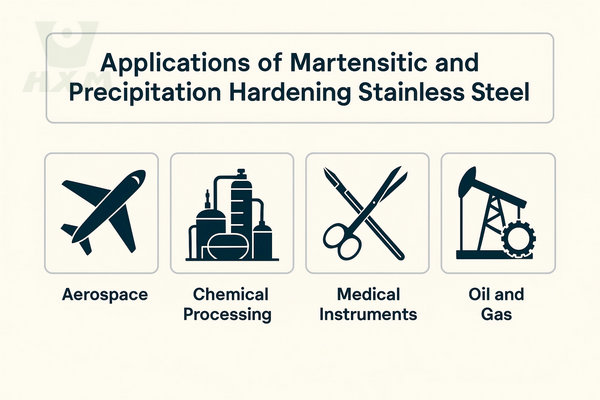
Martensitic vs. Precipitation Hardening Stainless Steel Applications:

Martensitic Stainless Steel Applications:

  • Surgical instruments.
  • Knife blades and cutlery.
  • Industrial valves and pumps.
  • Turbine components.

Precipitation Hardening Stainless Steel Applications:

  • Aerospace structural components.
  • Chemical processing equipment.
  • High-performance springs.
  • Oil and gas industry components.

Example Case:

  • 420 Martensitic Stainless Steel → used in surgical instruments for hardness and precision.

  • 17-4 PH Stainless Steel → widely used in aerospace turbine blades and high-strength fasteners.

Martensitic vs. Precipitation Hardening Stainless Steel Applications

Martensitic vs. Precipitation Hardening Stainless Steel Cost:

Precipitation hardening stainless steel is typically 30%-50% more expensive than martensitic stainless steel, depending on alloy content and processing. Martensitic stainless steel has a simple chemical composition (high carbon content, low nickel or no nickel) and relatively low raw material cost. Precipitation hardening stainless steel contains alloying elements such as nickel, copper, and aluminum, which increase strength and corrosion resistance but increase material cost.

Martensitic vs. Precipitation Hardening Stainless Steel Corrosion Resistance:

Martensitic Stainless Steel: Offers moderate resistance to corrosion in environments with low chemical exposure. Often used in applications like cutlery, turbine blades, and valves.

Precipitation Hardening Stainless Steel: Provides superior corrosion resistance, making it suitable for marine environments, aerospace, and chemical processing.

Martensitic vs. Precipitation Hardening Stainless Steel Heat Treatment Process:

Martensitic Stainless Steel:

    • Requires quenching (heating and rapid cooling) to form martensite.
    • Tempering adjusts hardness and improves toughness.

Precipitation Hardening Stainless Steel:

    • Undergoes solution treatment followed by aging to precipitate strengthening phases.
    • Allows for higher strength without compromising corrosion resistance.

Why do Engineers Prefer to Use PH Stainless Steel?

In modern industrial applications, especially in the South American and European markets, we see a growing shift toward PH alloys for several reasons:

A. Better Corrosion Resistance

Martensitic steels have lower chromium and nickel content, making them vulnerable in humid or chemical environments. 17-4 PH offers the high strength of martensite but with the “passive layer” protection similar to 304 stainless steel.

B. Superior Dimensional Stability

Quenching martensitic steel is a “violent” thermal event that often causes parts to warp or crack. PH steel undergoes a low-temperature aging process (e.g., H900 or H1150), which ensures that precision-machined parts maintain their exact tolerances.

C. Ease of Fabrication

You can machine PH stainless steel in its “Condition A” (solution treated) state when it is relatively soft, and then harden it as the final step. This significantly reduces tool wear and labor costs compared to machining hardened martensitic steel.

Material Selection Guide: Martensitic Stainless Steel vs. Precipitation Hardening Stainless Steel

The choice between these two types of stainless steel depends on the application requirements:

Choose Martensitic (410/420/440C) if:

  • You need extreme surface hardness for cutting tools, surgical blades, or bearings.

  • The environment is dry and non-corrosive.

  • Budget is the primary concern for a basic high-strength part.

Choose PH Stainless (17-4 PH/15-5 PH) if:

  • You are designing pump shafts, valve internal parts, or aerospace fasteners.

  • The part will be exposed to saltwater, steam, or mild chemicals (Oil & Gas industry).

  • The part has complex geometries that cannot risk distortion during heat treatment.

Both martensitic and precipitation-hardened stainless steels play a vital role in a variety of industries around the world. Understanding their differences in composition, mechanical properties, and applications can help you make the right choice for your project.

If you are looking for high-quality stainless steel products, contact Huaxiao Metal today. We offer a wide range of stainless steel grades to meet your specific needs.

Request a quote today to learn about our comprehensive stainless steel production capabilities and more!

Engineering Selection Logic: The Real Selection Methods of Professionals

In real-world engineering projects, the decision between martensitic and PH stainless steel is rarely based on hardness alone.

Engineers typically evaluate four critical factors:

① Load Type: Static vs Cyclic

  • Martensitic stainless steel performs well under static or intermittent loads

  • PH stainless steel is preferred for fatigue-critical or cyclic loading conditions

② Heat Treatment Timing

  • Martensitic steels are usually hardened after machining

  • PH stainless steels allow machining in solution-treated condition, then aging — reducing distortion risk

③ Service Environment

  • Mild corrosion → Martensitic may suffice

  • Marine, chemical, or stress-corrosion environments → PH stainless steel is safer

④ Failure Risk & Lifecycle Cost

Choosing a cheaper grade that fails early often results in:

  • Unplanned downtime

  • Redesign costs

  • Re-certification delays

From a lifecycle cost perspective, PH stainless steel often delivers better long-term value, despite higher initial material cost.

What Happens If You Choose the Wrong Grade?

This is where many projects fail.

Common Real-World Issues:

  • Using 420 instead of 17-4PH → premature fatigue cracking

  • Using 17-4PH instead of 420 → unnecessary cost and machining difficulty

  • Ignoring aging deformation → assembly misalignment

In many cases, failures are not caused by poor material quality, but by misjudging service conditions.

Cost & Procurement Considerations

From a procurement perspective:

  • Martensitic stainless steel

    • Lower raw material cost

    • Simpler heat treatment

    • Shorter lead times

  • PH stainless steel

    • Higher alloy and processing cost

    • Aging treatment consistency is critical

    • Greater supplier capability is required

A reliable supplier should provide heat treatment guidance, not just material.

How Huaxiao Metal Supports Material Selection

At Huaxiao Metal, we do more than supply stainless steel.

We help customers:

  • Confirm grade suitability based on the application

  • Optimize heat treatment routes

  • Evaluate cost-performance alternatives

  • Reduce over-engineering and procurement risk

In many cases, we help customers determine whether a properly heat-treated martensitic grade can replace PH stainless steel or whether long-term reliability truly requires PH material.

Choosing between Martensitic and PH stainless steel isn’t just about the price—it’s about the lifecycle of your components. At Huaxiao Metal, we stock a wide range of 17-4 PH, 15-5 PH, and 400-series bars and plates ready for global export.

FAQ: Martensitic Stainless Steel vs. PH Stainless Steel

Precipitation hardening stainless steels such as 17-4 PH usually offer higher tensile strength and toughness than martensitic grades like 420.

Yes, 17-4 PH is a precipitation hardening stainless steel with a martensitic matrix after heat treatment.

Precipitation hardening stainless steels typically have better corrosion resistance than martensitic stainless steels.

410, 420, and 440C are widely used martensitic grades, each offering varying levels of hardness and corrosion resistance.

They are extensively applied in aerospace, marine, and petrochemical industries, where both strength and corrosion resistance are critical.

Because precipitation-hardening stainless steel contains additional alloying elements and requires a more complex heat treatment process, its price is typically 30% to 50% higher than that of martensitic stainless steel.

However, martensitic stainless steel has lower upfront costs; precipitation-hardening stainless steel generally has a higher life-cycle value.

Yes. Martensitic steels require high-temperature quenching, which often causes “warping” or dimensional changes. PH stainless steels, however, are hardened via a low-temperature aging process (e.g., H900 at 480°C). This low-temperature cycle ensures superior dimensional stability, making it the ideal choice for high-precision CNC machined parts.

17-4 PH has significantly better weldability. Martensitic grades like 420 are highly susceptible to “cold cracking” and require strict pre-heating and post-weld heat treatment (PWHT). 17-4 PH can be welded using standard methods (GTAW/GMAW) in Condition A and then hardened, providing a much more reliable joint for structural components.

While 410 is a strong martensitic steel, 17-4 PH offers significantly better resistance to stress corrosion cracking (SCC) and general corrosion. In harsh offshore or subsea environments, the addition of copper in 17-4 PH provides a protective layer that 410 lacks, leading to a much longer service life for pump shafts and valves.

Conclusion & Material Selection Guide

Martensitic stainless steel and precipitation-hardening stainless steel each have their own important applications, but they differ in their respective strengths:

  • Choose Martensitic Stainless Steel when you need:

    • High hardness and wear resistance

    • Cost-effective solutions

    • Applications like cutting tools, pumps, and medical devices

  • Choose Precipitation Hardening Stainless Steel when you need:

    • Very high strength combined with good corrosion resistance

    • Components in aerospace, marine, or chemical industries

    • Long-term reliability under harsh environments

👉 Looking for the right stainless steel for your project?

Huaxiao Metal offers a full range of stainless steel materials, including martensitic and precipitation-hardening stainless steels.

Huaxiao Special Alloy Steel Products

Inconel 617 Alloy Bar Suppliers

Inconel 617

Home › Steel Products › Special Alloy › Inconel Alloy › Inconel 617 Inconel 617 Supplier – UNS N06617 / W.Nr. 2.4663 Nickel Alloy Products UNS N06617 / 2.4663 — Co-Reinforced
Read More »
inconel alloy 601 tube

Inconel 601

Home › Steel Products › Special Alloy › Inconel Alloy › Inconel 601 Inconel 601 — Al-Enhanced Heat Resistant Alloy UNS N06601 / 2.4851 / NiCr23Fe — Al₂O₃ protective film, industry-leading carburization
Read More »
Inconel X-750 Bar SuppliersI and Manufacturers

Inconel X-750

Inconel X-750 The Spring & Fastener Superalloy UNS N07750 — precipitation-hardened nickel superalloy with unmatched spring relaxation resistance to 815°C (1500°F). When springs must hold their
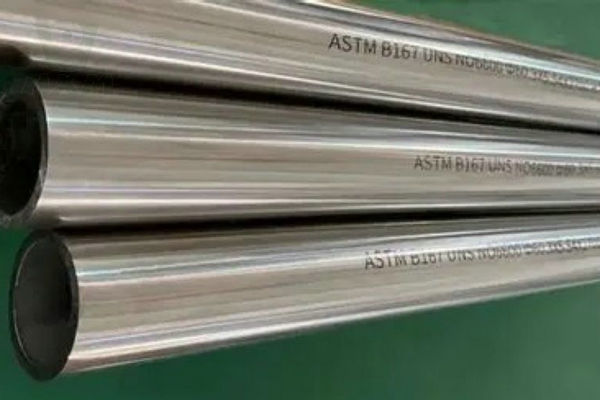
Read More »
Inconel 600 Tube

Inconel 600

Home › Steel Products › Special Alloy › Inconel Alloy › Inconel 600 Inconel 600 Supplier – UNS N06600 Nickel Alloy Products UNS N06600 / 2.4816 — Standard Ni-Cr High-Temperature Alloy
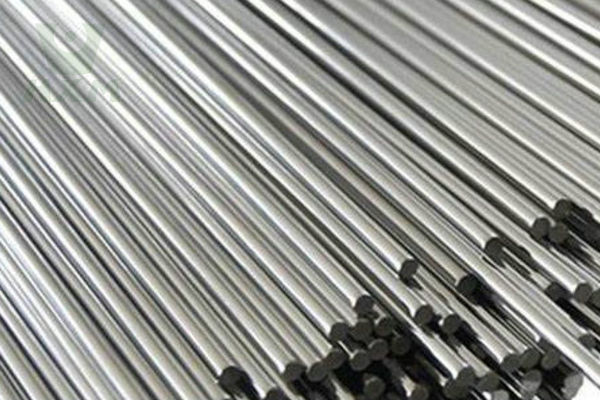
Read More »
Inconel 718 Bar, 718 Inconel Alloy Bar

Inconel 718

Inconel 718 Nickel Superalloy — AMS 5662/5663 Bar, Forging, Sheet Supplier The strongest commercially available nickel-iron-chromium alloy. Gamma-prime & gamma-double-prime precipitation hardened to 1375 MPa
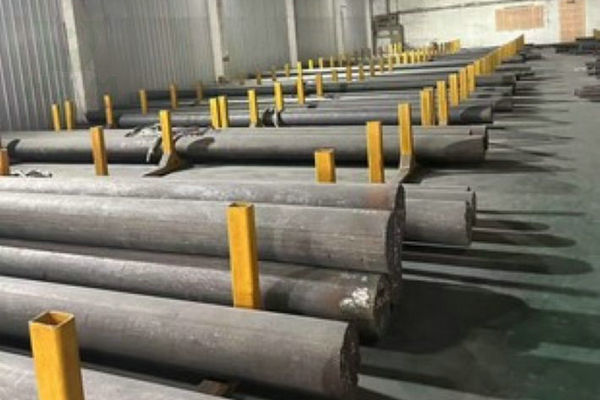
Read More »
Inconel 625 Alloy Tube Stock

Inconel 625

Inconel 625 (UNS N06625 / 2.4856) — The Corrosion Champion of Nickel Superalloys Best Seller — Best Corrosion Resistance Huaxiao Metal supplies Inconel 625 sheet,
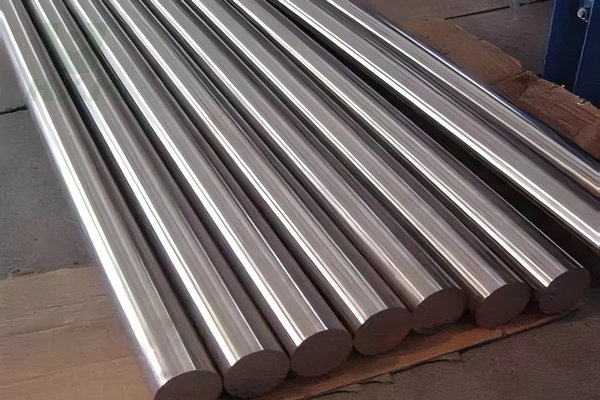
Read More »
Finished 13-8 Mo stainless steel bright bars centerless ground AMS 5629

13-8 Mo Stainless Steel

13-8 Mo Stainless Steel Bar, Plate & Forging Supplier AMS 5629 / UNS S13800 / 1.4534 High-Strength PH Stainless Steel Huaxiao Metal supplies high-performance 13-8
Read More »

Share:

Facebook
Twitter
Pinterest
LinkedIn

Contact Us For Metal Prices

Table of Contents

On Key

Related Posts

Welcome