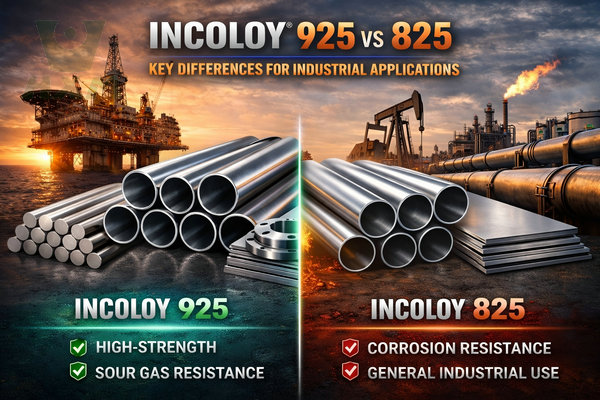
When it comes to selecting high-performance nickel alloys for oil & gas, chemical processing, or marine applications, Incoloy 925 and Incoloy 825 are two of the most trusted choices. While both alloys share similarities in corrosion resistance and mechanical strength, understanding their differences is crucial for engineers and procurement specialists aiming for long-lasting, cost-effective solutions.
In this article, we provide a detailed comparison of Incoloy 925 and Incoloy 825, covering chemical composition, mechanical properties, corrosion performance, typical applications, and procurement tips. By the end, you will know exactly when to choose Incoloy 925 over 825 and how Huaxiao Metal can supply both alloys with global delivery and competitive pricing.
Introduction to Incoloy 925 and Incoloy 825
What is Incoloy 925?
Incoloy 925 (UNS N09925) is a precipitation-hardening nickel-iron-chromium alloy with additions of molybdenum, copper, titanium, and aluminum. It is engineered to provide:
Exceptional resistance to stress corrosion cracking in sour gas (H₂S) and marine environments
High tensile and yield strength after aging
Excellent performance in high-pressure and high-temperature applications
Huaxiao Metal offers Incoloy 925 in sheets, plates, bars, pipes, and custom components, making it a preferred choice for oil & gas, chemical, and offshore industries.
What is Incoloy 825?
Incoloy 825 (UNS N08825) is a nickel-iron-chromium alloy with copper and molybdenum, known for:
Excellent resistance to oxidizing and reducing acids
Strong performance in chloride-containing and seawater environments
High corrosion resistance but slightly lower mechanical strength compared to Incoloy 925
Incoloy 825 is widely used in chemical processing, seawater equipment, and nuclear power plants.
Incoloy 925 vs Incoloy 825 – What’s the Difference?
Choosing between Incoloy 800 and Inconel Alloy 825 depends on several factors, including chemical composition, mechanical properties, and cost. Below, we break down the main differences:
Chemical Composition Comparison
| Element | Incoloy 925 (%) | Incoloy 825 (%) | Notes |
|---|---|---|---|
| Nickel (Ni) | 42–46 | 38–46 | 925 has slightly higher Ni for strength |
| Chromium (Cr) | 19.5–23.5 | 19–23 | Similar corrosion resistance |
| Iron (Fe) | Balance | Balance | Base matrix for both alloys |
| Molybdenum (Mo) | 2.5–3.5 | 2.5–3.5 | Helps resist pitting |
| Copper (Cu) | 1.5–3.0 | 1.5–3.0 | Strengthens corrosion resistance in acids |
| Titanium (Ti) | 1.9–2.4 | – | Precipitation hardening element |
| Aluminum (Al) | 0.1–0.5 | – | Enhances age-hardening |
| Carbon (C) | ≤0.03 | ≤0.05 | Weldability and toughness control |
Analysis:
- Incoloy 925 includes Ti and Al to enable precipitation hardening, significantly increasing tensile and yield strength.
- Incoloy 825 focuses on general corrosion resistance, especially in acidic or chloride-rich environments, but has lower mechanical strength.
Mechanical Properties Comparison
| Property | Incoloy 925 | Incoloy 825 | Notes |
|---|---|---|---|
| Solution Annealed Tensile Strength | ≥ 685 MPa | 515–690 MPa | 925 is stronger |
| Yield Strength | ≥ 271 MPa | 205–275 MPa | 925 is better for high-load applications |
| Aged Tensile Strength | ≥ 1154 MPa | – | Precipitation hardening exclusive to 925 |
| Hardness | HRB 76 (annealed) | HRB 70–80 | 925 slightly harder |
| Elongation | 56% | 30–50% | 925 retains ductility after aging |
Conclusion:
- Incoloy 925 is preferred for high-stress, high-pressure, and sour service applications.
- Incoloy 825 is sufficient for standard chemical processing and seawater applications where extreme strength is not required.
Corrosion Resistance Comparison
Sulfide Stress Corrosion Cracking (SSC)
Incoloy 925: Excellent resistance due to Ni, Ti, and Al balance
Incoloy 825: Moderate resistance; may require additional coatings in sour environments
Chloride and Seawater Environments
Both alloys offer strong resistance, but Incoloy 825 is slightly more cost-effective in general marine applications.
Acidic & Oxidizing Environments
Incoloy 825: Excellent performance in oxidizing acids (sulfuric, nitric)
Incoloy 925: Also resistant, but optimized for stress cracking and high-strength applications
Key Takeaway:
Choose Incoloy 925 for sour gas, oilfield tubing, and high-stress applications
Choose Incoloy 825 for chemical plants, general corrosion, and less demanding mechanical loads
Typical Application Comparison
Incoloy 925
Oil & Gas Industry: Downhole tubing, packers, valves
Offshore & Marine: Shafts, fasteners, high-pressure equipment
Chemical Processing: High-temperature reactors, sour gas lines
Incoloy 825
Chemical & Petrochemical Plants: Heat exchangers, tanks, piping
Marine & Seawater: Pumps, valves, seawater handling equipment
Power Generation: Nuclear reactor components, boiler tubes
Cost & Procurement Considerations
| Aspect | Incoloy 925 | Incoloy 825 |
|---|---|---|
| Material Cost | Higher due to Ti & Al | Lower |
| Fabrication | Slightly more challenging due to the hardness | Easier |
| Availability | Specialty alloy; may require pre-order | Widely available |
| Certifications | EN 10204 3.1, NACE MR0175 | EN 10204 3.1, NACE MR0175 |
Recommendation:
For critical, high-pressure, or sour service applications, the extra cost of Incoloy 925 is justified.
For general corrosion resistance and standard chemical service, Incoloy 825 is cost-effective.
Which Is Better: Incoloy 925 vs Incoloy 825?
There is no absolute “better” alloy between Incoloy 925 and Incoloy 825 — the better choice depends entirely on service environment, mechanical load, and long-term reliability requirements. However, for high-risk and performance-critical applications, Incoloy 925 clearly offers decisive advantages.
Choose Incoloy 925 If:
Incoloy 925 is the better option when your application demands both corrosion resistance and high mechanical strength.
✔ Operating in sour gas (H₂S) or CO₂-rich environments
✔ Equipment is exposed to high pressure or cyclic mechanical stress
✔ Long service life and maximum safety margins are required
✔ Components require precipitation hardening for enhanced strength
✔ Typical industries: oil & gas downhole tools, offshore platforms, high-pressure valves
👉 In these conditions, Incoloy 825 may meet corrosion requirements but often lacks the strength margin needed for long-term reliability.
👉 Incoloy 925 significantly reduces the risk of stress corrosion cracking and mechanical failure.
Choose Incoloy 825 If:
Incoloy 825 remains a cost-effective and reliable solution for applications where extreme strength is not the primary concern.
✔ Mainly exposed to general corrosion or acidic media
✔ Operating under moderate pressure and temperature
✔ Strength requirements are lower, but corrosion resistance is critical
✔ Typical industries: chemical processing, heat exchangers, seawater systems
👉 For these environments, Incoloy 825 provides excellent corrosion resistance at a lower material cost.
Final Recommendation for Engineers and Buyers
If your project involves sour service, offshore conditions, or high mechanical stress, Incoloy 925 is the better and safer long-term investment, despite its higher initial cost. The improved strength and resistance to stress-related failures often result in lower lifecycle costs and reduced maintenance risks.
On the other hand, if your application focuses on general corrosion resistance with controlled mechanical loads, Incoloy 825 offers excellent performance with a more economical price point.
📌 Not sure which alloy is right for your project?
📩 Contact Huaxiao Metal for expert material selection advice and fast quotations for both Incoloy 925 and Incoloy 825.
Why Huaxiao Metal is Your Trusted Supplier
Huaxiao Metal provides both Incoloy 925 and 825 with:
Global supply to Europe, South America, the Middle East, and Asia
Full certification and Mill Test Reports
Competitive pricing and fast quotation turnaround
Technical guidance for material selection and processing
📩 Get a quote for Incoloy 925 or 825 today and ensure your project meets both quality and cost requirements.
Key Takeaways: Incoloy 925 vs Incoloy 825
| Factor | Incoloy 925 | Incoloy 825 |
|---|---|---|
| Precipitation Hardening | Yes | No |
| Mechanical Strength | Higher | Moderate |
| Sour Gas SSC Resistance | Excellent | Moderate |
| General Corrosion Resistance | Excellent | Excellent |
| Typical Price | Higher | Lower |
| Recommended Use | Oil & gas, high-stress, offshore | Chemical processing, marine, standard industrial |
Bottom Line:
If your project requires maximum strength and resistance to sour gas or high-pressure service, Incoloy 925 is the optimal choice.
For general corrosion and standard industrial applications, Incoloy 825 offers reliable performance at a lower cost.
FAQ – Incoloy 925 vs Incoloy 825
What is the main difference between Incoloy 925 and Incoloy 825?
The primary difference lies in mechanical strength and hardening capability.
Incoloy 925 is a precipitation-hardened nickel-iron-chromium alloy, offering significantly higher yield and tensile strength than Incoloy 825, which is a solid-solution strengthened alloy.
While both alloys provide excellent corrosion resistance, Incoloy 925 is designed for high-stress, high-risk environments, especially in oil and gas applications.
Is Incoloy 925 stronger than Incoloy 825?
Yes. Incoloy 925 is substantially stronger than Incoloy 825.
Incoloy 925 can be heat-treated to achieve much higher yield strength
Incoloy 825 cannot be precipitation hardened and has lower mechanical limits
For applications involving high pressure, vibration, or cyclic loading, Incoloy 925 offers a clear performance advantage.
Which alloy is better for oil and gas applications, Incoloy 925 or 825?
Incoloy 925 is generally the better choice for oil and gas applications, particularly for:
Sour service (H₂S-containing environments)
Downhole tools and components
Offshore platforms and subsea equipment
High-pressure valves and fasteners
Incoloy 825 is still used in oil and gas systems, but mainly where corrosion resistance is required without high mechanical stress.
Can Incoloy 825 replace Incoloy 925?
In most cases, Incoloy 825 cannot directly replace Incoloy 925.
Although Incoloy 825 may meet corrosion requirements, it often fails to meet strength and safety margins required in critical components. Substituting 825 for 925 can increase the risk of mechanical failure or stress corrosion cracking in demanding environments.
Is Incoloy 925 more expensive than Incoloy 825?
Yes, Incoloy 925 typically has a higher material cost due to:
Higher alloying content (Mo, Cu, Ti)
Additional heat treatment processes
Superior mechanical performance
However, in high-risk applications, Incoloy 925 often delivers lower total lifecycle cost by reducing downtime, maintenance, and failure-related expenses.
Which alloy has better corrosion resistance, Incoloy 925 or 825?
Both alloys offer excellent resistance to corrosion, including:
Chloride-induced corrosion
Sulfuric and phosphoric acids
Seawater environments
However, Incoloy 925 provides enhanced resistance to stress corrosion cracking under combined mechanical load and corrosive conditions, making it more suitable for harsh service environments.
What product forms are available for Incoloy 925 and Incoloy 825?
Both alloys are commonly supplied in:
Bars and rods
Plates and sheets
Pipes and tubes
Forgings and custom machined parts
Huaxiao Metal supplies Incoloy 925 and Incoloy 825 in multiple specifications, with support for custom sizes and fast global delivery.
How do I choose between Incoloy 925 and Incoloy 825 for my project?
The choice depends on three key factors:
Mechanical load and pressure level
Corrosive media and service environment
Safety and service life requirements
If your project involves high stress, sour service, or offshore conditions, Incoloy 925 is usually the safer and more reliable choice. For moderate conditions, Incoloy 825 remains a cost-effective solution.
👉 For accurate material selection and pricing advice, contact Huaxiao Metal’s technical team.
In Conclusion: Partner with Huaxiao Metal for Reliable Alloy Solutions
Incoloy 800 vs 825: each has unique strengths tailored to specific industrial needs. Understanding the differences in their chemical composition, mechanical properties, and corrosion resistance is critical for making an informed decision. Whether you need high-temperature durability or robust corrosion resistance, Huaxiao Metal offers a wide range of Incoloy products to meet your requirements.
Contact Huaxiao Metal today for:
Latest Incoloy 800 and Incoloy 825 prices
Material certificates and technical data sheets
Customized processing and export packaging solutions
Contact us today for pricing and expert guidance!
Huaxiao Special Alloy Steel Products

13-8 Mo Stainless Steel
13-8 Mo Stainless Steel Bar, Plate & Forging Supplier AMS 5629 / UNS S13800 / 1.4534 High-Strength PH Stainless Steel Huaxiao Metal supplies high-performance 13-8
17-7PH Stainless Steel
Leading 17-7PH Stainless Steel Supplier | AISI 631 Sheet, Strip, Coil & Foil in Stock Certified AMS 5528 / ASTM A693 / UNS S17700 Precipitation
15-5PH Stainless Steel
15-5PH Stainless Steel Supplier | UNS S15500 Plate & Bar Stock 15-5 PH Stainless Steel – High Toughness PH Grade Huaxiao Metal supplies 15-5PH stainless
17-4 PH Stainless Steel
17-4PH Stainless Steel Supplier | UNS S17400 Plate, Bar, Sheet in Stock 17-4 PH Stainless Steel – Factory Supply, Fast Delivery 17-4 PH (also known
Incoloy Alloy 925
Incoloy Alloy 925 (UNS N09925) – Sheets, Plates, Bars, Pipes, Coils, Strips, Wires High-Strength Corrosion-Resistant Nickel Alloy Supplier & Manufacturer Incoloy 925 is a precipitation

Incoloy 825
Incoloy 825 Alloy (UNS N08825) – Sheets, Plates, Bars, Pipes, Coils, Strips, Wires Corrosion Resistant Nickel-Iron-Chromium Alloy Supplier & Manufacturer Incoloy 825 alloy (UNS N08825)
Incoloy 800
Incoloy 800 Alloy – Sheets, Plates, Bars, Pipes, Coils, Strips, Wires Incoloy 800 is part of our Incoloy alloy product range, which includes various nickel-iron-chromium

Molybdenum Metal & Alloys
Molybdenum Metal & Alloys Products – High-Quality Suppliers & Manufacturers | Huaxiao Metal Molybdenum-based materials—whether in the form of pure molybdenum metal, molybdenum alloys, or

Tungsten Alloy
Tungsten Alloy Supplier – Rods, Plates, Sheets, Tubes, Wires & Custom Parts Tungsten alloy, also known as tungsten heavy alloy (WHA), is a high-density engineering