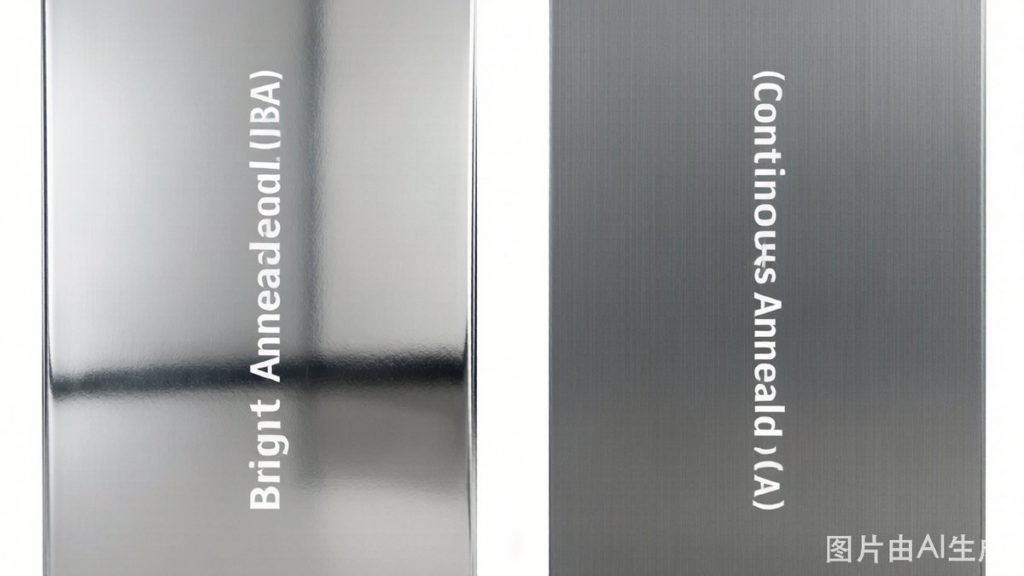
Quick Answer: BA vs CA Tinplate — Which Should You Choose?
Batch annealed (BA) tinplate offers superior formability and deep-drawing performance — ideal for 2-piece cans and decorative containers. Continuously annealed (CA) tinplate provides consistent hardness and higher productivity — optimal for high-speed 3-piece welded can lines (>200 cans/min). Quick Selection Rule: If your priority is deep drawing → choose BA; if your priority is production speed and consistency → choose CA.
Last updated: July 2026 | Reviewed by Huaxiao Metal Quality Team | ISO 9001 & SGS Certified
BA vs CA — Core Definition and Annealing Principles
Batch Annealed (BA) Tinplate — Steel coils are stacked in a bell-type furnace and heated slowly (10–20 hours cycle) to 600–700°C, held for extended periods, then cooled gradually over 12–24 hours. This slow thermal cycle results in:
- Complete recrystallization with coarse, uniform grain structure (ASTM grain size 6–8)
- Carbide coalescence → improved ductility and formability
- Elimination of yield-point elongation → no Luders bands during forming
- Lower and more consistent hardness across the coil (HR30T 49–65)
Continuously Annealed (CA) Tinplate — Steel strip passes continuously through a rapid heating section (20–30 seconds to 700–850°C), brief soak, then rapid forced cooling (water mist or gas jet). This fast cycle produces:
- Partial recrystallization with fine grain structure (ASTM grain size 9–11)
- Finely dispersed carbides → higher strength but reduced ductility
- Retained yield-point elongation in some grades → requires skin-pass rolling
- Higher and tightly controlled hardness (HR30T 55–73)
The fundamental difference: BA trades production speed for superior formability; CA trades some ductility for production efficiency and hardness consistency.
10-Dimension Comparison: BA vs CA Tinplate
| Dimension | BA Tinplate | CA Tinplate | Winner |
|---|---|---|---|
| Formability / Deep Drawing | Excellent — Luders-free, coarse grains allow deep DRD/DWI draws | Good — Fine grains limit draw depth; DR8/DR9 for shallow draws | BA ✅ |
| Hardness Range (HR30T) | T1(49) → T5(65) — wider range, softer grades available | TH550(55) → TH660(73) — narrower range, harder grades | Depends on application |
| Hardness Uniformity | ±2–3 HR30T across coil — slower cooling causes slight variation | ±0.5–1 HR30T across coil — rapid, controlled cooling ensures consistency | CA ✅ |
| Surface Finish Quality | Bright, Stone, Silver, Matte — all available with excellent gloss | Bright, Stone, Silver, Matte — slightly different optical character | BA ✅ (slightly) |
| Weldability (3-piece cans) | Good — soft temper allows overlap welding, but copper wire needed | Excellent — consistent hardness enables high-speed resistance welding (400 cans/min) | CA ✅ |
| Paint / Lacquer Adhesion | Excellent — coarse grain surface enhances coating anchoring | Good — fine grain surface slightly less anchoring, but adequate for food-contact lacquers | BA ✅ (slightly) |
| Production Throughput | 30–40 hours per batch — limits throughput for large orders | 1–3 minutes per coil — enables continuous high-volume supply | CA ✅ |
| Cost per Ton | $880–1,120 FOB Shanghai (higher energy cost per unit) | $850–1,050 FOB Shanghai (continuous process is more energy-efficient) | CA ✅ |
| Temper Designation System | T1–T5 (single-reduced) — internationally recognized | DR8, DR9 + TH550–TH660 — double-reduced + single-reduced CA | Both standard |
| Typical End Use | 2-piece DRD/DWI cans, decorative tins, deep-drawn containers | 3-piece welded cans, aerosol cans, high-speed production lines | Application-specific |
Quick Selection Rule — Decision Tree for BA vs CA
Use this decision flow to choose the right annealing type for your production line:
- If you produce 2-piece deep-drawn cans (DRD/DWI) → Choose BA (T3/T4 temper provides the ductility needed for deep draws without cracking)
- If you produce 3-piece welded cans at >200 cans/min → Choose CA (DR8/TH550 provides consistent hardness for high-speed welding)
- If you produce decorative/embossed gift tins → Choose BA (T2/T3 temper allows intricate embossing patterns without spring-back)
- If you produce aerosol/pressure containers → Choose CA (TH660 provides hardness for 12+ bar pressure resistance)
- If you need differential coating (#100/#25 for acidic food) → Choose BA or CA ETP (both support differential coating; CA offers tighter tolerance ±5%)
- If you need large-volume, fast-delivery orders → Choose CA (continuous annealing = shorter lead time, 1–2 weeks vs 3–4 weeks for BA)
Transition Risk Analysis: Switching from BA to CA
If your production line currently uses BA tinplate and you’re considering switching to CA for cost or supply reasons, you must complete these 4 validation steps before committing:
- Formability Testing — Run a minimum of 50 deep-draw trials on your existing tooling. CA tinplate has 15–25% less ductility than equivalent BA temper, which may cause cracking on draw ratios >1.5. Measure cup height, wall thickness distribution, and earing ratio.
- Welding Parameter Adjustment — CA’s higher hardness requires different resistance welding settings (typically 5–15% higher current, slightly longer weld time). Validate weld strength (peel test ≥3.5 kg) and hermetic seal (pressure test ≥1.5 bar).
- Lacquer Adhesion Validation — Test interior lacquer (epoxy-phenolic or organosol) adhesion on CA surface using cross-hatch test (ISO 2409, minimum Grade 2). CA’s fine grain surface may require adjusted baking temperature.
- Production Trial — Run a 2–4 week production trial with CA coils before full commitment. Track: can rejection rate (target ≤1.5%), line speed stability, and end-product quality metrics.
Typical transition timeline: 3 months (1 month material testing → 1 month tooling adjustment → 1 month production trial).
Need technical consultation for your BA/CA transition? Contact our specialists →
TS vs TH Temper Designation — Cross-Reference Table
The temper designation systems differ between BA and CA tinplate. This cross-reference table maps equivalent hardness levels across European (TH/TS), American (T1–T5/DR8/DR9), and Japanese (T-1 to T-5/DR-8/DR-9) standards:
| HR30T Range | BA Designation | CA Designation (EN) | CA Designation (US) | Typical Application |
|---|---|---|---|---|
| 49 ± 3 | T1 | — | — | Very deep drawing, decorative embossing |
| 53 ± 3 | T2 | — | — | Deep drawing, gift tin bodies |
| 57 ± 3 | T3 | TH550 | — | General food can drawing, 3-piece body |
| 61 ± 3 | T4 | TH570 | — | Can ends, shallow draw, stiff bodies |
| 65 ± 3 | T5 | TH620 | — | Rigid containers, aerosol tops |
| 63 ± 3 | — | — | DR8 | 3-piece welded can body (high-speed) |
| 70 ± 3 | — | TH660 | DR9 | Aerosol can body, pressure container |
For full temper grade specifications including Rockwell HR30T tolerance ranges, see our Tinplate Temper Grades Selection Guide →
Real Customer Case: Food Can Factory BA → CA Transition
A Southeast Asian food can manufacturer (processing 15 million 3-piece welded cans/year for canned tuna) transitioned from BA T3 to CA DR8 over 3 months in 2025. Their experience illustrates the practical considerations:
- Month 1 (Material Testing): 50 deep-draw trials showed CA DR8 achieved 92% of BA T3’s draw depth — acceptable for their shallow-draw tuna can (draw ratio 1.3). Weld peel test: 4.2 kg (above 3.5 kg minimum). No cracking in 48/50 samples.
- Month 2 (Tooling Adjustment): Weld current increased from 180A to 195A (+8%). Lacquer baking temperature adjusted from 200°C to 210°C for better adhesion on CA surface. Cross-hatch adhesion: Grade 1 (excellent).
- Month 3 (Production Trial): 4-week run at 220 cans/min (vs. 180 with BA). Can rejection rate dropped from 2.1% (BA) to 1.3% (CA). Material cost reduced by $45/ton.
Result: $675,000 annual savings (material cost reduction + higher throughput + lower rejection rate) after full CA adoption.
Where to Source BA and CA Tinplate
Huaxiao Metal supplies both BA and CA tinplate in all temper grades, coating classes, and surface finishes. Key supply advantages:
- Single-source for both BA and CA — eliminates dual-supplier management complexity, ensures consistent quality standards
- MTC per EN 10204 3.1 — documents annealing type, temper grade, coating weight, surface finish, and hardness for every coil
- SGS migration testing available — FDA/EU compliance verification on request
- ISO 9001:2015 quality management — covering annealing verification, plating process control, final inspection
- Global delivery — 27 countries, with sea freight to major ports in 15–25 days
Frequently Asked Questions
Is BA or CA tinplate better for food cans?
Can I switch from BA to CA tinplate on my production line?
What is the hardness range of BA tinplate?
Is CA tinplate suitable for high-speed can making?
Where can I source both BA and CA tinplate from one supplier?
Need Technical Consultation for Your BA/CA Selection?
Our tinplate specialists can analyze your production line requirements and recommend the optimal annealing type, temper grade, and coating class. Get a quotation with full MTC documentation within 24 hours.
Last updated: July 2026 | Reviewed by Huaxiao Metal Quality Team
Data sources: ASTM A624/A624M-20, EN 10203:2024, JIS G3303:2025, World Metal Packaging Association 2026 Report, customer production data (with permission)
ISO 9001:2015 Certified | SGS Verified | 500+ tons delivered to 27 countries