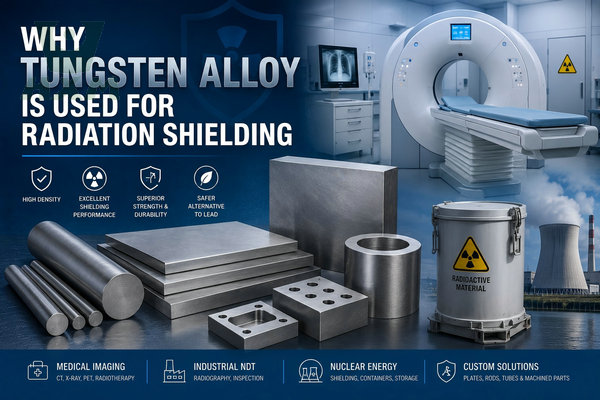
Radiation shielding is a critical requirement in medical imaging, nuclear energy, industrial inspection, and scientific research. Engineers must select shielding materials that can effectively absorb harmful radiation while meeting increasingly strict safety, environmental, and space-saving requirements.
For decades, lead was the dominant shielding material. However, modern equipment manufacturers are increasingly turning to tungsten alloy as a superior alternative. Thanks to its exceptional density, high atomic number, mechanical strength, and environmental advantages, tungsten alloy has become one of the most widely used radiation shielding materials in advanced applications.
This article explains why tungsten alloy is used for radiation shielding, how it compares with lead, and which tungsten products are commonly used in radiation protection systems.
The Challenge of Modern Radiation Shielding
Radiation protection systems must achieve several goals simultaneously:
- Block X-rays and gamma rays effectively
- Minimize equipment size and weight
- Maintain long-term structural stability
- Meet environmental regulations
- Reduce maintenance and replacement costs
As medical devices, industrial inspection equipment, and nuclear systems become more compact, traditional shielding materials often struggle to meet these requirements.
This is one of the key reasons why demand for tungsten shielding materials continues to grow worldwide.
What Makes Tungsten Alloy an Effective Shielding Material?
Extremely High Density
Density is one of the most important factors affecting radiation attenuation.
Tungsten heavy alloys typically offer densities ranging from 17.0 g/cm³ to 18.8 g/cm³, significantly higher than most engineering metals.
Density Comparison
| Material | Density (g/cm³) |
|---|---|
| Tungsten Alloy | 17.0 – 18.8 |
| Pure Tungsten | 19.3 |
| Lead | 11.3 |
| Stainless Steel | 7.9 |
| Aluminum | 2.7 |
Because tungsten alloy is substantially denser than lead or steel, engineers can achieve the same shielding performance using smaller and thinner components.
This is particularly important in portable medical equipment and compact industrial systems where space is limited.
High Atomic Number Improves Radiation Absorption
Tungsten has an atomic number of 74.
Materials with high atomic numbers are more effective at absorbing X-rays and gamma radiation.
As a result, tungsten shielding components provide excellent attenuation efficiency across a wide range of radiation energies.
This allows equipment designers to reduce shielding volume without sacrificing protection.
Excellent Mechanical Strength
Unlike lead, tungsten alloy is a true engineering material.
Benefits include:
- High hardness
- Excellent wear resistance
- Superior dimensional stability
- Resistance to deformation
These properties make tungsten shielding components more durable and reliable over long service periods.
Why Many Industries Are Replacing Lead with Tungsten
Lead has been used for radiation shielding for many years due to its relatively high density and low cost.
However, lead also presents several limitations.
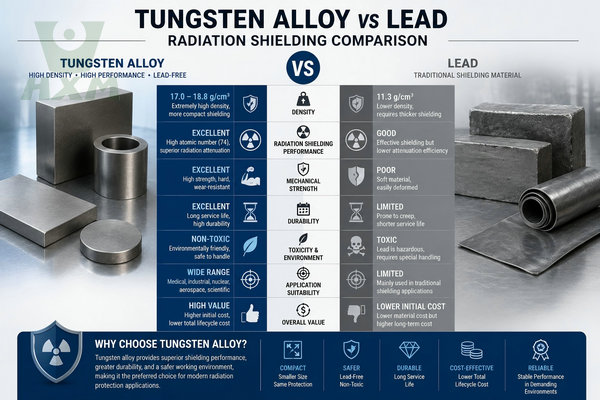
Tungsten Alloy vs Lead for Radiation Shielding
| Property | Tungsten Alloy | Lead |
| Density | 17–18.8 g/cm³ | 11.3 g/cm³ |
| Toxicity | Non-toxic | Toxic |
| Mechanical Strength | Excellent | Poor |
| Durability | Excellent | Limited |
| Dimensional Stability | Excellent | Poor |
| Service Life | Long | Moderate |
Lead is soft and can deform under load.
It also requires special handling and disposal procedures due to environmental and health concerns.
Tungsten alloy solves many of these problems while providing higher shielding efficiency.
For this reason, medical equipment manufacturers increasingly specify tungsten-based shielding solutions in new product designs.
Common Tungsten Radiation Shielding Applications
Medical Imaging Equipment
Medical equipment manufacturers use tungsten shielding materials in:
- CT scanners
- PET scanners
- X-ray systems
- Radiation therapy equipment
- Nuclear medicine devices
Tungsten shielding helps reduce radiation exposure while allowing equipment to remain compact and portable.
Industrial Radiography Systems
Industrial non-destructive testing (NDT) systems require reliable radiation protection.
Tungsten alloy is commonly used for:
- Source holders
- Shielding containers
- Collimators
- Inspection equipment components
Its durability makes it suitable for demanding industrial environments.
Nuclear Energy Applications
The nuclear industry uses tungsten shielding materials for:
- Radioactive isotope storage
- Nuclear inspection systems
- Shielding blocks
- Transport containers
High density and structural integrity make tungsten alloys particularly suitable for these applications.
Recommended Tungsten Alloy Grades for Shielding
The most commonly used shielding grades include:
| Grade | Density |
| 90WNiFe | 17.0 g/cm³ |
| 92.5WNiFe | 17.5 g/cm³ |
| 95WNiFe | 18.0 g/cm³ |
| 97WNiFe | 18.5 g/cm³ |
The higher the tungsten content, the greater the density and shielding effectiveness.
The optimal grade depends on:
- Radiation energy level
- Space limitations
- Weight requirements
- Machining needs
- Budget considerations
How to Choose the Right Tungsten Shielding Material
Before selecting a tungsten shielding solution, consider:
Radiation Type
Different shielding designs may be required for:
- X-rays
- Gamma rays
- High-energy isotopes
Available Installation Space
Limited space often favors higher-density tungsten grades.
Machining Requirements
Complex shielding components may require extensive CNC machining.
Regulatory Compliance
Medical and nuclear industries often require strict material traceability and quality documentation.
Huaxiao Metal Tungsten Shielding Solutions
Huaxiao Metal supplies a complete range of tungsten alloy products for radiation shielding applications.
Available products include:
- Tungsten alloy plates
- Tungsten alloy sheets
- Tungsten alloy rods
- Tungsten alloy tubes
- Tungsten shielding blocks
- Custom machined shielding components
Our engineering team can manufacture according to customer drawings and application requirements.
Services include:
- CNC Turning
- CNC Milling
- EDM Cutting
- Precision Grinding
- Surface Finishing
Whether you need raw materials or finished shielding components, we can provide customized solutions for your project.


FAQ – Tungsten Alloys are Used for Radiation Shielding
Is tungsten better than lead for radiation shielding?
In many applications, yes. Tungsten alloy offers higher density, greater mechanical strength, improved durability, and eliminates the environmental concerns associated with lead.
What density of tungsten alloy is used for shielding?
Most shielding applications use grades ranging from 17.0 g/cm³ to 18.5 g/cm³.
Is tungsten shielding safe?
Yes. Tungsten alloys are considered significantly safer to handle than lead-based shielding materials.
Can tungsten shielding be machined?
Yes. Tungsten heavy alloys can be CNC machined into complex shielding components and custom parts.
What industries use tungsten radiation shielding?
Medical imaging, industrial radiography, nuclear energy, scientific research, and defense industries commonly use tungsten shielding materials.
Conclusion
As radiation protection requirements continue to evolve, tungsten alloy has become one of the most effective shielding materials available today. Its combination of high density, excellent radiation attenuation, superior strength, and environmental advantages makes it an ideal choice for medical, industrial, and nuclear applications.
If you are looking for tungsten alloy plates, rods, tubes, shielding blocks, or custom radiation shielding components, Huaxiao Metal can provide tailored solutions to meet your technical requirements.