A practical comparison guide for engineers and procurement teams selecting nickel-based superalloys for high-temperature applications
If you are designing a gas turbine component, selecting material for an aerospace engine hot section, or sourcing nickel-based superalloys for high-temperature industrial equipment, the Nimonic alloy family is almost certainly on your shortlist. But with multiple grades available — 75, 80A, 90, 263, and more — how do you know which one to specify?
This guide breaks down the four most commonly procured Nimonic grades side by side. You’ll find chemical composition limits, temperature ceilings, mechanical property data, and — most importantly — a practical decision framework that helps you match the right grade to your actual operating conditions.
Key takeaway upfront: Nimonic 75 is the general-purpose high-temperature alloy (no precipitation hardening). Nimonic 80A adds age-hardening for higher strength at moderately high temperatures. Nimonic 90 pushes strength and temperature even further with cobalt content. Nimonic 263 is the choice when weldability and formability matter as much as heat resistance.
Quick Comparison: All Four Grades at a Glance
| Property | Nimonic 75 | Nimonic 80A | Nimonic 90 | Nimonic 263 (C263) |
|---|---|---|---|---|
| UNS Number | N06075 | N07080 | N07090 | N07263 |
| W. Nr. | 2.4951 | 2.4952 | 2.4632 | 2.4650 |
| Base Composition | Ni-Cr | Ni-Cr-Ti-Al | Ni-Cr-Co-Ti-Al | Ni-Cr-Co-Mo-Ti |
| Key Alloying Elements | Cr 18–21%, Ti 0.2–0.6% | Cr 18–21%, Ti 1.8–2.7%, Al 1.0–1.8% | Cr 18–21%, Co 15–21%, Ti 2–3%, Al 1–2% | Cr 19–21%, Co 19–21%, Mo 5.6–6.1%, Ti 1.9–2.4% |
| Hardening Mechanism | Solid solution only | γ’ precipitation (Ni₃(Al,Ti)) | γ’ precipitation (Ni₃(Al,Ti)) | γ’ precipitation (Ni₃(Al,Ti)) |
| Density | 8.37 g/cm³ | ~8.19 g/cm³ | ~8.2 g/cm³ | ~8.36 g/cm³ |
| Melting Range | 1340–1380 °C | 1320–1365 °C | ~1310–1370 °C | ~1300–1355 °C |
| Max Service Temp. | ~980 °C | ~815 °C | ~920 °C | ~780 °C |
| Tensile Strength (RT, aged) | ≥717 MPa | ~1000–1200 MPa | ≥1080 MPa | ~1004 MPa |
| Yield Strength 0.2% (RT, aged) | ≥276 MPa | ~600–750 MPa | ≥695 MPa | ~585 MPa |
| Strength at 780 °C | Low (not recommended) | ~450–550 MPa | ~500–600 MPa | ≥541 MPa (tensile) |
| Weldability | Good | Moderate | Limited | Excellent |
| Price Level (relative) | $ (lowest) | $$ (moderate) | $$$ (higher) | $$$ (higher) |
| Product Forms | Sheet, plate, bar, tube, wire, strip, extrusion | Sheet, plate, bar, tube, wire, strip, forging | Sheet, plate, bar, tube, wire, strip, forging, extrusion | Sheet, plate, bar, tube, wire, strip, forging |
| Key Standards | BS HR5, HR504, AMS 5766 | BS HR1, HR201, AMS 5767 | BS HR2, HR202, AMS 5829 | BS HR10, HR206, AMS 5886, AMS 5872 |
Nimonic 75: The Workhorse for Moderate-Stress, Extreme Heat
Nimonic 75 (UNS N06075 / W.Nr. 2.4951) is an 80/20 nickel-chromium alloy with controlled additions of titanium and carbon. Unlike its higher-numbered siblings, it is not precipitation-hardenable — it relies entirely on solid-solution strengthening. This simplicity is its greatest strength.
Nimonic 75 at a Glance UNS N06075
Tensile Strength: ≥717 MPa
Price Level: $ Most Affordable
Where Nimonic 75 Excels
- Industrial furnaces: Components, fixtures, and structural parts that need oxidation resistance at sustained high temperatures but face only moderate mechanical loads.
- Heat treatment equipment: Baskets, trays, and jigs that cycle between ambient and 900 °C+.
- Gas turbine engines: Sheet metal fabrications in cooler sections where weldability is needed.
- Nuclear engineering: Components requiring a combination of moderate strength and excellent corrosion resistance.
- Petrochemical processing: Parts exposed to high-temperature oxidizing environments.
When NOT to Choose Nimonic 75
Avoid Nimonic 75 when your application requires high mechanical stress at temperatures above 600 °C. The alloy lacks the γ’ precipitation strengthening that gives 80A, 90, and 263 their high-temperature load-bearing capability. If you are designing a turbine blade or a high-stress fastener operating above 650 °C, move to Nimonic 80A or 90.
Need Nimonic 75 sheet, bar, or tube?
Nimonic 80A: Age-Hardenable Strength for Turbine Parts
Nimonic 80A (UNS N07080 / W.Nr. 2.4952) takes the same Ni-Cr base as 75 and adds significant titanium (1.8–2.7%) and aluminum (1.0–1.8%). These additions enable γ’ precipitation hardening — the formation of ordered Ni₃(Al,Ti) precipitates that dramatically increase strength at elevated temperatures.
Nimonic 80A at a Glance UNS N07080
Tensile Strength (aged): ~1000–1200 MPa
Price Level: $$ Moderate
Where Nimonic 80A Excels
- Gas turbine blades: One of the classic applications — 80A was developed specifically for turbine blading in early jet engines and remains widely used.
- Exhaust valves: Internal combustion engines and diesel engines operating at elevated temperatures.
- Nuclear boiler tube supports: Where both corrosion resistance and elevated-temperature strength are required.
- Die casting inserts and cores: Resists thermal fatigue from repeated heating/cooling cycles.
- High-temperature fasteners and springs: Bolts, studs, and springs that must retain clamping force at 600–750 °C.
- Automotive turbocharger components: Rotors and housings in high-performance applications.
Heat Treatment Matters
Nimonic 80A’s properties are heavily dependent on correct heat treatment. The standard two-step cycle is:
- Solution treatment: 1080 °C for 8 hours, air cool
- Ageing: 700 °C for 16 hours, air cool
Always confirm that your supplier provides material in the correct heat-treated condition for your application. Huaxiao Metal supplies 80A in solution-treated, aged, or solution-treated + aged conditions per AMS 5767 and BS HR1 specifications.
Nimonic 90: Maximum High-Temperature Strength
Nimonic 90 (UNS N07090 / W.Nr. 2.4632) is a nickel-chromium-cobalt precipitation-hardening alloy that represents the highest strength among these four grades. With 15–21% cobalt content and increased titanium (2–3%) and aluminum (1–2%), it achieves exceptional creep resistance and stress rupture strength at temperatures up to approximately 920 °C.
Nimonic 90 at a Glance UNS N07090
Where Nimonic 90 Excels
- Turbine blades (highest-stress stages): The premier choice for blades in the hottest, highest-stress sections of gas turbines where neither 80A nor 75 can survive.
- Turbine discs: Rotating components requiring creep resistance under centrifugal loading at near-melting temperatures.
- Hot working tools: Dies, mandrels, and extrusion tooling that must maintain hardness at forging temperatures.
- High-temperature springs: Where 80A is insufficient — springs that operate at 750–920 °C.
- Exhaust reheaters: Afterburner and thrust augmenter components in military and supersonic engines.
The Cobalt Factor
The high cobalt content (15–21%) in Nimonic 90 serves two critical functions: it raises the γ’ solvus temperature (the temperature at which strengthening precipitates dissolve), and it reduces the stacking fault energy of the matrix, making dislocation climb more difficult — directly improving creep resistance. This is also why Nimonic 90 costs more: cobalt is a strategic metal with volatile pricing. If your application doesn’t require this extreme performance, 80A or 263 may be more cost-effective.
Sourcing Nimonic 90 to AMS 5829 or BS HR2?
Nimonic 263 (C263): The Weldable Superalloy
Nimonic 263, also known as Alloy C263 (UNS N07263 / W.Nr. 2.4650), was designed with a different philosophy than 80A and 90. While it delivers high-temperature strength, its primary design goal was excellent fabrication characteristics — specifically, the ability to be formed and welded in the annealed condition while still achieving high strength after ageing.
Nimonic 263 at a Glance UNS N07263
Where Nimonic 263 Excels
- Combustion chambers: Sheet metal fabrications in the hottest section of gas turbine engines. The alloy’s weldability is essential for the complex seam welding required in combustor cans.
- Turbine casings and rings: Large structural components that need both high-temperature strength and the ability to be fabricated from plate and sheet.
- Afterburner components: Military engine parts requiring formability, weldability, and high-temperature oxidation resistance.
- Transition ducts and liners: Hot gas path components in industrial gas turbines.
- Welded assemblies: Any application where the component is constructed by welding multiple sub-parts together — 263 is the clear winner here.
Why Weldability Matters
The critical distinction: Nimonic 80A and 90 can suffer from strain-age cracking in the heat-affected zone during post-weld heat treatment, requiring careful pre-heating and controlled cooling. Nimonic 263 was specifically formulated to avoid this problem, with excellent intermediate-temperature ductility that accommodates welding stresses. It can be welded using TIG or MIG processes with matching-composition filler wire, and in the annealed condition it is easier to form than Waspaloy or Rene 41.
How to Choose the Right Nimonic Grade — Decision Framework
Use the following questions to narrow down your selection. Answer them in order, and the recommended grade will emerge.
Step 1: What is your peak operating temperature?
| Temperature Range | Recommended Grade | Reason |
|---|---|---|
| Above 920 °C | Nimonic 75 | Only 75 can survive; moderate strength only |
| 815–920 °C | Nimonic 90 | Highest strength in this range; good creep resistance |
| 700–815 °C | Nimonic 90 or 80A | 90 for maximum strength; 80A for better cost |
| 650–780 °C | Nimonic 263 or 80A | 263 if welding needed; 80A for simpler shapes |
| Below 650 °C | Nimonic 80A or 263 | Either works; choose by other factors below |
Step 2: What level of mechanical stress will the part experience?
| Stress Level | Best Grade | Alternative |
|---|---|---|
| High stress >500 MPa at 700 °C+ | Nimonic 90 | — |
| Moderate stress 300–500 MPa at 600–750 °C | Nimonic 80A | Nimonic 263 |
| Moderate stress at >800 °C, low mechanical load | Nimonic 75 | — |
| Low stress, primarily thermal load | Nimonic 75 | — |
Step 3: Does the part require welding during fabrication?
Yes → Nimonic 263. No other Nimonic grade in this group was designed for welding the way 263 was. If welding is required but your temperature exceeds 780 °C, consult our engineering team — we can explore Nimonic 101, 105, or 115 options.
No welding → proceed to Step 4.
Step 4: What is your budget constraint?
Nimonic 75 is the most cost-effective option, driven by its simpler composition and wider availability. 80A adds roughly 15–25% to the material cost. 90 and 263 both carry a premium: 90 for its cobalt content, 263 for its cobalt + molybdenum. If your application can accept the lower strength of 75, it will deliver significant material cost savings — but never sacrifice performance for price in safety-critical components.
Quick-Decision Application Matrix
Nimonic Alloy Pricing: What to Expect
Nimonic alloy pricing is driven by three main factors: raw material composition (especially nickel, cobalt, and molybdenum content), product form complexity (sheet vs bar vs tube), and order quantity.
Relative Price Comparison
| Grade | Price Level | Main Cost Driver | Typical Use Case |
|---|---|---|---|
| Nimonic 75 | $ — Lowest | Nickel content only (~80%) | Bulk furnace components, fixtures |
| Nimonic 80A | $$ — +15–25% vs 75 | Ti + Al + heat treatment process | Turbine blades, exhaust valves |
| Nimonic 90 | $$$ — +20–35% vs 80A | High cobalt (15–21%) | Max-strength turbine components |
| Nimonic 263 | $$$ — Similar to 90 | Cobalt + molybdenum | Welded combustors, casings |
Typical minimum order quantities: 5 kg for standard grades and sizes; 50–100 kg for non-standard dimensions or special surface finishes. Samples and trial orders are welcome — we support projects from prototype to production scale.
Ready to get a Nimonic alloy quote?
Frequently Asked Questions
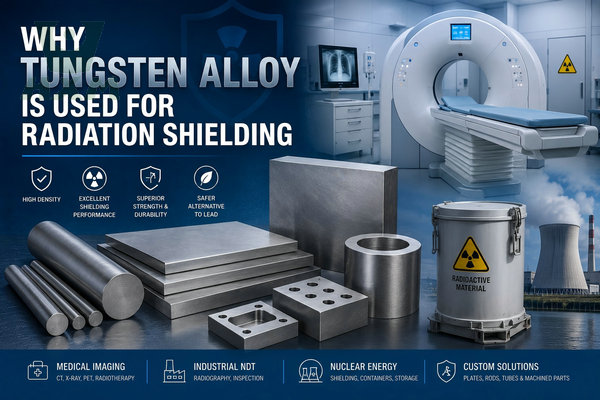
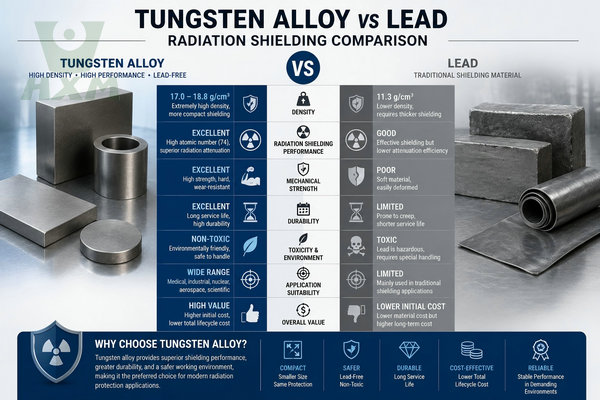
Is tungsten better than lead for radiation shielding?
In many applications, yes. Tungsten alloy offers higher density, greater mechanical strength, improved durability, and eliminates the environmental concerns associated with lead.